A Dose of Theology – Abecedarians

Today I’m strarting what I hope will be a (fairly) regular series on this blog, its called “A Dose of Theology.” In it I will be pointing out an interesting theological term and giving you some useful (and maybe not so useful) information on it. This week’s term comes to you thanks to the people over at Credo House Ministries.

Abecedarians

A 16th century German sect of Anabaptists led by Nicholas Storch who believed that all knowledge, even knowledge of the alphabet, prevents people from a true knowledge of God. Abecedarians believed that God would provide all necessary understanding through divine means such as visions and ecstatic experiences. According to them, all theology and academic learning amounted to an idolatrous abandonment of the Christian faith. Their name, Abecedarians, comes from their denial of the ABCs.

Used in a sentence: The Abecdearians make a good case for not learning your ABC’s… well maybe not such a good case.

Undergraduate Doxology, I mean Philosophy

This is my final post in my Theology vs. Undergraduate Philosophy Series ( When Theology and Undergraduate Philosophy Clash and St. Paul on Perceptual Plasticity and Theoretical Neutrality… Kind of. ), I promise! But I just can’t resist posting this final paragraph.

I really can’t believe that I ended the paper with the gospel and doxology!

Christian behavior is not merely about doing good works and adhering to a particular set of rules and regulations,  it is about “doing things which bring God’s wisdom and glory to birth in this world.” (Wright 71) Christian theology says that Christians are a part of new creation, they are a part of God’s renewal of creation according to his original vision for creation.  As Christians, God allows us to participate in His renewal and redemption of creation.  Thus by living according to God’s original vision for creation, we proclaim the fact that He reigns.  By having passions which fit into God’s original vision for creation we come alongside the voices of heaven saying: “The kingdom of the world has become the Kingdom of our Lord and of his Messiah, and he will reign forever and ever.” (Revelation 11:15)

Oh and again… (not to brag but just to show that University’s aren’t as “unchristian” as some say) I got an A on this paper!

St. Paul on Perceptual Plasticity and Theoretical Neutrality… Kind of.

Or When Theology and Undergraduate Philosophy Clash (Pt. 2)

I’m still reading that paper that I blogged about last time… you know the one I wrote while an undergraduate at UCLA. I still marvel at the fact that its so unapologetically Christian. This section of the paper is cool because its so deeply scriptural but yet it takes serious Churchland’s work on the philosophy of perception.

When Paul calls Christians to be transformed by the renewing of the mind he is calling Christians to a new way of thinking, a new way of looking at and interpreting the world that they live in, Paul is calling them to think “Christianly.”  In this verse, Paul contrasts the way of thinking which is characteristic of those in the world and the way of thinking which is characteristic of those who are a part of the body of Christ.  Paul seems to think that the transformation of the mind is not something that occurs automatically when one comes to know the truth of Christ’s lordship.  The transformation of the mind into a mind that thinks “Christianly” is a process that involves effort both on one’s behalf as well as on God’s behalf.  In Philippians 3:12 we notice that both God and us are at work in the process of learning to think Christianly, here Paul pleads with the Philippians to work out their salvation (i.e. their becoming holy), because it is God who is at work in them to will and work according to God’s good pleasure.  The transformation of the mind is a transformation that occurs not only when we have knowledge of what God’s will is but when we are able to apply that knowledge to our lives.  Paul Churchland who believes that all perceptions are theory laden, illustrates the idea that mere knowledge is not enough to create genuine transformation in his paper “Perceptual Plasticity and Theoretical Neutrality”. Churchland says that a physics student does not come to see the motions of common objects in a new way simply by memorizing Newton’s three laws.  Although most freshmen physics students do in fact memorize these laws, it is only those who have practiced the skills of applying those laws that come to see the motions of common objects according to those laws.  Although knowing the laws is vital to the transformation process, it is the application and practice which leads to the transformation of those student’s minds (Churchland 176)  The same can be said about the Christian walk.   Having knowledge of what is good and bad is vital to having one’s mind be transformed into the type of mind that thinks “Christianly”, but it is the practicing and application of that knowledge that leads to the transformation of the mind.   Once this transformation has occurred we will be able to think “Christianly.”

When Theology and Undergraduate Philosophy Clash

The other day I was looking through some of my old philosophy papers from my time as an undergraduate at UCLA. I want you to get a glimpse of the type of stuff I was writing about. I really cannot believe that I started a 20 page philosophy paper with a paragraph like this. It really makes me wonder, “what was I thinking!”

In doing philosophical theology, the distinction has often been drawn between special revelation and general revelation.  As examples of philosophers who have worked with general revelation we have Thomas Aquinas who believed that apart from special revelation, we can use reason to come to the knowledge of claims like the claim that God exists, that God is omniscient, or that God is omnipotent.  However within the Christian tradition, it is not a commonly held belief that complete knowledge of God and his character can be attained by mere reason alone, philosophy is not a tool powerful enough to come to know God.  It is at this point that special revelation comes into play.  Special revelation which includes the Scriptures, both the Old and New Testament, has played an enormous role in the Christian conception of God.  From the scriptures one comes to know things such as the claim that God is love (1 John 4:16) as well as his character, and his care for the poor and oppressed as is displayed in passages like Isaiah 30:18, Deuteronomy 15:7-8, and James 1:27.  Through special revelation one also comes to know what for Christians is central to their belief, the salvific ministry and Lordship of Jesus the Christ (Matthew, Mark, Luke, John).   It also should be noted that Christ himself is one form of special revelation as noted in John 14:4-12, in which Jesus says that if you know him you will know the Father as well, and that those who have seen him have seen the father as well.

By the way, the paper was titled “The Transformation of the Passions: Controlling One’s Passions Within a Christian Framework.” And I got an A on the paper.

The Antinomian Calvinist

I have often heard that the preaching of the gospel leads to antinomianism… When I ask what people mean they often say something along the lines of “calvinism leads to a disregard for the law” i.e. Calvinists are antinomian.

Check out what Scot McKnight (someone who is not a Calvinist) has to say about this claim:

And a comment about the charge that Calvinism is antinomian. My own experience is that this charge is false; Calvinists are not antinomian, and in fact have a tendency (paradoxically) toward a more legalistic framework. To be sure, an emphasis on election and final perseverance can promote antinomian ideas, but I’ve only seen such sillinesses among the immature or in the rhetoric of opponents.

But what I’m seeing today among some young Calvinists, e.g., Tullian Tchividjian, appears to me to be an exaggeration of grace theology at the expense of how the Bible frames ethical practices and injunctions. Not to mention how even Calvin talked about the law’s usefulness for the Christian. Clearly, there is no attempt with these — as has been the case at times in church history — to justify sin or to minimize sin. It has to do with the law and commands and how to frame ethics. In other words, instead of simply permitting someone like Jesus or Paul to say “follow me” or “do this” they tend to have a need to explain each and everyone of those as expressions of a grace at work in the life so that “follow me” really means “God’s grace will prompt following me.” As I view such approaches, the potency of the command and the appeal to the will are blunted. I don’t see this tendency in Calvin’s commentary on the Sermon on the Mount, which I’m reading now.

Let me make two comments on this:

  1. McKnight makes an observation that I have often made myself, namely that some reformed people tend to be the stuffiest, most legalistic, most “our tradition is right yours is wrong, most judgmental Christians around (and I say this as someone who identifies with the reformed tradition). Really it makes no sense! Reformed people should be the most gracious, most forgiving, most ecumenical people around.
  2. McKnight is right in pointing out certain Calvinists (e.g. Tullian) who exaggerate grace theology and blunt the language the Bible uses to speak about following Jesus. I often hear a warning before any talk of biblical commands, the warning often goes “I’m not being legalistic… you follow the commands as a response to the gospel.” Yeah that is about right. But adding this caveat to every command leaves a hole in our holiness. It downplays the difficulty of obedience. It downplays the fact that we work in conjunction with the work that the Spirit initiates within us to obey. Obedience does not happen simply by looking at the gospel or thinking about grace. Obedience happens when the Spirit works in us to obey. The Holy Spirit is a gift of grace. That is the part of grace we should emphasize.

What is the Gospel?

Recently I came across a review of Gospel by J.D. Greear written by Scot McKnight. Scot is a scholar I respect a ton, his writing is always forceful but charitable, he always attempts to stay true to the text itself rather than a system, he is ecumenical in his outlook, and from my few brief encounters with him he seems like a really nice guy. Having said that, whenever Scot speaks I listen because there is always something valuable in what he says. Anyway back to the review…Greear read the review which and responded to the review in the comments. This in turn sparked a discussion online between Greear and McKnight. In it McKnight sticks a dagger (at least I believe) in the Gospel Centered tendency to make everything “gospel.” Now being reformed I sympathize a lot with Greear, and I believe that its fine to teach out of one’s theological system, but I think that McKnight is on to something that many reformed and gospel centered people forget, namely that although justification is a marvelous gift from God, a gift that deserves to be meditated upon constantly, and that justification is a key part of the gospel…

Justification is not the Gospel, King Jesus is the Gospel.

Here is what McKnight has to say about the Gospel.

JD, thanks for your graciousness — after all, I pointed at you in this post. Here’s a big one for me: in my view, many (I’m not saying this about you) see in the word “gospel” what amounts to “my theology, a rich theology of grace that is far more difficult to accept and is far more rigorous than others think and there are only a few of us who really believe it all and have the courage to take it all in.” In other words, “gospel” has become “high Calvinist theology.” Much of what I see in TGC’s gospel-shaped, gospel-focused, gospel-this-and-that, is for me mostly the same as high Calvinism.

Remove it all and replace it with “Jesus, King Jesus, Lord, Savior” and now we’ve got the gospel. The gospel is about Jesus, not about our theological systems. I see then in your study an emphasis with which I’d agree as a theology, we are accepted by God on the basis of what God has done for us and not by what we do … all is well at good there, but the gospel is first and foremost a declaration of good news about Jesus as King. The gospel is not that I’m accepted but that Jesus is King, he is accepted in the beloved circle of the Father, and because we are in him we too are accepted. Make sense to you?

Scot McKnight
Scot McKnight

So what do you think? Is the gospel the same thing as justification by faith or is it the announcement that Jesus is Messiah and Lord?

The Catholic Universalist

Pope Francis is a Universalist! At least that is what some people are going to want to say once they read the statements on atheism that he made during his homily at Wednesday Mass on 5/22/13.

It has been reported that Francis made some incendiary comments on Wednesday that has infuriated many Catholics and has reminded protestants of why they left the Catholic church hundreds of years ago. Francis was preaching from the Gospel of Mark, a pericope where some of Jesus’ disciples were angry that someone who was outside of their group was doing God. Here is what Francis says

“They complain… if he is not one of us, he cannot do good. And Jesus corrects them: “Do not hinder him, let him do good.”

Francis explains that the disciples were “a little intolerant…convinced that those who do not have the truth, cannot do good…this was wrong…Jesus broadens the horizon. The root possibility of doing good — that we all have — is in creation.”

He goes on to say that:

 “The Lord created us in His image and likeness, and we are the image of the Lord, and He does good and all of us have this commandment at heart: do good and do not do evil. All of us. ‘But, Father, this is not Catholic! He cannot do good.’ Yes, he can… “The Lord has redeemed all of us, all of us, with the Blood of Christ: all of us, not just Catholics. Everyone! ‘Father, the atheists?’ Even the atheists. Everyone!”.. We must meet one another doing good. ‘But I don’t believe, Father, I am an atheist!’ But do good: we will meet one another there.”

The media was quick to respond to these comments by saying that “Atheists should be seen as good people if they do good.” And that “Francis reaching out to atheists and people who belong to no religion is a marked contrast to the attitude of former Pope Benedict.” Some media outlets have even said that Francis says “Atheists who do good are saved” and “Atheists who do good go to heaven.”

Let me put my cards out on the table. I am a Francis Fan. Even though I am protestant, evangelical, charismatic, and reformed. And I also believe in the principle of Christian and Academic Charity. Also, in these statements seem to represent a huge break in Francis’ former attitudes towards atheists. So lets stop and think about these statements for a second.

Question: Does Francis believe that Atheists are inherently good?
Answer: No

Nowhere does Francis say that Atheists are good. Notice carefully what he does say. “The root possibility of doing good – that we all have is in creation.” He does not say “the possibility of being good. He says “the possibility of doing good.” This is completely uncontroversial. Many within the Reformed tradition, including Kuyper (and others who follow the Dutch Calivinst tradition) have affirmed the doctrine of common grace. We are not utterly depraved. We are totally depraved. This means that sin infects (or affects) all that we do, even the “good” things. So nowhere is Francis denying the doctrine of original sin.

Question: Does Francis believe that Atheists can be saved by their good works?
Answer: No

As a Catholic Francis does believe that humans are saved by works. But with one HUGE caveat. Humans are saved through meritorious works. Works are only meritorious if they are performed in Christ, by means of grace. As a protestant I disagree with this. I believe that we are saved through the work of Christ alone and that our works are evidence of the fact that we are in Christ. Nevertheless the Catholic stands firm in asserting that salvation is not earned by our own efforts. God’s grace empowers us to do the works that are salvific. By definition atheists are not in Christ, yes they can do good works, but no these works are not meritorious, therefore they are not salvific. Atheists will not be saved. Atheists won’t be in heaven… that is unless they repent and put their faith in Christ. This is not an issue over grace versus redemption through works. This is not per-reformation Catholicism creeping in.

Question: Does Francis believe that Atheists are redeemed by the blood of Christ?
Answer: Yes

Francis does believe that atheists are redeemed by the blood of Christ. He probably believes that murders, Buddhists, Muslims, adulterers, gluttons, financial crooks, and liars are redeemed by the blood of Christ. What else would these people be redeemed by? I understand that this is probably the most controversial part of his statement. But note… he is not saying he believes in universal salvation! He simply asserts that he believes in universal redemption. Even more specifically it seems as though he is asserting the doctrine of unlimited atonement. He highlights the fact that Christ died for all… not just the elect. Some Reformed people will balk at this (5 Pointers) others will see it as not being an issue (4 Pointers). Regardless, Francis surely is not a Catholic universalist.

Question: So what is Francis Saying?
Answer: Work together for the common good.

Its important to remember that this homily was given in light of what happened in Oklahoma, the terrible tornadoes. He is simply saying that as Christians we must not be afraid to work together with non-Christians (even atheists) for the sake of the common good. In light of the tornadoes in Oklahoma this means that Christian relief organizations can come alongside of non-Christian organizations in order to serve the community through good works. This means that Christians can even serve in non-Christian organizations to do good for the community. This is no different than what certain strands of Reformed theology have always asserted, namely that people must work together for the common good because that is a part of how God’s common grace is manifested.

Welcome To Shelbyville – A “Political” Review

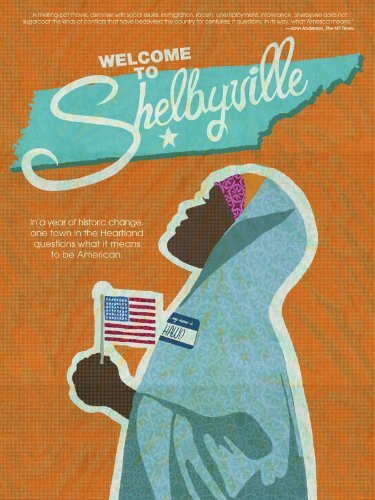
Welcome to Shelbyville is a documentary recounting the story of the town of Shelbyville, Tennessee during the 2008 presidential election; it recounts the reactions to his election by various different groups: Anglo-Americans, African Americans, Hispanics, and Somali Refugees. In addition to this, it also recounts the various groups’ reactions to a new group of Somali refugees. Through this film, we are presented with a microcosm of America; America is rapidly changing, it must figure out how it will react to the religious and cultural changes that are on the horizon. In this brief paper I will highlight some of the cultural differences between the groups and examine how their responses to each other might lead to the various groups becoming more culturally aware.
Welcome to Shelbyville

All four groups represent very different cultural values which are manifested in their views on politics, economics, and religion. In examining the Anglo-Americans values on politics we see that they desire to keep things the way they are. They feel threatened by change. Thus they display an aversion to risk. At one point some Anglo members of the local Rotary club say that “Shelbyville is not Mayberry anymore,” meaning that it is no longer the ideal picture of America that they are used to. This attitude towards political change is illustrated during the election of Barack Obama. At one point, a Presbyterian Pastor says that “the election is historic but troubling…the nation we know and love is changing.” The African American and Hispanic views of politics however is quite different. They see the change as hopeful. Having seen discrimination against minorities they see this new government as possibly bringing about change. In this election alone we see that the Anglos of Shelbyville have a strong uncertainty avoidance. Cultural differences are also displayed in the various groups views about economics. The Hispanics and Somalis are willing to work difficult, menial jobs in order to provide for their families. In fact, the Hispanic person Miguel Gonzalez is very proud to work for General Motors. He sees the value of hard work. The Anglos in the film however are best characterized by what the ESL teacher says about them, she says that some people wouldn’t work there (Tyson or General Motors) even if they paid them. This is an interesting observation, because at one point we see an Anglo couple complaining about how the immigrants have taken their jobs, however jobs are available, its just that the jobs that are available aren’t the ones the Anglos want. Cultural differences are also displayed in the various groups’ religious practices. Although we don’t exactly see their spirituality, we are given a view into how their political views impact their church services. Both the Anglo Presbyterians and the African Americans bring in their political views into their sermons. The Hispanics do not even mention their faith. The Somalis seem to be deeply impacted by their faith. We are told that they pray during designated prayer times, even if they are not at their mosque. We also see that their religious leader acts as a leader in the community, thus their religious life intersects with their daily lives, however they do not refer to politics in their meetings. Finally, the Anglo Baptists are also shaped by their religious views. They too do not allow their politics to intersect with their religious practices, but they do allow it to affect their social life. This is displayed in their decision to have a church put on community outreach for the Somalis.

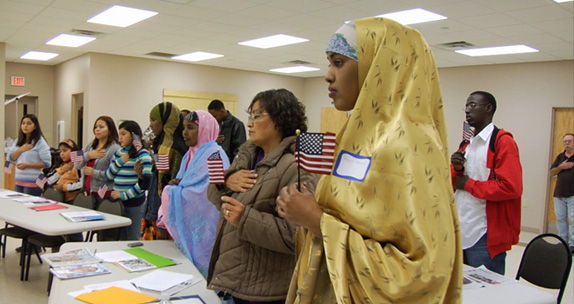
In addition to the differences between these groups that are seen in their politics, economics, and religion we also see differences in their reaction to the Somali refugees. The Anglo Americans have the most hostile reaction to them. For instance, the former Mayor says that the Somali’s “have diseases,” the “Muslims are here to kill us,” the “Somalis don’t like us.” On one radio show we hear an Anglo complain about being forced to comply with the Somali culture. Another Anglo says that “they are more aggressive,” he complains that they try to bargain and haggle at the store, he sees them as being rough and impolite. These attitudes are only one type of reaction typical of the Anglos. The Presbyterian pastor Stephen Caine, displays a more mild manner aversion to them. He points out that the Anglos are now the minority, and their ways are being threatened but he also realizes that if the churches are going to survive then need to learn to adapt. The African Americans take a more neutral stance towards the Somalis. They find them strange, they have strange food and wear strange clothing. One man at a barbershop complains that he can’t communicate with them. He doesn’t see them as a problem, however he finds that situations get awkward when the Somalis are around. The Hispanics display the most positive attitude towards the Somalis. The ESL teacher that is helping them become culturally oriented is Hispanic. The same ESL teacher also helps them address the problems they face with the news reporter, Brian Mosley. In addition to this it is also the Hispanic community that initiates the “welcoming initiative.” Being immigrants themselves they understand the problems the Somalis face. The greatest difference between the groups lies in their reaction to the Somalis. The anglos react negatively, whereas the Hispanics and African Americans take a more positive stance towards them. The African Americans are in favor of reaching out to them, but they are not willing to take an active role in doing so. The Hispanics lead the charge in this area.
Welcome to Shelbyville Somali

The differences between the reactions towards the Somali’s are rooted in struggles for power. The Anglos are losing power. They are becoming a minority, they are “losing jobs,” and they are being forced to change the ways of life that they were accustomed to living. The African Americans are also being forced to change, but since they do not possess as much power as the Anglo’s they do not feel as threatened thus they are not as averse to the changes that are required of them. Finally, the Hispanics, which possess the least amount of power in Shelbyville, are the ones who have the least conflict with the Somalis. This is likely because they are in a similar position as them. Both are relatively new to Shelbyville and the Southern States. Both work “menial” jobs and both struggle with the language. Thus their similarities bring them together.

Another reason for cultural conflict lies in what the groups believe that America should be like. The Anglos believe that it should stay the way it is, the other groups are open to change and are even hopeful that it will happen. This is seen in their responses to Barack Obama’s election. The Presbyterian church finds the election historic but troubling. The African American church sees hope in Obama’s election. They believe it will bring financial, physical, and spiritual well being to the country. The Hispanics believe it displays what they love most about this country, namely that anyone can make it if they work hard enough. The Somalis have little to no reaction to the election.

Different conceptions of what America should be like are also seen in how the groups respond to the cultural differences in the Somalis. The some want them to leave, others want them to conform to their ways, and some are willing to assimilate them as long as they leave behind their cultural values and adopt American values. The African Americans play a small role in welcoming the Somalis helping the become acculturated. They are willing to help them feel welcome, but they do not take an initiating role in welcoming them. This fact is seen in the scene involving the meal between the various groups. The African American ladies are friendly towards the Somali’s, they even try to understand what Somalia is like, however they display cultural insensitivity when it comes to their style of dress and the topic of terrorism. It is the Hispanics that initiate the most beneficial cross-cultural initiatives. By teaching the ESL class, organizing the meeting with the Newspaper, and initiating the meal between the Somalis, African Americans, and Hispanics all groups begin to move towards being culturally aware people. These initiatives are helpful because they help break down language barriers and help remove misconceptions that exist between the groups. Both of these tasks, the breaking down of language barriers and the correction of misconceptions help the groups identify with each other. As the groups begin to identify with one another they learn that they have nothing to fear when it comes to the changes that are happening around them.