A Dose of Theology – Hamartology

Hamartology

The theological study of sin. Hamartology concerns itself with the understanding, origin, nature, and consequences of sin. Also it studies the way in which sin is transmitted across the human race.

Used in a sentence: If you are studying the fall of man in Genesis 3, you are doing hamartology.

Equipping the Church International (ECI) – Updates

As you, the reader, probably know, I am on the board for a non-profit orgnization called Equipping the Church International (or ECI for short). We are an organization that provides theological education for under resourced pastors in Latin America. We are barely getting started up, but exciting opportunities are already coming our way! For example this weekend I am going to Ensenada, Mexico to teach on shepherding God’s flock out of 1 Peter 5:1-4! Its my first time ever preaching in Spanish!

Here are some updates in the form of an email I received from Jose Luiz Amezquita:

Hello ECI Team!

Blessings!

I hope things are going well for you and your families!

We continue to pray and seek God’s direction for ECI and I encourage you to continue to pray for the development process and the team.

Updates

501-Process: I’m so excited to say that we are beginning the process of submitting all the legal papers for our 501 (c) (3) that will be focused on missions, training leaders and pastors around the world and also compassion ministry. I deeply appreciate every one of you who has participated in this process and who still are participating.

Ensenada Baja California, México: We have our pastor’s Conference on Saturday June 29, 2013 all day.  Please be praying for us so we can communicate God’s word clearly and pray for the pastors so they can yield to the Holy Spirit as they receive God’s word.  We are leaving Friday the 28th at 10:30 a.m. and coming back Saturday night.

We now have our mailing address for ECI: 4212 E. Los Angeles Ave. Suite 4166   Simi Valley, CA 93063

It has truly been a joy to partner with you and I’m incredibly thankful for your commitment, service, and faithfulness.

Please let me know if you have any questions.

Today’s Verse: Bring my sons from afar and my daughters from the end of the earth, everyone who is called by my name, whom I created for my glory (Isaiah 43:6-7).

Missional Rhythms

“We don’t want to add things to our schedule, but bring intentionality to what we are already doing.” – Caesar Kalinowski (HT: VERGE Network)

Missional Rhythms

There is a big difference between living life and tacking on mission as a side thing vs. living life on mission and being intentional about creating missional rhythms in everyday life. What do you lean towards?


Cool Christian Beards (pt. 3): B.B. Warfield

Its been a while since I last posted in our “Cool Christian Beards” series, but its time for the cool Christian beard to make a comeback! Today we have one of the most famous beard protestant theologians. Although he isn’t as famous as the bearded Calvin or the non-bearded Luther and Edwards, this bearded theologian is one of the most important theologians for evangelicals. Most evangelicals don’t know him, but the truth is that almost all evangelicals have adopted his doctrine of scripture. Today I present to you B.B. Warfield!

BB Warfield Beard

B.B. Warfield was born on November 5, 1851 in Lexington, Kentucky to the Union officer and editor of the Farmer’s Home Journal William Warfield and Mary Breckinridge Warfield, the daughter of a Princeton graduate and the founding president of a Presbyterian seminary in Kentucky. Having growing up in a pious and intelligent family it was not unusual for Benjamin to develop an interest in mathematics and science, as well as a knack for theological studies. At the age of six he would have already completed the shorter catechism, and would have begun to study the larger catechism and memorize large amounts of Scripture.

After graduating from College in 1871 with several awards and recognitions he went to study in Edinburgh and Heidelberg. Eventually he came back the United States, entered Princeton Seminary and began ministering in the Presbyterian Church. Eventually he decided to go back to Europe for further studies, this time in Leipzig, Germany. After his studies he returned to the U.S. to work at a Presbyterian church in Baltimore, but he was shortly contacted by Western Seminary to teach New Testament. He took the job and published many articles. Thus he began to be recognized as an apt scholar.  In 1887 Warfield was called to teach at Princeton Seminary as professor of didactic and polemic theology. He taught at Princeton for thirty-four years and died in 1921.

Benjamin Breckinridge Warfield is one of the most influential theologians in the history of American Christianity (although he is now dead…) Most lay people have no clue as to who he is or what he did, his theology has influenced the lives of countless American Christians; specifically his articulation of the doctrine of the inerrancy of Scripture.

Why Did God Rescue Humanity?

Why does God save us through Jesus Christ? My theological hero, Jonathan Edwards, has argued that God saves for the sake of his own glory, which is simultaneously what is best for us. John Piper has famously adopted this same line of thought. Yet the idea that God saves us, through Jesus Christ, for the sake of his own glory is not a modern notion, nor is it simply a “reformed” notion; we find traces of this even in the writings of Athanasius:

Truly this great work (salvation and incarnation) supremely befitted the goodness of God. For if a king constructed a house for a city, and it is attacked by bandits because of carelessness of its inhabitants, he in no way abandons it, but avenges and saves it as his own work, having regard not for the carelessness of the inhabitants but for his own honor. All the more, so God Word of the all-good Father did not neglect the race of human beings, created by himself, which was going to corruption, but he blotted out the death which had occurred through the offering of his own body, and correcting their carelessness by his own teaching, restoring every aspect of human beings by his own power.

According to Athanasius God won’t abandon his creation into the hands of death and destruction, and he will certainly not abandon the pinnacle of creation: human beings, to that same fate. To do otherwise would be a blemish upon God’s holiness and honor.

God saves us for the sake of his own honor!

Thanks be to God!

Why Did the Son Become Incarnate?

Why did the Son become incarnate? That is a good question. Several people on the A-Team (Athanasius, Augustine, Aquinas and Anselm) have all taken a shot at answering this question. Usually the answer gets tied in to the doctrine of atonement. Here is what Athanasius has to say about that question:

For speaking of the manifestation of the Savior to us it is necessary also to speak of the origin of human beings, in order that you might know that our own cause was the occasion of his descent and that our own transgression evoked the Word’s love for human beings, so that the Lord both came to us and appeared among human beings. For we were the purpose of his embodiment, and for our salvation he so loved human beings as to come and appear in a human body. Thus, then, God created the human being and willed that he should abide in incorruptibility; but when humans despised and overturned the comprehension of God, devising and contriving evil for themselves, as we said in the first work (Against the Gentiles), then they received the previously threatened condemnation of death, and thereafter no longer remained as they had been created, but were corrupted as they had contrived; and, seizing them, death reigned. (De Incarnationae S.4)

So why did the Son become incarnate? Quite simply, the Son became incarnate to save us from the death we had brought upon ourselves.

Thanks be to God!

Christ-Centered Hermeneutics – 2 Corinthians 1:20

Recently on The Exchange, Ed Stetzer started a blog series devoted to the issue of Christ-Centered Old Testament Preaching (see Part 1 and Part 2). He has invited several respected scholars including Daniel Block, David Murray, Walter Kaiser, and Brian Chapell to weigh in on the discussion.

But this is an issue that is so important to the life of the Church that he also invited others from around the blogosphere to also weigh in…

Here are my two cents:

I don’t by any stretch of imagination consider myself an OT scholar. I do dabble a bit in the Old Testament (being an OT substitute lecturer at Eternity Bible College), but I would primarily see my own area of expertise being in the NT (afterall it should be, I am an NT Prof.). I mainly teach through Pauline Literature and I am fascinated with the NT use of the OT. Richard Hays and G.K. Beale have been extremely helpful for me in understanding how the NT uses the Old. Yet, working the other way OT pointing to the NT is a lot more difficult. On top of that, many of us have to preach this way, so its vital for us who teach the Bible and who preach to figure out for ourselves what the relationship between the OT, NT, and Christ is.

Over the last few years Preaching Christ from the OT has been a hot button issue. With the growing prominence of Reformed blogs and the Gospel Coalition, this issue has come to the forefront of evangelicalism. The Evangelical Theological Society’s Far west Regional Meeting in 2012 even had this as its central theme. So Lets start out by clarifying the issue, or better yet problem…

In most people’s minds we are faced with a two pronged dilemma:

  • We should take seriously what the authors themselves have to say.
  • We should preach Christ and Christ crucified.

Problem 1 – We Should Take Seriously What the Authors Themselves Have to Say

Going through seminary, I took classes on “The Hebrew Bible.” It wasn’t the “Old Testament” it was the TaNaK. Torah, Prophets, Writtings. We read it as it was organized in the Masoretic Texts. We read it as though we were not Christians. Some professors brought it back to Christ as a side-note, but the emphasis was on reading the Old Testament as though we didn’t even possess the New Testament. This in and of itself is already a hermeneutical move, nevertheless we were taught that when studying the Old Testament we ought not quickly jump to the New Testament, to do so would not be to take the Old Testament and its writer’s intentions seriously. So at the end of the day, to take the text seriously meant not to read Christ into the Old Testament. This is understandable, because Christ-Centered OT preaching is often done very poorly. Have you ever heard anybody preach on how Rahab’s red scarf is a type of Christ? I have… its hard not to scoff at a sermon like that.

Problem 2 – We Should Preach Christ and Christ Crucified

Paul famously resolved to only preach Christ and Christ crucified. Many preachers I know have taken this up as their own mantra, and have taken it to be equivalent to “Gospel-Centered Preaching” or more accurately “justification-by-faith-centered preaching.” Others justify Christ-Centered OT preaching by pointing out what Jesus says about his own relation to the Old Testament. In John 5:39 Jesus says to his opponents, “You diligently study the Scriptures because you think that that by them you possess eternal life. These are the Scriptures that testify about me.” In Luke 24 we are told about the story of Jesus’ encounter with two disciples on the road to Emmaus. At dinner Jesus begins with Moses and all the Prophets, and he explains to them what was said in all the Scriptures concerning himself. So we have a Pauline injunction to always preach Christ, we have Jesus himself saying that all Scriptures concern him, but on top of that we have a deep rooted tradition of reading the OT typologically.

Jonathan Edwards is one of my theological heroes, I have devoted much of my studying in seminary to his theology, one thing that he does is point out how everything reveals Christ.

Check out what he says in his miscellanies:

“I expect by very ridicule and contempt to be called a man of a very fruitful brain and copious fancy but they are welcome to it. I am not ashamed to own that I believe that the whole universe, heaven and earth, air and seas, and divine constitution and history of the holy Scriptures, be full of images of divine things, as full as a language is of words; and that the multitude of those things that I have mentioned are but a very small part of what is really intended to be signified and typified by these things.”

He sees Christ everywhere! Why can Edwards say this and why does he risk ridicule and contempt in order to find God (and more specifically Christ) in things like storms, spiders, marriage, family, historical occurrences, and the Old Testament? The reason is quite simple. He believes that “God is a communicative being.” In fact in one of his Miscellanies Edwards says that “communication of himself to their (humans) understanding is his glory, and the communication of himself with respect to their wills, the enjoying faculty is their happiness.”

So it seems as though Paul, Jesus, and Edwards (and the Church broadly speaking) has always placed an emphasis on preaching Christ from all of Scripture. How shall we pass this two pronged dilemma? Well I’m not even sure it is a dilemma.

Why Preaching Christ from the Old Testament is Not a Problem

Daniel Block mentions three problems with preaching Christ from the OT:

  • Christo-centric preaching often morphs into a Christo-centric hermeneutic, which demands that we find Christ in every text.
  • Christ-centered preaching may obscure the intent of the original author and in so doing may actually reflect a low view of Scripture.
  • Rather than clarifying many First Testament texts, Christ-centered preaching may rob them of both their literary quality and their spiritual force.

It would be worthwhile to respond to these objections, but I won’t, instead I will focus on laying out one way which we could preach Christ from the Old Testament, yet stay true to the original human author’s intentions….

The Old Testament authors wrote “directionally” so that the OT scriptures do in fact lead to Christ. Thus we can preach Christ in every Old Testament sermon.

Notice what I am not saying… I am not saying that the cross or our justification is found in every text. I am not saying that every text contains the gospel. I am not saying that Jesus the 1st century citizen of Palestine is in every text. Rather I am saying that all the Old Testament leads to Christ. I believe that it does this in at least three ways:

  1. The OT anticipates a Messianic figure of some sort
  2. The OT anticipates a time when the promise to Abraham would be fulfilled
  3. The OT anticipates YHWH dwelling with his people forever

These three “anticipations” run throughout all the Old Testament as a thread would weave its way through an intricate tapestry. Sometimes a single thread will be on the front side of the tapestry, in full display, but at other times it will be on the back side, hidden from view; nevertheless it is always a part of the tapestry. These three themes or anticipations run through the entire Old Testament, and each of these three themes are fulfilled in Christ.

Four Examples (Three Easy and a Hard One)

Messiah
Consider any part of the Law and Writings. Within these writings there are is a central theme that runs throughout, namely “the expectation of a future anointed king or priest figure who brings salvation to the people of God” (Stanley Porter, The Messiah in the Old and New Testaments, 4). If you want proof of this take a look at Genesis 3:15, 14:17-20, Numbers 24:17-19, Pslams 2 and 100, Daniel 9:24-26. Although messianic concepts are not fully fleshed out at this point, they are certainly there.

Consider the prophetic literature. Within the prophets there are numerous retelling of Israel’s history through the lens of Israel’s unfaithfulness. But even within these re-telling there is almost always references to past or present Hebrew leaders and their successes or failures.  These leaders often serve as figures that the authors use to create anticipation (or stir the audience’s imagination) for a future anointed leader who will not fail.

Land
Also within the prophetic literature, there is a strong anticipation for the day when Israel will posses its land and live in Shalom. This is all an out working of the Abrahamic Covenant. Interestingly enough though, Abrahamic Covenant language is picked up even when they are in exile. Jeremiah 29, encourages the exiles to “produce offspring,” “settle down and cultive gardens,” and “bless the city.” It parallels God’s words to Abraham which promise “offspring,” “land,” and “blessing.

YHWH’s Dwelling Place
The Torah anticipates YHWH’s dwelling with his people, in fact this is the central theme of Genesis and much of the law, namely that God wants a people to dwell among.  This is especially expressed in a “temple” theme that runs throughout  the Torah but also in the Writings and Prophets. Genesis is a cosmic temple. The Tabernacle is a proto-temple modeled after the eschatological temple.  Chronicles emphasizes why YHWH’s presence will leave the people. Ezekiel explains, from a priestly standpoint, why YHWH’s kabod left, and promises that YHWH’s kabod will return to his people and dwell with them forever. Even the minor prophets anticipate the day when YHWH will return in all his glory to the temple.

Proverbs
My point in illustrating all of this is that the OT is built around these three themes, and anywhere you turn to in the OT you will find these themes. You will even find them in the book of Proverbs. Some people are quick to point out that you don’t find Christ in the Proverbs. But step back for a second, who is the book written to? Its written to the son of a King, so that the son might rule wisely. Much of the OT anticipates a messianic (or proto-messianic) king who rules with perfect wisdom.  This truly wise king is sometimes talked about as YHWH himself or some Davidic descendant. So even the book of proverbs points to Jesus because  it illustrates what a truly wise king lives like. If you keep bringing any individual proverb back to the purpose of the book as a whole, you see a kingly messianic theme.

Now Get to Christ!

I think its relatively undisputed that these three themes run throughout all of the Old Testament. They might not be found in each passage, but they are certainly found in entire books and collections of scripture (Torah, Writings, Prophets). Now we can get to Christ… How? Christ is the anticipated Messiah. Christ is the fulfillment of God’s promises to Abraham (land, offspring, blessing). Christ is YHWH coming to dwell among his people. If Christ is the fulfillment of these three themes or anticipations, and all of the Old Testament authors intentionally wrote in anticipation of the fulfillment of these themes, then we have warrant to preach Christ from the Old Testament. Doing that might not be an easy task, and it will involve immersing ourselves into the Hebrew worldview that desperately anticipated these things. But if we do this, then we will be that much better for it, because we will come to appreciate Christ as the fulfillment of all of God’s promises.

“For no matter how many promises God has made, they are “Yes” in Christ. And so through him the “Amen” is spoken by us to the glory of God.” – 2 Corinthians 1:20

Let us say “Amen!” to the fact that Christ is the fulfillment of all of God’s promises in the Old Testament!

Living an Unhurried Life – Prayer

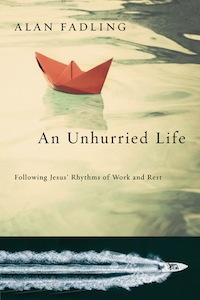
I recently picked up a book by Alan Fadling, called An Unhurried Life: Following Jesus’ Rythms of Work and Rest. I picked it up upon the recommendation of Paul Jensen, the executive director of the Leadership Institute, whom Alan is the director of a ministry within that ministry.  Its kind of cool actually, many years ago Alan Fadling used to be the college pastor at the church that I am now the college director for. Things have really come full circle, Alan is coming to our college ministry to lead a half-day spiritual retreat. I don’t actually know Alan, but I do know Paul, and if he has the same kind of heart that Paul has then I know we are in for a real treat. But I digress….

In this book Alan calls us to find a balance between our sense of calling and our call to rest. He has a chapter on productivity, and he says that being unhurried doesn’t mean that you lack productivity. He also has a chapter on spiritual practices for living an unhurried life. This chapter is great. I got a taste of a few of these practices in my class with Paul Jensen at Fuller. He also talks about how living an unhurried life allows us to care well for others. Today though I want to pull out an excerpt on his chapter on being “unhurried enough to pray.”

Check out what Alan has to say on prayer:

Some of us are paid in Christian leadership roles. Others volunteer our time to serve. As a leader myself, I think about Jesus’ rhythm of ministry and prayer. What is inviting to me? What resistance rises up within me. For example, to what degree do I see prayer as a strategic activity of leaders in general and of my leadership responsibilities in particular…. One of the single most fruitful activities in which a leader can engage in is praying. Praying for the people God has entrusted to our care.

As a paid Christian Leader, I ask myself whether prayer is legitimate work during office hours or whether I should do it only “on my own time.” Do I see the office as the place where I do the important stuff, where I deal with paperwork, prepare messages, run the institution, plan the events, keep appointments, talk on the phone, and get things done? Is it at all possible that our office hours could reflect the kind of time that the early church leadership spent together sharing in the word, praying, and enjoying fellowship? And is it possible that I might do every task or conduct every meeting in a spirit of prayer? (106-107)

He brings up some very important points. I honestly find myself using my office hours for “office type things.” But is that all that my job consists of? Shouldn’t prayer be a part of my “job?” What about spending time alone with Jesus? I think the same type of questions could be asked about leading a Life Group: Should our pre-meetings simply be a time where we assign tasks and plan out the night? Or should we spend that time praying? Perhaps we need to engage in prayerful planning… These are all the type of questions I don’t have answers to. But I do know that Paul calls us to pray unceasingly, which probably means that everything we do must be infused with a prayerful heart and attitude.

Questions for Reflection:

  • What do you think the role of prayer is in leadership?
  • Does the way you actually lead reflect your beliefs about prayer?
  • What steps could you take to help your belief and actions match up?

An Unhurried Life

A Dose of Theology – Archibald Alexander

Archibald Alexander (1772-1851) an American educator and theologian, was President of Hampton-Sydney College (Virginia) from 1797 to 1806. In 1807 he became pastor of Pine Street Presbyterian Church in Philadelphia. He received the Doctor of Divinity in 1810 from the College of New Jersey. He is most noted as founder and first principal of Princeton Seminary serving there from 1812 to 1840. As principal and professor of theology, he is considered the first of the great “Princeton theologians.” He continued as professor at Princeton until his death in 1851. He was buried in Princeton Cemetery. (HT: Theopedia)

Charles Hodge, the most famous student and successor of Alexander, named his son Archibald Alexander Hodge after his mentor.

Quote: “Do not for a moment suppose that you must make yourself better, or prepare your heart for a worthy reception of Christ, but come at once – come as you are.” —Archibald Alexander


My Reading List for June Through July

For those of you who are curious, here is my reading list for the rest of June through the month of July:

Theology

  1. Karl Barth – Evangelical Theology
  2. Athanasius – De Incarnatione

Philosophy

  1. Marcus Pound – A (very) Critical Introduction to Zizek

Literature

  1. C.S. Lewis – On Stories: And Other Essays on Literature
  2. Paulo Cohello – The Alchemist

Ministry

  1. Alan Fadling – An Unhurried Life: Following Jesus’ Rhythms of Work and Rest
  2. Jimmy Siebert & Larry Kreider: The Three Loves
  3. Ajith Fernando – Jesus Driven Ministry
  4. Spiritual Parenting – Michelle Anthony