Preventing Suicide

You are a practical theologian. That is the premise that Preventing Suicide is built on. As a pastor, chaplain, or counselor its is important for you the reflect upon your own theology of suicide. Why? Well because what you belief affects what you do, because there isn’t one Christian position on suicide, and finally because most people in the church have no clue what to do when it comes to dealing with people who are suicidal. Karen Mason, in Preventing Suicide, attempts to address these three issues.

People who do vocational ministry have the privilege of being able to discuss theological issues regarding life, death, suffering, and community – all issues that are very important to those who are at risk of self-harm or suicide. Ministers also deal with people who are undergoing great amounts of suffering. Whether it’s a broken relationship, the loss of a loved one, the loss of a job, or depression pastors often deal with people who are going through things that put them at great risk for suicide. According to Mason,

“Pastoral caregivers have unique competencies necessary in suicide prevention. They offer their primary discipline of practical theology as well as faith beliefs and behaviors that protect against suicide. Pastors, chaplains, and pastoral counselors need to be prepared to be involved in suicide prevention, intervention, and postvention because suicide already exists in the faith community.

This book covers a wide range of topics including:

1) People who are at risk for suicide

2) Myths about suicide

3) Christian views regarding suicide

4) Theories of Suicide

5) How to help someone in a suicide crisis

6) How to help those who have survived suicide attempts

7) How to help those who help people who are suicidal

8) How to help the friends and family of those who have committed suicide

9) How to help your church deal with a suicide

I found this book to be extremely helpful. Not once in seminary did we cover the topic of suicide – thus everything I know about it I have picked up along the way. Most helpful for me were the chapters one who is at risk for suicide and also the chapter on how to hep someone who is suicidal. The chapter contained some very practical steps that everybody should know regarding suicide prevention. In fact, it is so helpful and practical (and important) that I will make it required reading for all of the small group leaders in my ministry. I know reading one chapter and discussing it isn’t enough training for dealing with suicide, however I believe it can be a really good starting point to begin the conversation.

This book should be required reading for anybody in ministry. I highly recommend that you get a copy and put it into the hands of anybody who does ministry, whether it’s a pastor, counselor, or even small group leader.

(Note: I received this book free of charge from IVP in exchange for an impartial review.)

Preventing Pastoral Burnout

Without at doubt anybody who is involved in any sort of pastoral ministry is liable to “burn out.” Pastors, chaplains, and pastoral counselors are all at risk for burning out. In fact some studies have shown that…

“protestant clergy had the highest overall work-related stress and were next to the lowest in personal resources to cope with the occupational strain.”

That is pretty shocking considering the fact that we have the power of the Holy Spirit to rely on, nevertheless people in ministry are very likely to burn out.

Only you can prevent pastoral burnout!

What are some signs that you might be experiencing burnout?

  • Making more mistakes
  • Lacking energy
  • Becoming anxious or afraid
  • Losing the wonder doing ministry
  • Leaning on alcohol, food, or porn to manage one’s emotions

Burnout is likely to happen when self-care is not a priority. It is likely to happen when there is a lack of balance in your life. But you might say, “oh I’m giving so out with taking little time to be refilled because I care so much for these people and I just don’t have time for “self-care.” Well the problem with that is that if you don’t pay attention to yourself and if you don’t care of yourself it will not only be to the detriment of yourself but also to the detriment of others.

In her book on suicide prevention, Preventing Suicide: A Handbook for Pastors, Chaplains, and Counselors, author and psychologist Karen Mason points out the fact that consistently working with suicidal people can lead to burnout even quicker. She writes “the self is limited. It has only so much energy. If it is not renewed, then depletion will take place.” She follows that up with several ways in which she has seen pastors replenishing the energy necessary to minister effectively to God’s people:

1-Practicing your faith (prayer, scripture reading, retreats, meditating on the gospel, etc.)

2-Reducing Isolation through supportive relationships

3-Maintaining your health (exercise, sleep, diet)

4-Relaxing through recreation, leisure, or hobbies

5-Remembering your call into your vocation

6-Reducing your load by setting boundaries; saying no

7-Regular self-debriefing i.e. processing through your stress

8-Regular debriefing with peers

9-Managing your thoughts about your perceived failures

10-Seeing a counselor

Self-care is vital if you are going to prevent burnout. For the sake of the people that you minister to make sure that you are taking care of yourself or else you won’t be able to care for them well!

Universal Atonement & The Sin of Unbelief

In a recent blog I posted I summarized Oliver Crisp’s recent argument that there is significant room within some key reformed confessions for one to hold on to a doctrine of atonement that excludes limited atonement and is open to universal atonement. I.e. that Christ died no just for the sins of the elect, but for the sins of all humanity. Essentially the argument goes like this:

1-Atonement is sufficient for all of humanity.

2-Faith is a necessary condition to receive salvation.

3-God intends the work of Christ, i.e. atonement, to be effective for all those who have faith.

4-Faith is a divine gift.

5-God provides faith for the elect.

6-Thus only the elect, who have been given faith, receive salvation i.e. the effective work of Christ.

However another blogger made a great observation, he said that the argument logically makes sense, however it has one major fault, he said that I had ignored the fact that Jesus died for the sin of unbelief…

If you’re atoned for all your sins, that must include the sin of unbelief – which is the sin of rejection and hatred of God and everything that He stands for. If you’re atoned for everything except faith, then you still have pretty much everything left to be atoned for!

This blogger certainly brings up a good point! Essentially he is making an argument similar to one that John Owen (the Puritan) had made. Here is what Owen says…

Unbelief is it a sin or is it not? If it be not how can it be a cause of damnation? If it be, Christ died for it,or he did not. If he did not, then he died not for the sins of all men. If he did, why is this an obstacle to their salvation? Is there any new shift to be invented for this? Or must we be contented with the old, namely because they do not believe? That is, Christ did not die for their unbelief, or rather, did not by his death remove their unbelief, because they would not believe, or because they would not themselves remove their unbelief; or he died for their unbelief conditionally, that they were not unbelievers. These do not seem to me to be sober assertions. (Works, 144)

A Portrait of John Owen - author of the "The Death of Death in Christ"
A Portrait of John Owen – author of the “The Death of Death in Christ”

Or elsewhere, Owen says…

God imposed his wrath due unto, and Christ underwent the pains of hell for, either all the sins of all men or all the sins of some men or some sins of all men. If the last, some sins of all men, then have all men some sins to answer for, and so shall no man be saved… If the second, this is it which we affirm, that Christ in their stead and room suffered for all the sins of all the elect in the world. If the first, why, then, are not all freed from the punishment of all their sins? You will say, “Because of their unbelief; they will not believe. But this unbelief is it a sin, or is it not? If not, why should they be punished for it? If it be, then Christ underwent punishment for it or not. If so why mus that hinder them more than their other sins for which he died from partaking of the fruit of his death? If he did not, then he did not die for all their sins. Let them chose which part they will. (The Works of John Owen, 173-74)

Essentially Owen is arguing that unbelief is a sin – therefore it is cause for damnation. If Christ died for the unbelief of all of humanity then all of humanity would be saved, because he would have atoned for all the sin of humanity (unbelief included.) However, not all of humanity is saved, therefore Christ could not have died for everybody’s unbelief – therefore we need limited atonement to make sense of why we don’t claim universalism.

This is exactly what this thoughtful blogger pointed out!

However one might want to say that even if unbelief is dealt with at the cross, under universal atonement, faith is still required for the application of the atonement that has been accomplished. If this is the case, then Christ has surely died for even the reprobate’s sin – unbelief included – however if they do not have the faith necessary to have the benefits of his death applied to them then they suffer the just punishment for their sin.

Faith is a necessary condition for appropriating the saving benefits of Christ’s death.

Creating Wiggle Room for Calvinists (Deviant Calvinism Book Review)

The anti-Calvinist blogs will never stop spinning the same message – Calvinism as a system is cruel, it creates a monster God, its fatalistic, and it is pessimistic (just to name a few “characteristics” of Calvinism). Roger Olson, a proponent of anti-Calvinism (who sort of reminds me of hard-nosed pro-Calvinist fundamentalists) has said that

If Calvinism is true, God is the author of sin, evil, innocent suffering and hell. That is to say, if Calvinism is true God is not all-loving and perfectly good.

These anti-Calvinists seem to forget that Calvinism or better yet, the Reformed tradition, is a lot broader and more varied than it is often portrayed. At least Oliver Crisp seems to think so.

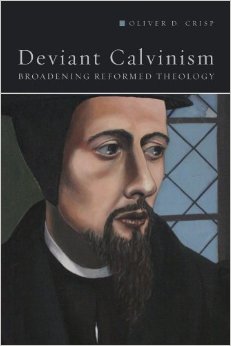
In Deviant Calvinism, Crisp argues that Calvinism really is a confessional tradition, however it is a confessionalism that tolerates doctrinal plurality within certain parameters. In this new book he aims to,

Commend to those within and without the ambit of the Reformed community way of looking at several central and defining doctrines of Calvinistic theology and broaden out what is regarded as appropriately Reformed doctrine.

Crisp acknowledges the fact that some myths about Calvinism just don’t seem to go away (no thanks to some in the neo-Puritan camp, Crisp didn’t say that, I did – Calvinism is so much bigger than just neo-Puritianism or being “Young, Restless, & Reformed”). For instance the myth that Reformed Christianity is anti-experiential, that it demands a doctrine of double predestination, that it is atheologically deterministic system, that it denies human freedom, that atonement must be definite in scope, etc.

The cover art for "Deviant Calvinism" was painted by Oliver Crisp himself!
The cover art for “Deviant Calvinism” was painted by Oliver Crisp himself!

Here Crisp takes some of these myths head on by going back into the standard confessions of the Reformed faith and by retrieving the theology of various Reformed theologians across the centuries.

Here are a few things Crisp shows throughout the book:

  1. That one can be both a Calvinist and a libertarian about human freedom.
  2. That one can be an Augustinian and a Universalist.
  3. That there are resources within Calvinist theology that can resist an Augustinian Universalism.
  4. That the scope of atonement need not be “limited.”
  5. That the major objection to the doctrine of universal atonement, the double payment objection, actually fails miserably

And he argues that all of these things fall well within the scope of Reformed confessionalism!

Review

I could not put this book down. I was so enthralled by it and the possibility moving past funadamentlistic neo-Puritianism (i.e. Johnny Mac and his cronies) that I read through it in a day and a half. Not only was it interesting though, it was very well argued. As is well known, Oliver Crisp is at the forefront of Analytic Theology – the theological method which applies the rigor and clarity of analytic philosophy to systematic theology. This method allows the author to make logically tight arguments; the strength of his method is especially on display in his chapter on Hypothetical Universalism (i.e. universal or unlimited atonement). He makes a strong case for how Calvinism does not require the doctrine of limited atonement; he does so by retrieving the theology of 1700’s British theologian John Davenant, The philosophy of John Martin Fischer, Mark Ravizza, and of course Harry Frankfurt. This particular essay is a superb example of what Analytic Theology ought to look like – it interacts with Scripture, historical resources, and contemporary analytic theology.

All in all, I highly recommend this book. It is the type of book that will cause you to think deeply about why you hold to the doctrines that you do, and it will challenge you to think outside of the box. I know it has certainly done this for me, in fact I will be posting some more thoughts about the book on my blog over the next few days.

(Note: I received this book free of charge from Fortress Press in exchange for an impartial review.)

The Righteousness of God

What does Paul mean when he says, “But now the righteousness of God has been manifested apart from the law” (Romans 3:21a)?

Romans 3:21-26

21 But now, apart from law, the righteousness of God has been disclosed, and is attested by the law and the prophets, 22 the righteousness of God through faith in Jesus Christ for all who believe. For there is no distinction, 23 since all have sinned and fall short of the glory of God; 24 they are now justified by his grace as a gift, through the redemption that is in Christ Jesus, 25 whom God put forward as a sacrifice of atonement by his blood, effective through faith. He did this to show his righteousness, because in his divine forbearance he had passed over the sins previously committed; 26 it was to prove at the present time that he himself is righteous and that he justifies the one who has faith in Jesus.

Recently I asked this question to some of the students in my Missionary Epistles Class. I got some really great answers, however it seemed that the phrase “righteousness of God” kept tripping up a lot of students.

I was discussing this with a couple of students online and you could really tell that a certain understanding of this phrase has permeated our evangelical minds. Usually we take this to mean the righteousness that comes from God. In many cases this is the right way to understand the phrase – not in this passage though….

Here is my quick reply as to how we should understand the phrase “righteousness of God” in this passage:

I think a fair amount of confusion is coming up because of how we are understanding the phrase “righteousness of God.” This passage is implying that now the righteousness of God is being made known apart from the law. Implying that before the righteousness of God had been made known through the law. How we understand this concept hangs on what we understand by the phrase “righteousness of God.” If we read it as “God’s righteousness which he reckons to us” then it sure seems to imply that in the past God reckoned us righteous through the law. However we might read God’s righteousness in a different way, we might read that phrase and understand it as God’s own righteousness, i.e. his saving righteousness through which he is committed to restore humanity’s broken relationship with himself. (Or as N.T. Wright puts it – God’s righteousness is his unswerving commitment to be faithful to rescue humanity). If we read it this way then it really makes sense of the passage – in the past God revealed his commitment to rescue humanity through the law, primarily because that was one stage of the plan, however, now we have entered the final stage of the plan in which God reveals his commitment to rescue humanity through the atoning work of Christ. It is not as though plan A – the law failed – and now Plan B – Jesus – has to be enacted, no, Jesus was the point all along, and Jesus is how God is revealing his saving righteousness.

In other words in this particular passage “the righteousness of God” refers to God’s saving righteousness, not something he gives to us.

Music Monday – “Child” by Washa

Unlike some of the stuff I have posted recently, i.e. Hip Hop, today I present to you a song that is fairly ambient, places an emphasis on tone and atmosphere, and makes use of complex instrumentation in order to create a mood that is both melancholic yet hopeful.

Enjoy!

(HT: The Good Christian Music Blog)

Limited Atonement vs. “Unlimited” Atonement

Most people tend to think that if one is reformed one is required to hold to the doctrine of limited atonement, the doctrine which says that the cope of Christ’s atoning work is accomplished on behalf of and applied only to the elect.

Stations of the Cross

In a recent article on “hypothetical universalism” (hear unlimited or universal atonement, not universalism), the doctrine by which the atoning work of Christ is universal in its sufficiency but applied only to an elect number less than the total number of fallen humanity Oliver crisp argues that there is significant room within some key reformed confessions in which one can hold to a doctrine of atonement that excludes limited atonement and is open to universal atonement. In this article (found in his most recent book Deviant Calvinism) he makes the historical case that this is so, there have been reformed theologians throughout history who have not compromised reformed orthodoxy by holding on to universal atonement. How is this the case? Essentially it hangs on a Lombardian dictum that Christ’s atoning work is sufficient for all humanity yet effective only for the elect, i.e. those that are predestined. Briefly the argument goes like this:

1-Atonement is sufficient for all of humanity.

2-Faith is a necessary condition to receive salvation.

3-God intends the work of Christ, i.e. atonement, to be effective for all those who have faith.

4-Faith is a divine gift.

5-God provides faith for the elect.

6-Thus only the elect, who have been given faith, receive salvation i.e. the effective work of Christ.

Do you think this argument works? What are the flaws in the argument?

Jason Sexton’s Advice to Students – Serve the Church!

Jason Sexton, a Systematic Theologian who holds positions at USC and Cal State Fullerton and heads up the Theological Engagement with California’s Culture Project, advises those pursuing theological and biblical studies to serve the church consistently and faithfully in order to flourish during their education

New Books from Baker

I remember the days of “book fairs” at elementary schools. A few weeks before the fair we would get a catalog of all the books we could order. There were Goosebumps, Clifford, Bernstein Bears, and Animorphs books galore. Now that I have grown up I am still getting those catalogs, except now adays its publishers sending me their Academic Catalogs with books that are about to be released. Every Fall, Winter, Summer, and Spring I have the opportunity to drool over the books I wish I had enough money to buy. Now I will definitely get a couple of books from each one of these publishers, I wish I could get them all but there are just so many!

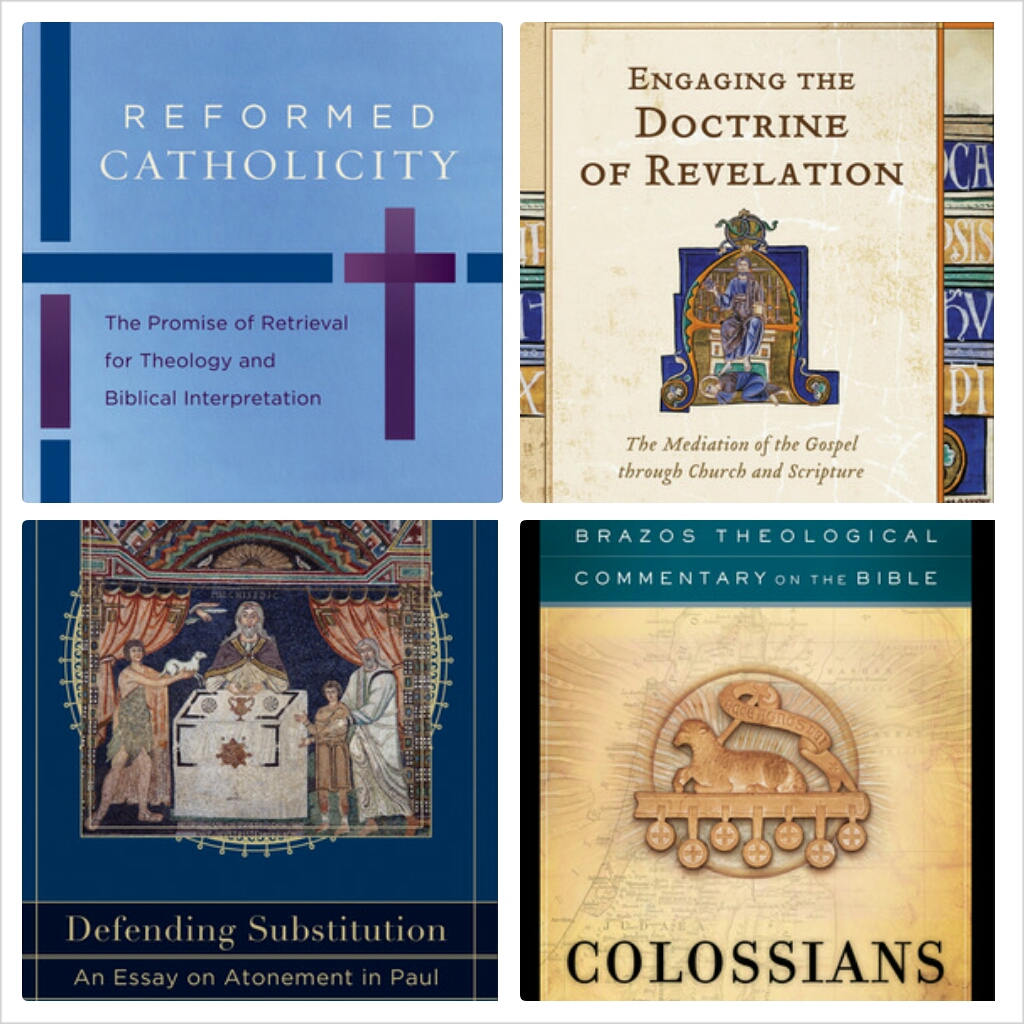
Anyway, here are a few of the books from Baker’s Fall 2014 Catalog that I am really looking forward to:

Baker Catalog Fall 2014

1-Reformed Catholicity by Michael Allen & Scott R. Swain (January 2015)

Can Christians be both catholic and Reformed? Can they believe in the authority of Scripture but also receive scripture within the context of the apostolic church? In this book Allen and Swain argue that to be Reformed means to go “deeper into true catholicity rather than away from it.” The authors seek to encourage theological renewal through retrieval of the rich resources of the historic Christian tradition.

2-Engaging the Doctrine of Revelation by Matthew Levering (November 2014)

This book argues that divine revelation has been truthfully mediated through the church, the gospel, and Scripture so that we can receive it in its fullness today. Levering’s approach engages contemporary and classical views of revelation across various traditions. The thing that excites me the most is who is endorsing this book: John Webster, John Millbank, and Hans Boersma. What a variety!

3-Defending Substitution: An Essay on Atonement in Paul by Simon Gathercole (February 2015)

There is no other book in this catalog that has me this pumped! Much of my work focuses on Christology and Atonement theories plus I love all that Simon Gathercole writes. He has a way of navigating through revisionist positions, taking what is best of these critiques and yet he always finds a way to show that the traditional Christian positions are actually more persuasive than the revisionist positions. In this book he takes us the highly contest subject of penal substitution. He argues that a thorough account of atonement must in fact include penal substitution.

4-Colossians by Christopher R. Seitz (September 2014)

Christopher Seitz has written quite a bit about how the NT and OT relate to one another. His approach usually involves drawing a link between the theology of the OT to the theology of the NT. So he is definitely known for his theological interpretation of scripture. This book however is the first time he has undertaken the project of interpreting one whole book of the bible. Colossians is my favorite New Testament book to study, so I am really looking forward to this book!


Book Review – Dad is Fat by Jim Gaffigan

I haven’t really made it a practice of reading these types of books, much less reviewing them, however my brain has been fried from a lot of intense work these past few months and I really needed a break. I needed to read something that wouldn’t stress me out. So I acquired a copy of Jim Gaffigan’s Dad is Fat. They say laughter is the best medicine, that definitely is not true, laughter won’t cure cancer or a broken leg, or broken ribs (actually laughter is the worst kind of medicine if you have broken ribs), however when it comes to stress laughter works wonders. This book had me laughing out loud the whole time.

Jim Gaffigan, as you probably already know, is the stand up comedian famous for his “hot pocket” routine. Yes the hot pocket bit does show up in the book, but it doesn’t play a major role in the plot line. Actually, there is no plot line in this book, it’s a collection of “essays” (can I even call them essays, essays sounds so formal and academic), about family life. They are mainly humorous observations of what it looks like to be a father of 5 in New York City. He shares with you, the reader the joys and horrors of raising 5 kids, who never want to sleep, in the city that never sleeps.

Among his “essays” one of my favorites was “Oh My God, You’re Pregnant?” in which he points out the absurdity of how people get surprised when they find out a celebrity is pregnant…

As human beings we end up acting like we are the first generation on this planet to deal with pregnancy. We are most shocked when really attractive, successful someone get pregnant. It’s unbelievable. “Did you hear Beyoncé got pregnant? Its almost as if she is a human being!

Another one of my favorites is his essay, “Toddlerhood.” He makes the keen observation that the more he thinks about it, adults are actually a lot like giant toddlers…

I think we are always unconsciously seeking to return to our early childhood. This is why we go to bars…Think of the last two times you had Jell-O. When you were three and when you were in that bar in Florida for spring break. Have you ever turned off lights in a room filled with children? They immediately start screaming and acting insane. Is it merely coincidence that lights are so low in bars? It’s just a license for adults to misbehave.

All in all this book had me laughing the whole time. And I’m pretty sure that if you pick it up you will be laughing as well.