NIV Application Commentaries on Sale for Just $4.99

The entire NIV Application Commentary series is on sale at $4.99 per volume!

When preaching, after I turn to exegetical commentaries, I like to turn to commentaries that blend exegesis with clear application. Recently I have been using the “Story of God” commentary series edited by Scot McKnight, but one classic series that fits this model is the NIV Application Commentary series. I highly recomend this series, it belends exegesis + historical bacgkround + application + theology really well. And right now, the series is on sale for $4.99 per kindle edition. You can’t pass this deal up! (HT:  The Cross Quoter)

Here are some of the best commentaries in the series.

Genesis – by John Walton
Deuteronomy – by Daniel Block
Judges/Ruth – by K. Lawson Younger
1 & 2 Chronicles – by Andrew Hill
Esther – by Karen Jobes
Ecclesiastes/Song of Songs – by Iain Proven
Isaiah – by John Oswalt
Jeremiah/Lamentations – by Andrew Dearman
Ezekiel – by Iain Duguid
Daniel – by Tremper Longman

Mark – by David Garland
Luke – by Darrell Bock
Romans – by Douglas Moo
1 Corinthians – by Craig Blomberg
Philippians – by Frank Thielman
Colossians, Philemon – by David Garland
Hebrews – by George Guthrie
2 Peter/Jude – by Douglas Moo
Revelation – by Craig Keener
On Figural Interpretation

This week, I’m focusing a bit on the New Testament use of the Old Testament. I’ve been sort of inspired by Richard Hays fantastic new book, Reading Backwards.  In it he argues that we need to learn to recover a figural reading of the Old Testament, specifically we need to learn to do this with the gospels. He ways that “all four of them [Mathew, Mark, Luke, John], in interestingly distinct ways, embody and enact the sort of figural Christological reading that Luther recommends.”

But what does Hays mean by “figural reading?” He uses Erich Auerbach’s classic definition to explain his point:

Figural interpretation establishes a connection between two events or persons in such a way that the first signifies not only itself but also the second, while the second involves or fulfills the first. The two poles of a figure are separated in time, but both, being real events or persons, are within temporality. They are both contained int the flowing stream which is historical life, and only the comprehension, the intellectus spiritualis, of their interdependence is a spiritual act.

In other words, figural reading, means that we move beyond merely saying that the Old Testament predicts stuff in the New Testament, we say that the stuff in the Old Testament prefigures or foreshadows stuff in the New Testament. All of this happens within history, thereby ensuring that the things in the past retain their value and significance as historical events, all the while maintaining that they contain a second level of significance, namely the meaning given to those events by latter occurring events.

To put it quite simply:

The Old Testament, read in light of the New Testament, contains types/figures of Christ and of the gospel.

Reading the Old Testament with Martin Luther

Why should we read the Old Testament? It seems pretty obvious to us today, but  in 16th century Germany there was a tendency to look down upon the value of the Old Testament. (No doubt Luther’s Law/Grace dichotomy had something to do with this…) Nevertheless Luther advocates for a figural sort of reading of the Old Testament, in other wrods he asks us to read the Old Testament in light of the New:

There are some who have little regard for the Old Testament. They thing of it as a book that was given to the Jewish people only and is not ouw ot date, containing only stories from past times… But Christ says in John 5, “Search the Scriptures, for it is they that bear witness to me… The Scriptures of the Old Testament are not to be despised but diligently read….Therefore dismiss your own opinions and feelings and think of the Scriptures as the loftiest and noblest of holy things, as the riches of mines that can never be sufficiently explored, in order that you may find that divine wisdom which God here lays before you in such simple guise as to quench all pride. Here you will find the swaddling cloths and manger in which Christ lies… Simple and lowly are these swaddling cloths, but ear is the treasure, Chris who lies in them.

Just as our treasured messiah was hidden and wrapped up in the swaddling cloths while he was in the manger, Christ our messiah is wrapped up in the swaddling cloths of the Law, Writings, and Prophets.

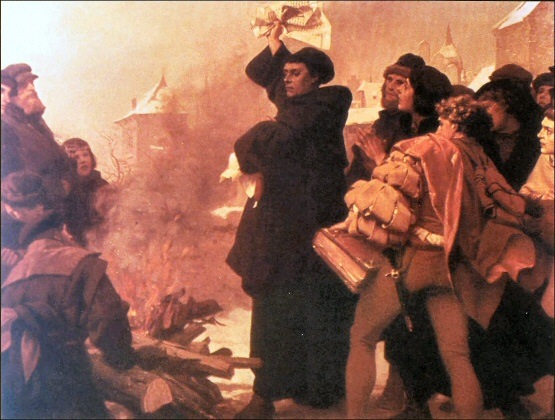
No Martin Luther! Don't Burn that Old Testament! Oh you aren't... its a Papal Bull. Okay proceed with the burning.
No Martin Luther! Don’t Burn that Old Testament! Oh you aren’t –  its just a Papal Bull. Okay proceed with the burning!

Book Giveaway! J.D. Greear’s “Jesus Continued…”

Thanks to the nice folks over at Zondervan I have a copy of Jesus Continued: Why the Spirit Inside of You is Better than Jesus Beside You. Instead of letting the extra copy collect dust on my bookshelf I figured it would be better served in the hands of one lucky winner. So, we are going to have a giveaway! How do you enter you ask? All you need to do to enter your name into the drawing is leave a comment telling me you did the following things—the more you do, the more chances you have of winning J.D. Greear’s excellent new book:

  1. Comment on this post and share how Mike’s book will benefit your personal growth in Christ.
  2. Follow me on Twitter (leave a comment saying you did)
  3. Share this giveaway on Facebook and Twitter (leave a comment saying you did)
  4. Like Zondervan Academic’s Facebook page (leave a comment saying you did)
  5. Like the Soma at Rocky Peak page on Facebook (leave a comment saying you did)
  6. Follow @Soma_RP on instagram – trust me its awesome!

While you are at, you should watch this video about the book

In a few weeks I will close the giveaway and pick the winner.

Because I am poor, I must limit this to USA and possibly Canada (unless you live in the middle of nowhere Canada – which is pretty much everywhere in Canada).

Karl Barth’s Letter to Diognetus

Letter to DiognetusThe god of the philosophers. A lot of people have beef with this “god.” With good reason too – God cannot come to be known through pure rationality. With that much I agree. I do believe that philosophy has an important role in articulating our theological convictions, but I would never say that philosophical reflection can lead us to true beliefs about our Trinitarian God. Knowledge of God is rooted in God’s revelation of himself. Only God can reveal God and we can known nothing about God unless God has chosen to reveal himself to us. This is the same argument that the author of the Letter to Diognetus makes to Diognetus:

As a matter of fact, before he [Christ] came, what man had any knowledge of God at all?  2Or do you really accept the idle nonsense talked by those plausible philosophers, some of whom asserted that God was fire—the very thing that they are on the point of going to, they call God!—while others claimed that he was water, and others said that he was yet another one of the elements created by God?  3And yet, if any one Of these lines of argument is acceptable, then each and every one of the other creatures could in the same way be shown to be God.  4No, this is just quackery and deceit practiced by wizards.  5No man has ever seen God or made him known, but he has manifested himself… (The Letter to Diognetus 8:1-5)

Christ is God’s word – without Christ there is no knowledge of God – revelation is God’s self-revelation of himself. Christianity is not a human attempt to find God, rather it is founded on God’s revelation of himself, it is founded upon the Word. With this much Karl Barth could agree. Maybe he wrote the letter to Diognetus, because it sure sounds like something he would say. (JK)

Alister McGrath’s Book on Lewis is Free for Kindle. Today Only!

Make Sure to get your free C.S. Lewis Biography!

HT: Zwinglius Redivivus

Alister McGrath’s Book on Lewis is Free for Kindle. Today Only

Posted on November 3, 2014

Alister tweets

Free today, “If I Had Lunch with C. S. Lewis: Exploring the Ideas of C. S. Lewis on the Meaning of Life” Kindle ed.:

Nice!

“Gospel Wakefulness” in The Letter to Diognetus

Letter to DiognetusIn the second half of the second century there was a shift in what type of literature Christians were writing. No longer were their letters and treatises simply pastoral or formational in nature, they began to be apologetic. That is, they began to make presentations for why one ought to hold to faith in Christ. They attempted to answer the objections and ridicule of the pagans around them, the began to take head on the deficiencies of pagan worldviews. Among these letters is The Letter to Diognetus, whose author is unknown. This particular letter has been described as “the pearl of early Christian apologetics.” Michael Haykin describes it as stemming from “the joyous faith of a man who stands amazed at the revelation of God’s love in his Son.” Haykin is spot on in how he describes this letter. As I have spent some time studying this letter, the last few days I have been blown away at his understanding of the gospel, and how much joy and affection for Christ is evident when this unknown author describes the gospel. The author gets the gospel! And it makes him rejoice in Christ! I wish that I had the sort of excitement and affection that this author expresses when he thinks about what Christ has done for him. Of course I experience that sometimes, but I really wish I could experience this sort of “gospel-wakefulness” that Jared Wilson describes, and the author of the letter experiences, all the time. Of course there are steps we can take to grown in our appreciation for the gospel – one of those steps is to surround ourselves with others whose minds are blown by the gospel, that might be somebody you known at church or it might be a dead author from 1,800 years ago.

Okay, enough talking about how excited the letter writer gets, he is what he says…

Instead of hating us and rejecting us and remembering our wickedness against us, he showed us how long-suffering he is. He bore with us, and in pity he took our sins upon himself and gave his own Son as a ransom for us – the Holy for the wicked, the Sinless for the sinners, the just for the unjust, the Incorruptible for the corruptible, the Immortal for the moral. For was there indeed, anything except his righteousness that could have availed to cover our sins? In whom could we in our lawlessness and ungodliness, have been made holy, but in the Son of God alone? O sweet exchange! O unsearchable working! O benefits unhoped for! – that the wickedness of multitudes should thus be hidden in the righteousness of One should justify countless wicked!
-Letter to Diognetus 9.2-5

The Legacy of Jonathan Edwards

Currently on the Amazon Kindle store you can get a copy of A God Entranced Vision of All Things: The Legacy of Jonathan Edwards for just $1.99! If you are a fan of Jonathan Edwards I highly recommend that you do not pass up this deal! It contains essays by numerous Jonathan Edwards scholars as well as some pastors who have carefully thought out the implications of Jonathan Edwards’ life and theology. In it you can look forward to essays by John Piper, Stephen Nichols, J.I. Packer, Mark Dever, Paul Helm, and Sam Storms just to name a few. The essays by Paul Helm and Sam Storms are worth the price alone!

Here is a preview of some of the essays you will get in this book:

  1. A God Entranced Vision of All Things: Why We Need Jonathan Edwards 300 Years Later – John Piper
  2. Pursuing a Passion for God Through Spiritual Disciplines: Learning From Jonathan Edwards – Donald Whitney
  3. Trusting the Theology of a Slave Owner – Sherard Bums
  4. The Great Christian Doctrine (Original Sin) – Paul Helm
  5. The Will: Fettered yet Free – Sam Storms
  6. Reading Jonathan Edwards: Objections & Recommendations – Justin Taylor.

So go ahead and add this collection of must-have essays on Jonathan Edwards to your library before the Kindle deal expires!


Happy Reformation Day!

It has been said that justification by faith alone is the doctrine on which the church stands or falls; on reformation day we discover the “rediscovery” (in a Christopher Columbus sense) of this doctrine. So on this Reformation I give you an awesome quote from the reformer Zacharias Ursinus:

“The righteousness with which we are here justified before God, is not our conformity with the law, not our good works, nor our faith; but it is the satisfaction which Christ rendered to the law in our stead; or the punishment which he endured on our behalf; and therefore the entire humiliation of Christ…whatever he did…is all included in the satisfaction which he made for us, and in the righteousness which God graciously imputes to us, and all believers.”

Zacharias Ursinus

“How can man, being a sinner, be just before God?…Man as a sinner can be regarded as righteous only on the ground of the imputation of Christ’s merits; and this is the question of which we speak when treating the subject of justification.”

Zacharias Ursinus would like to say:

Happy Reformation Day!

5 Great Deals for Your Kindle

What I love about the Kindle is that every once in a while you will find awesome deals – often at $0.99 or $1.99. Today I discovered four great books, and I got them all! Here they are in their categories:

Church History

Rediscovering the Church Fathers: Who They Were and How They Shaped the Church – $0.99 – Michael Haykin

Commentary

Galatians: Gospel-rooted Living – $0.99

Ministry

A Meal with Jesus: Discovering Grace, Community, and Mission around the Table – $0.99 – Tim Chester

Jonathan Edwards

A God Entranced Vision of All Things: The Legacy of Jonathan Edwards$1.99 – John Piper & Justin Taylor

Church and Society

Recovering Classic Evangelicalism: Applying the Wisdom and Vision of Carl F. H. Henry – $0.99 – Gregory Thornbury