Atonement is Penal and Substitutionary

Atonement is both penal and substitutionary – here is John Webster on what is happening on the cross:

He becomes, that is, the bearer of our sins. “Surely,” Isaiah tells us, “Surely he has borne our griefs and carried our sorrows” (53:4); and again: “the Lord has laid on him the iniquity of us all” (53:6); and again: “he bore the sin of many” (53:12). It’s easy to misunderstand this. If we’re not careful, we can think that what’s happening in the passion is that God is simply punishing an innocent victim for our wrongdoings—as if God simply requires that the punishment for our crimes should be enacted, and it doesn’t matter who is punished. But Jesus is not just a mute sacrificial animal. If he is like a lamb led to the slaughter, it’s not because God is victimizing him; it is because he is God himself fulfilling his own purpose; it is because he is God the Son, freely and lovingly acting out the will of the Father. “It was the will of the Lord to crush him” (53:10). That does not mean that God just vented his anger at sin on Jesus. It means that he, Jesus, the Son of God, is God himself bearing the wounds of our wickedness. God does not save us by sacrificing someone other than himself. God sacrifices himself. In his Son, God himself bears our sins. He makes himself an offering for sin (Hebrews 7:27). Or as Colossians puts it “in him”—Jesus—“all the fullness of God was pleased to dwell, and through him to reconcile to himself all things, whether on earth or in heaven, making peace by the blood of his cross” (1:19).

Webster, J. (2014). Confronted by Grace: Meditations of a Theologian.

Called or Converted? (Pt. 2)

A short while ago I began to address the question whether Paul was called or converted. It’s a question that has preoccupied a lot of scholars – especially in our post-holocaust world. It seems to many (including E.P. Sanders) that if you say that Paul converted away from Judaism and towards Christianity you are being anti-semitic i.e. that Judaism is a lesser religion than Christianity. This is a ridiculous accusation – if in fact Paul was converted and not called to another form of Judaism – that in no way implies anti-Semitic feelings. Its simply calling a spade a spade – Paul either converted or he didn’t. I understand that to say that he converted from Judaism to Christianity is a bit anachronistic: Christianity as an institutionalized religion was not a thing – and they certainly did think of themselves as starting a brand new religion. I think the issue – calling or conversion – boils down to how much contunity you see between Paul’s Judaism and the fulfilled Judaism as taught by Jesus Christ.

In his rather thick book Paul: Apostle of God’s Glory in Christ, Thomas Schriener says something very similar. He points out that some scholars today maintain that Paul was called and not converted – “In other words, Paul did not conceive of himself as forsaking Judaism and joining a new religion called Christianity when he was summoned to be an apostle.” (45) Schriener however believes that those who try to segregate Paul’s call from his conversion are mistaken – it is appropriate to speak of a call and a conversion. He argues this by pointing us to Paul’s own words in his letters. Paul says that he was “formerly in Judaism.” (Gal 1:13) – implying that he is no longer a part of Judaism. Tom points out that Paul could have easily spoken of his call to apostleship as the fulfillment of his Judaism, but he never does.

Tom acknowledges that Paul did conceive of his faith as the fulfillment of the OT scriptures and in that sense Paul did see continuity with his Judaism and his Christianity. Schreiner concludes by saying that Paul understood his own calling as a conversion as well…

He does not estimate his past as a valid and acceptable way to escape God’s wrath on the day of judgment. He rejects his past with passion and vehemence and says that those who advocate such a theology stand under God’s cures. This is the language of a man who was called and converted. (47)

I’ll shoot straight with you… I think Schriener is wrong. Sure I agree with him that we shouldn’t abandon call and conversion language when talking about Paul. Paul certainly received a call upon his life (which I think is modeled after several passages in Isaiah) and certainly he was converted – if by that we mean there was a turn around in attitude towards Christ. However, I don’t think we can say that Paul was converted from Judaism to Christianity. Paul might have been converted from a form of Judaism – specifically the sect of the Pharisees – to another form of Judaism. This “conversion” required a turn around (from persecuting Christ followers to being a Christ follower.) So their certainly was a radical change in Paul. However, Paul it seems to me still talks about Christ and Christianity as the goal of the OT Scriptures – as the fulfillment of Judaism. Where all this gets tricky is that we tend to conflate the term Judaism (or the term Jew especially in John) with Judaism as a whole. Usually (its certainly the case in John when he talks about the Jews) the author is speaking of a particular group of Jews (in John’s case the temple leaders and scribes/Pharisees) not all Jews. I think Paul is doing the same thing. When he talks about leaving behind Judaism – he isn’t talking about Judaism as in OT Judaism but a specific form.

So to answer the question – was Paul called or converted? The answer is yes. He was called to a new role in a new (but actually ancient) form of Judaism to which he had recently been converted into.

The Shape of Paul’s Theology

Apocalyptic or redemptive-historical? That is the main question most people are debating nowadays when it comes to the shape of Paul’s theology. Certain places – like Galatians (especially the opening chapter) have a sort of apocalyptic feel. But other places like Romans – certainly has a redemptive-historical feel. So what is the primary motif undergirding Paul’s understanding of what God is doing in the world? Is it something that develops over time (redemptive-historical) or is it something that suddenly breaks in (apocalyptic)? I don’t think we have to choose & neither does Michael Bird:

The shape of Paul’s theology depends on whether we understand it as consisting of either apocalyptic themes and patters that focus on the relationship between this age and the new ager or whether it consists principally of the redemptive historical progress of salvation from Israel to the church through the coming of Christ. There is no need to make an either/or decision here, though, since Paul’s apocalyptic eschatology and redemptive historical motifs are linked in the narrative nature of Paul’s theology. In Paul’s letters the implied stories of creation, Adam, Abraham, and Israel find their definitive resolution in Christ. The story of Christ is really a story about the invasion of the future age into the present. This heavenly invasion brings with it a climax to these various substories, which result in the vindication of the covenant God and his new-covenant people. (IP, 21)

Shepherding God’s Flock

Towards the end of 2014 I spent some time praying, asking God what areas of growth he wanted me to focus on in 2015. Two areas that came up were 1) Preaching and 2) Shepherding. God wanted me to work on my preaching and communication skills and God wanted me to grow in having a heart that reflects his own compassion for his flock. It almost seemed like perfect timing that Kregel asked me to review Shepherding God’s Flock: Biblical Leadership in the New Testament and Beyond.

Shepherding God’s flock is a collection of essays complied by Benjamin Merkle and Tom Schreiner written by leading pastors and scholars on various issues of church leadership. The book focuses on three areas:

  1. Biblical Theology of Shepherding
  2. Historical Theology Regarding Shepherding and Ecclesiology
  3. Modern and Practical Approaches to Shepherding

Leadership and shepherding in the OT and NT is addressed by James Hamilton, Andreas Kostenberger, Benjamin Merkle and Tom Schreiner. Presbyterian, Anglican, Baptist, and Roman Catholic perspectives and polity structures are addressed by Nathan Finn, Jason Duesing, Shawn Wright, Michael Haykin and Gregg Allison. The modern side of shepherding is addressed by Bruce Ware and Andrew Davis.

This book is definitely written from a Baptist perspective, this means that everything in the book is slightly slanted towards and elder led, congregationally ruled ecclesiology and understanding of the elder’s role. Having a “baptistic” ecclesiology, there is much for me to agree with in this volume, though I do have to admit that I am very sympathetic with Presbyterian localized ecclesiology (teaching elders and ruling elders).

I enjoyed this book very much and I actually learned a ton. The book wasn’t as much about the role of a shepherd – but more so a book about biblical church polity. That is okay, its not what I expected but I certainly appreciated it – especially because my time at Fuller Seminary didn’t include much thinking about polity. (We were focused on other aspects of ecclesiology.) Overall this is a fantastic collection of essays. I honestly believe that this will become an indispensable textbook for any class on ecclesiology or church structures. I wouldn’t be surprised if I ended up using this book as a textbook in the future. It includes everything one would want from a textbook for an eldership/church polity class – it has biblical material, historical-theology material, and practical material.

Note: I received this book courtesy of Kregel Publishers in exchange for an impartial review.

A Tale of Two Skywalkers

As someone who preaches I’m always looking for awesome illustrations that can help the audience better come to grips with tough theological concepts. One of those concepts is the relation between Adam and Christ – or as Paul refers to them in Romans: the First and Last Adam.

Theologically what is going on in Romans 5 is a comparison between two “Adams.” Sin enters the world through the first Adam. Sin is defeated by the last Adam. The first Adam is faithless, the last Adam is faithful. The first Adam is disobedient. The last Adam is righteous. Where this gets tricky is when Paul starts to talk about Adam and Jesus as being the two representatives heads of humanity. Adam was the first human representative: so what is true of him is true of human beings – namely that human beings are guilty of sin before God. But this federal representation is true of Christ as well – what is true of Christ is true of his people: the are holy and righteous. Christ, the second and last Adam delivers the offspring of the first Adam from their sin by his own faithfulness and obedience. This is a wonderful gospel truth… but how do you preach this in a way that is clear and compelling to non-theologians? You do it with a story everyone loves: Star Wars!

Star Wars

The Tale of Two Skywalkers

Michael Bird gives a wonderful illustration of how to preach the federal headship of Adam and Christ to a modern audience:

In want of a modern analogy, George Luca’s six part saga Star Wars can be called a “Tale of Two Skywalkers”, and in many ways mirrors the Adam-Christ contrast of Romans 5 and 1 Corinthians 15 where Adam and Christ stand for the two respective heads of humanity. They are representatives or types of either a corrupted humanity (Adam) or a redeemed humanity (Christ). The first Skywalker (Anakin Skywalker) faced the temptation to give into the dark side of the force: he gave into it and death, destruction, and chaos followed. In contrast, the second Skywalker (Luke Skywalker) faced the same temptation, but was faithful and obedient to the Jedi vocation, and consequently hope, life, and triumph of good followed. In fact, Luke was able to redeem the first Skywalker, his father Anakin, form evil through his faithfulness. (IP, 43)


Two Concepts of Freedom in Galatians

You, my brothers and sisters, were called to be free. But do not use your freedom to indulge the flesh; rather, serve one another humbly in love. – Paul in his Letter to the Galatians

At Soma (the college group I lead) we are currently in a series on Relationships – Where’s Your Heart. It’s a relationship series based upon the conviction that where your treasure is there your heart will also be. This series has led us to examine the purity of our hearts and the motives of our hearts in relationships. This weekend we turn to Paul’s thoughts on freedom.

The passage above is pretty straightforward – we have been called to be free. We are not under the law – we really are free! But what does that mean? What is freedom? I won’t get into this in this upcoming weekend’s sermon, however having some philosophical background for the concept of freedom really helps us understand this passage.

Two Concepts of Freedom

In 1958, Isaiah Berlin, delivered what is now considered a classic paper on the philosophy of freedom. The paper, titled: “Two Concepts of Freedom” lays out (quite obviously) two different concepts of freedom. The first is what he calls “negative freedom.” This type of freedom is concerned with the question “What is the area within which the subject- a person or group of persons – is or should be left to do or be what he is able to do or be, without interference by other persons?” The second, which he calls positive freedom is concerned with the question “Who or who is the source of control or interference that can determine someone to do or be this rather than that.” He says that these two versions of freedom are clearly different, yet at times they certainly overlap. Berlin is absolutely right – at times it is hard to determine which sort of freedom we are talking about.

So there you have it – at the most basic level there are two types of freedom: Negative and Positive. Just to reiterate – Negative freedom has to do with freedom from coercion – it could be considered “freedom from.” Positive freedom has to with powers and abilities – it could be considered “freedom too.” As an analytic political philosopher Berlin is actually concerned with issues revolving around citizens freedom in regards to governmental structures. He wants to know whether when we talk about citizens being free and the government encouraging freedom whether we are talking about negative or positive freedom. Should the government merely not interfere with citizens (negative freedom) or should the government enable citizens to express and live out their desires (positive freedom). I have thoughts about that – but this isn’t the place or time to address those issues – I want to turn my attention to Paul and his view on freedom in this Galatians passage.

Freedom in Galatians

Paul says

You, my brothers and sisters, were called to be free. But do not use your freedom to indulge the flesh; rather, serve one another humbly in love.

It seems to me that Paul has two versions of freedom that he is working with – yet its sort of tricky because he moves with ease between these two versions of freedom even within one verse! Paul certainly has negative freedom in mind when he talks about Christians being called to be free – we are free from the coercive powers of sin, death, and the law. But he also seems to imply that freedom is more than just being free from these things – freedom is being free to do other things as well: freedom to serve, freedom to love, freedom not to indulge in the flesh. In this other sense freedom is not simply the lack of coercion, its the power or ability to do what one actually wants. Freedom is a positive power – which is to be used in service and love. I believe that this is the primary mode of freedom within Paul’s thought. Paul (almost) always talks about freedom in a positive sense. Freedom in Christ isn’t primarily a freedom from other sorts of things which bind us (though it is that at times) – Freedom in Christ is the power to be what Christ has created us to be. It is a positive freedom which says that our new natures given to us by Christ actually determine our actions. This version of freedom takes seriously the fact of new creation and the indwelling of the Holy Spirit. Or to put things more simply and in the type of language Paul is using here:

As a believer you aren’t simply free from the obligations of law – you are free to actually carry the law to its fulfillment.

Christ and Reconciliation

Training Leaders International is a missions organization devoted to training leaders in the global south who find themselves in need of formal theological education. TLI (as it is often called) just started a journal called Journal of Global Christianity (JGC). The journal was birthed out of three desires:

  • To provide the global church an opportunity to interact with each other on topics that impact them directly.
  • To spur on those in particular who have an overwhelming amount of access to educational opportunities to see the need more clearly and possibly be moved to even help meet that need.
  • To challenge and encourage readers throughout the world.

I had the privilege of being a part of the first issue of this very practical/pastoral and theological journal. In it I review Veli-Matti Kärkkäinen‘s Christ and Reconciliation. Here is my review:

Living in the third millennium we find ourselves in a world shaped by cultural, ethnic, sociopolitical, economic, and religious plurality. These are the sorts of issues that Christians cannot ignore while doing ministry in a globalized world, yet many Christians have been guilty of not paying serious attention to these realities. Veli-Matti Kärkkäinen in Christ and Reconciliation attempts to address this problem. Christ and Reconciliation is volume one of a five-volume systematic theology project designed to address these issues while staying faithful to Scripture, the long-standing tradition of the church, and a broadly evangelical perspective. In this the first volume, he explains that this project is built upon two key convictions. First, it builds upon the conviction that systematic theology, or what he calls constructive theology, must be faithful to Scripture and to Christian tradition, especially but not limited to confessions and creeds. Second, this project is based upon the conviction that in order to coherently argue for the truth of Christian doctrine in our pluralized world, there is a need for Christian theology to engage in conversation and dialogue with those outside of our tradition (p. 24). Holding on to these convictions results in what he calls a “fresh innovative vision of Christian doctrine and theology” (p. xii). One might call this theological project “fresh and innovative” not because he deviates from Scripture and Christian tradition, but rather because he addresses various topics not normally addressed in systematic theology for instance: violence, race, ethnicity, inclusivity, colonialism, and the theology of other religions…..

You can read the rest of the review here.


Free Books – Two Key Books in Pauline Studies

I love the fact that Logos gives out a free book each month. But sometimes those books are hit or miss. This month though, its definitely a hit. They are giving away an awesome book on Pauline Studies and they are throwing in a game-changing book for dirt cheap . The first book – the free book – is Stephen Westerholm’s short book Justification Reconsidered: Rethinking a Pauline Theme.

Note: You can read my review of Justification Reconsidered by clicking on the link here.

Justification Reconsidered

Here’s a short blurb: Much has been written of late about what the Apostle Paul really meant when he spoke of justification by faith, not the works of the law. This short study by Stephen Westerholm carefully examines proposals on the subject by Krister Stendahl, E. P. Sanders, Heikki Räisänen, N. T. Wright, James D. G. Dunn, and Douglas A. Campbell. In doing so, Westerholm notes weaknesses in traditional understandings that have provoked the more recent proposals, but he also points out areas in which the latter fail to do justice to the apostle.

The other book is Douglas Campbell’s game-changing (and largely wrong) The Deliverance of God: An Apocalyptic Rereading of Justification in Paul.

Here’s a short blurb: This book breaks a significant impasse in much Pauline interpretation today, pushing beyond both Lutheran and “New” perspectives on Paul to a noncontractual, “apocalyptic” reading of many of the apostle’s most famous—and most troublesome—texts. In The Deliverance of God, Douglas Campbell holds that the intrusion of an alien, essentially modern, and theologically unhealthy theoretical construct into the interpretation of Paul has produced an individualistic and contractual construct that shares more with modern political traditions than with either orthodox theology or Paul’s first-century world. In order to counter-act that influence, Campbell argues that it needs to be isolated and brought to the foreground before the interpretation of Paul’s texts begins. When that is done, readings free from this intrusive paradigm become possible and surprising new interpretations unfold.

You can pick this must-read, conversation changing, book for just 99 cents when you get the free Westerholm book.

If you don’t have logos – don’t worry! You can download the app for free on your mobile device and still purchase individual titles. So you don’t need to spend hundreds of dollars on Logos to get these two books.

Called or Converted?

A lot has been written over the past few decades about the nature of Paul’s Damascus road event. Was Paul called or converted? I guess how you answer that really depends on how you see the relationship between Judaism and Christianity. If you see a lot of continuity – you might say that he was “called” to fulfill Judaism’s original mandate of being a nation which exists for the nations of the world. if you don’t see a lot of continuity – you could say he was converted away from Pharasaism towards Christianity. Regardless of what you believe – it is without a doubt that Paul experienced something that radically changed him – his understanding of himself – his understanding of who Jesus of Nazareth is – and his understanding of who these Christ followers were. So what really caused this change?

Michael Bird answers that question is marvelous fashion…

But what caused Paul to reconfigure his biography, reverse his allegiances and pursue the proclamation of the good news in the face of deadly opposition? The answer is that a ferocious force had seized and turned him inside out, upside down, and spun him round half a dozen times. This encounter with the risen Jesus had an enormous impact on his continuing religious experience of God, on his missionary drive, and upon his theological reflection about God, Israel, Torah, and salvation. That grace event killed Saul the Pharisee and birthed Paul the apostle. (IP, 37)

I absolutely love the imagery Bird uses here…

A ferocious force had seized him and turned him inside out, upside down, and spun him round half a dozen times.

What was this ferocious force? It was an encounter with the risen Jesus. Isn’t that the pattern of all of our salvation? We encounter the risen Jesus in a new way – and life is never the same.

May we all continue to experience Christ in that way daily!

The Happy Christian

Of the writing of self-help books there is no end.

I think the author of Ecclesiastes wrote that or someone else. I don’t really remember… I’m kidding. But really though – whoever is publishing these self-help books is making bank! The formula is pretty easy – you tell the reader that if they follow a few simple steps they will be on track for a better, more fulfilling, happier life. Books like that kind of make me want to gag! So when I saw David’ Murray’s new book The Happy Christian: Ten Ways to Be A Joyful Believer in a Gloomy World, I was shocked! Really Dr. Murray! Don’t The Happy Christiantell me you have succumbed to the self-help market too! Well – I read the book and I was pleasantly surprised (and definitely relieved)! The title sort of sounds like a self-help book but its not!
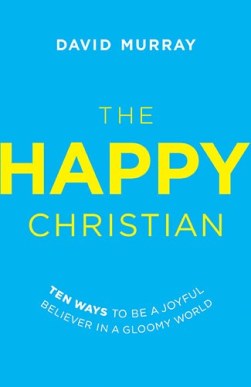
In The Happy Christian Murray makes the revolutionary claim that Christians should be the most joyful people on earth. Who would have thought! I mean it seems pretty obvious right? But most Christians don’t actually live joyfully like that. Here is what Murray has to say about Christian happiness:

Christian happiness is so large, so multi-layered, so multidimensional, that its virtually impossible to define in one sentence. But let me try: Christian happiness is a God, centered, God glorying, God given sense of God’s love that is produced by right relationship to God in Christ and that produces loving service of God and others. (xix)

Murray certainly isn’t repacking a health, wealth, and prosperity gospel. Nor is he advocating for the power of positive thinking – he is returning to the core conviction that Christians should be the most joyful and happy people on earth simply because we know God.

Murray begins with three very simple things we need to get right if we are going to be happy:

Facts + Thoughts + Feelings

Prioritize the facts – what is actually true? Interpret the facts! Use the facts do dictate your thoughts and feelings. If every believer simply did this they would live much happier lives.

After establishing this basic foundation Murray walks through several areas where we can begin to find joy in our lives…

Find joy in your salvation

Find joy in community

Find joy in common grace

Find joy in praise

Find joy in serving

Find joy in work

Find joy in diversity

As Christians we have many reasons to be joyful!

Sidenote: My favorite part of the book was the chapter on diversity. Murray is brutally honest and transparent with his own failings and sin when it comes to pursuing diversity. He explains how God challenged him in this area and how he came to repentance. Then he paints a beautiful picture of how God intended his bride to be a diverse body representing people from every tribe, tongue, and nation.

Who is book for? Really is for anybody who wants to experience more joy of the Lord in their lives. If that’s you – and you are ready to shed the negativity in your life and exchanged it for the positive power of the gospel then pick up this book when its release in a few weeks.

Until then… I have a copy of the book to give away!

Book Giveaway

To get a free copy do one of the following things and you will be entered to win a copy:

  • Comment below regarding why you want to read this book or how you have recently experienced joy in the Lord.
  • Like this blog post.
  • Re-blog this blog.
  • Like my post on Facebook and/or tell me why you want a copy of the book.
  • Follow me on twitter – @CWoznicki – and tell me why you want this book.

Good luck!

Note: I received a free copy of this book courtesy of the publisher in exchange for an impartial review.