Over the last few weeks I have been answering some common questions about Christianity and Culture. Today I turn my attention to the other subject one is never supposed to talk about in a proper setting. Thankfully this isn’t a proper setting – so lets talk politics!
How does Christian allegiance intersect with national allegiance? Does national allegiance pose a challenge to Christian values in any way?
In Christ and Culture Revisited (a book that I have mentioned several times in the last few weeks), D.A. Carson succinctly articulates his position when he says that
The texts (i.e. the Scriptures) encourage good citizenship within the Empire while insisting on the Christian’s primary allegiance to a heavenly citizenship. The proclamation of the gospel transforms people….sooner or later such transformation will either improve the state or excite its opposition. (172)
I wholeheartedly agree with Carson’s position.
Throughout the Bible, especially in the New Testament (and also in the exilic period) there is definitely a sense that one is to submit to the authorities that God has placed above oneself. In the modern day this can range from teachers, to police officers, to the federal government. However, it is also clear from the Bible that one’s primary allegiance is to God himself, anything else would be idolatry.
The Bible is clear that one’s primary allegiance is to God alone, anything else would be idolatry.
Usually this is not a problem, the government (at least in the United States) does not usually legislate in such a way that Christians are forced to choose to act in a Christian manner or in an American manner. However when such legislation does occur, Christians have the responsibility of refusing to bow the knee before anyone other than God. It is in these situations that Christians must express the fact that their allegiance is not towards America but to God. One such situation that immediately comes to mind is immigration. The immigration debate is often framed in light of what is best for America, but as a Christian who believes that my allegiance is to God and his purposes before it is to America and its purposes there are situations where I will have to deviate from American foreign policy. This deviation from American policy will likely be unpopular in the eyes of those (even Christians) who think in terms of what is “best” for the United States. It might even incite opposition from these people, but that is to be expected. In my opinion, this is an issue of idolatry. Who or what is worship directed to? Is it to God or is it to our state?
Some questions for you to chew on (courtesy of an anonymous friend at Church):
In the lives of Daniel and his friends, we see that they clearly obeyed the laws of the land in almost every circumstance, despite the fact that Babylon was clearly their enemy…
Are there any laws you find yourself being tempted to disregard? If so, why?
How does it detract from our witness when we are not living in submission to authorities?
As Christ followers, our sole allegiance is to God, and there is a limit to our submission to our country.
Keeping in mind the examples of Daniel, Shadrach, Meshach, and Abednago, what are 2 or 3 examples of when we should stand against our own government?
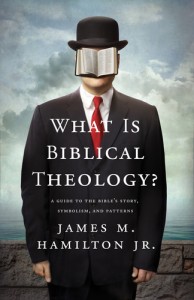
We all live inside of a story. No this isn’t a Stranger than Fiction or Truman Show kind of statement; I mean that all of us (whether consciously or unconsciously) have a bigger picture story (a narrative) that shapes our lives. Some people live according to a story written by a guy named Charles Darwin – other live according to a story written by advertising firms – others live stories written by their local community’s traditions. All of these stories have a hint of truth to them yet none of them are the real story. There is only one real story – it’s the story told in the Scriptures. James Hamilton Jr.’s book What is Biblical Theology? A Guide to the Bible’s Story, Symbolism, and Patterns helps us understand that story.
Overview
Hamilton’s book is broken up into three parts:
The Bible’s big story
How the biblical authors use symbols to summarize and interpret the story
What the Church’s role is in that story
The three parts of this book can be put into three words: “story, symbol, and church.” (22) Each section is quite short (the whole book is only a little over 100 pages) yet its packed with great information. Hamilton frames the Bible’s big story around the concepts of salvation, judgment, and God’s glory. He shows how the biblical authors use people like David and Moses as well as symbols like floods, lambs, trees, temples, and exile to get the story moving forward and to help the reader make sense of prior parts in the story. Yet these elements ultimately point forward to the climax of the story – the life, death, and resurrection of Jesus Christ. The church today fits into that big story and lives in light of the climax of the story. Knowing the story well and being able to articulate it helps us to see where we are at and it gives our lives and tasks a meaning that is much bigger than ourselves.
What I Liked
A nuanced understanding of biblical theology – He says that BT is the “interpretive perspective reflected in the way the biblical authors have presented their understanding of earlier Scripture, redemptive history, and the events they are describing, recounting, celebrating, or addressing…” (16) I really like this definition, primarily because it maintains the unity of scripture while leaving room for diversity between authors.
A thoughtful explanation of what is going on in Typology – I like the fact that he points out the fact that the biblical authors are consciously using types. This (in my opinion) can be used to parlay detractors of typology who claim that typology is irresponsible and a form of eisgesis. He says that “later biblical authors notice patters and similarities between earlier characters, with the result that the later authors highlighted similar patterns and characteristics in their own material.”
It is a practical and encouraging book – It gets really practical in the last section of the book. I wholeheartedly believe that one of the most important tasks of preachers and pastors is to help their flock see that they are a part of a bigger story. Knowing that one is part of the bigger story gives our lives purpose, it teaches us to be selfless, it encourages us to revolve our lives around what God is doing rather than revolving our lives around our own needs and desires. The entire last section is devoted to this very task – placing the church in the grand narrative of scripture.
Recommendation
While I was finishing up the book one of our pastors walked into my office. He asked me what I was thinking about the book. He asked if I was drawing anything from it or whether it was simply a book to pass on to others as a resource. It took me a second to decide whether it was personally enlightening or if its just a book to pass a long to somebody who needs to learn the basics of Biblical Theology. I ended up deciding that there was a lot in here that was personally beneficial. I loved the section on Types – I heavily rely on typology when preaching the Old Testament. Also I will probably use his definitions of typology and biblical theology when teaching at EBC. Yet I see this book as primarily being a resource for people new to Biblical Theology. I would definitely hand this book to upcoming preachers and pastoral interns. Biblical Theology (primarily through N.T. Wright) has shaped so much of my life and ministry, that I wouldn’t want anybody to miss out on the wonders of Biblical Theology.
(Note: I received this book courtesy of Crossway in exchange for an impartial review.)
Political Theology is currently a flourishing field, with even atheists like Slavoj Zizek contributing to the task. This book, Political Theology: Contemporary Challenges and Future Directions, edited by Francis Schussler Fiorenza, Klaus Tanner, and Michael Welker capitalizes on this field’s popularity and seeks to give some direction to the current discussions within Political Theology. The goal of this book was specifically to articulate “an understanding of the future tasks and potential of Political Theology in a local and global context.”
For those of unfamiliar with this field, Political Theology seeks to articulate ways in which theological concepts (explicitly or implicitly) serve as a foundation for all political, social, economic and cultural thought. It isn’t simply a discussion of Church and State, neither is it simply concerned with God’s role in politics. When speaking of Political Theology we must understand that we aren’t doing Theology proper (that is why even atheists can do Political Theology). We might consider Political Theology a sort of Feuerbachian “Theology as Anthropology” or at least carrying that tradition into our day. Johan Baptist Metz makes this anthropological connection in his essay when he points out that his own Political Theology has been shaped by Karl Rahner’s “anthropological turn” of the discourse of God. All this to say, in this book we are dealing with a political “theology as anthropology.”
This short book (only 86 dense pages long) consists of six essays, all birthed out of a Political Theology conference at the University of Heidelberg in 2010. Jurgen Moltmann makes the first contribution – he highlights the fact that all theologies are political and gives us a brief tour of several forms of Political Theology. Johan Baptist Metz writes an essay contrasting his own Political Theology with the theology of Carl Schmitt. He advocates for a theology which is even more grounded in current contexts as opposed to a metaphysical timeless Political Theology. Elisabeth Schussler Fiorenza adds her typical feminist take to this discussion. She argues that Political Theology needs more feminist analysis. Her husband contributes an essay as well – he argues that politics in a pluralist context needs Political Theology because religiously shaped discourse contributes something that no other sort of tradition can. Klaus Tanner makes his contribution by examining the Political Theology of Pope Benedict XVI. Michael Welker concludes this collection of essays by contrasting the Political Theology of Habermas and Ratzinger. He argues that Political Theology needs to draw more from the social sciences, and that it could take its cue from the philosophy of Habermas.
Overall this book highlights three themes: 1) The future of Political Theology needs to understand the contextual nature of social relations, 2) Political Theology requires a higher degree of interaction with the social sciences, and 3) Political Theology must embrace multicontextual and pluralistic environments (XII-XIV).
Analysis
The two essays that I found most helpful were Motmann’s and Francis Schussler Fiorenza’s essays. Moltmann made a strong case that there is no such thing as a-political theology. He presents the reader with a strong overview of how his thesis plays out in various context (Latin America, places undergoing ecological crises, and other global contexts). He also makes a good point that one cannot have Liberation theology in non-Christian contexts since Liberation and justice comes in the name of Jesus Christ. Francis Schussler Fiorenza’s essay was also very helpful. More than any other essay, this essay explained Carl Schmitt’s Political Theology and provided a helpful contrast with it. He makes the case that much of American political theology has been shaped by Schmitt’s ideas – both liberal and neo-conservatives are full of Schmitt’s ideas. What is needed is a critique of his theology – this critique will involve two deeply Christian concepts, that of Sin and that of Transcendence.
There are plenty of things that I felt like critiquing as I was reading this book, but I am going to restrain myself from focusing too much on any one essay – rather I will explain one issue that I have with Political Theology in its entirety. The one problem that I had with political theology is that it really doesn’t seem to be “Political Theology” it really seems to be “Political Anthropology.” God actually plays a very small role in most of these theologian’s theology (except for Moltmann and Fiorenza’s). As I mentioned in my summary above, Political Theology is a sort of Feuerbachian “Theology as Anthropology.” Metz (it seems to me) would wholeheartedly agree. This is a shame because I had thought that Theology had moved past its Feuerbachian stage. I though that Barth had exposed the foolishness of “Liberal” theology, yet Political Theology (it seems to me) is Feuerbach redivius. Consider the fact that even atheists can do Political Theology – it doesn’t get more Feuerbachian than that!
Do I recommend this book? Yes I do. If you want a taste of what Political Theology is like, and you want a glimpse into it future then this is a great book. Yet to me it seems as though the entire project of Political Theology is built on a foundation of quicksand. Unless Political Theology starts doing a little more “theology” I am probably going to stay away from it unless absolutely necessary.
(Note: I received this book courtesy of NetGalley and WJK in exchange for an objective review.)
Everything is awesome! If the song is not stuck in your head after seeing Lego Movie then you probably watched it on mute and in closed captioning. Seriously though, the song plays over and over and over again – until you start believing that everything really is awesome. It’s a really clever trick though, play a song with a very simple message that reinforces the main message of the movie.
Everything is awesome – Everybody is awesome!
It’s a really simple message if you think about it. Everybody, even normal people have the capability to radically affect the world. However the key to actually affecting the world around us is “believing” (as a stupid cat poster once told us) that we really are awesome.
Name it and claim it! I am awesome! I can do awesome things!
I’m not going to pooh-pooh the movie though. I loved it, the humor was sophisticated – the “honey where is my pants” tv show was genius. The jokes about $30 cups of coffee, Lego cars stuck in traffic, popular songs, etc. are brilliant social commentary – kids won’t get it but who cares, this movie isn’t just for kids! And then to top it off (another spoiler alert) Will Ferrell showed up! Yes I loved it!
The movie was also filled with some great messages: creativity as opposed to conformity for the sake of conformity is something to be valued, working together as a team is better than working as an individual, we shouldn’t overlook “normal” people because “normal” people are often at the root of social change. I loved these messages. There is plenty of fodder for sermon illustrations in this movie, there were also plenty of clips that I would love to show in a sermon too!
Of course I had some issues with the movie. Maybe its me being too philosophical, but I noticed a lot of existential themes running through the film. Not that this is a bad thing (necessarily) but children are so easily swayed and indoctrinated that I am not sure I want them to draw from this movie in order to form their worldview.
(Sidenote: It goes without saying, but we need to be careful what we teach our children. We Christians are so quick to jump on objectionable material – sex, cussing, violence – and are willing to accept anything as long as it doesn’t have those three sinful things as a part of it. For instance, I know many Christians object to things like Harry Potter, yet they have no qualm with The Secret Garden because the secret Garden doesn’t contain evil things like witchcraft. Yet the Secret Garden espouses a pantheistic worldview; why don’t Christians ban stuff like that?)
There was another kids movie released recently that was chock full of existentialist messages. That movie was so over the top with existentialism that it was laughable. The Lego movie isn’t that blatantly existentialist, yet its still there. For instance – Vitruvius makes up the prophecy, yet if one chooses to live by the prophecy then the prophecy is true. This is basically the existentialist position on religion, there is no metaphysical backing for religion, yet if one chooses to live as though it were true, then that makes it meaningful and hence true. Then, and this is way more subtle, Emmet has to stare into the abyss before he can make the leap of faith…. Okay Kierkegaard!
Now onto the “Anabaptist” part of this review; I am no Anabaptist, I am reformed, yet I find something strangely attractive about Anabaptist political theology… So let may lay down some Anabaptist foundations before we examine The Lego movie,.
Howard Yoder distinguishes between three different forms of church: 1) activist, 2) conversionist, and 3) confessing. The Activist church’s primary concern is the building of a better society. The Conversionist church’s primary concern is inward change. Its primary concern is the individual soul, it isn’t concerned with social change or social ethics. The Confessing church however rejects the individualism of conversions and the secularism of the activists (as Yoder would say), its concern is primarily to be a faithful witness to Christ. For this reason the confessing church sees itself as an alternative polis. According to Stanley Hauerwas, the confessing church “knows that its most credible form of witness (and the most effective thing it can do for the world) is the actual creation of a living breathing community of faith.
Bare with me! We are getting to the Lego part!
The primary symbol of the confessing church is the cross. Hauerwas says that “the cross is not a sign of the church’s quiet, suffering submission to the powers that be, but rather the church’s revolutionary participation in the victory of Christ over those powers. Anabaptists call this “revolutionary subordination.”
The Anabaptist position of “revolutionary subordination” is the position of taking a similar stance towards the world as Jesus did on the cross. On the cross the powers and authorities used their power for evil, Jesus “revolutionary subordination” is Jesus commitment not to play according to the power games of the powers and principalities. Rather than fight back, or try to convince them of his innocence, Jesus willingly takes on the cross and in turn shows them their weakness and lack of power.
Revolutionary subordination suggests that one need not play according to the rules of the “power game” with the oppressive powers and principalities. It suggests that one ought not “play” according to their rules and their ways, rather one should let them “defeat” us because in our defeat they will be shown impotent.
Now on to the Lego Movie!
Think back to Lord Business’ goal in life; he wants everything to be perfect. He wants perfect towns, perfect workers, perfect models, etc. He wants awesomeness to rule the world! Now think of the Master Builders. How do the Master builders want to defeat Lord Business? They want to build the perfect model, they want the perfect spaceship, they want the perfect plan. They want something that is awesome.
Everybody’s world revolves around perfection/awesomeness – even though they (Lord Business and the Master Builders) are on the opposite team, they are playing the same game.
It’s the game that says “only some things are awesome – and we know what those things are.” Enter Emmet – the guy who doesn’t look so awesome on the outside (or on the inside for that matter). Here is a guy who doesn’t know how to play the perfection/awesomeness game. He is normal, he has nothing to offer. His plans aren’t awesome. The things he builds aren’t awesome. He is as boring and simple as you can get. He is a Lego man who cannot play the “awesome game,” if it were up to everybody else he would be on the sideline watching. Yet in the end, it is Emmet who defeats (of better yet reforms) Lord Business. How does he do that? Emmet refuses to play the awesome game. In a world that says that “some things are awesome” Emmet says “everything is awesome.” Now this is not strictly true, not everything is worthy of awe, yet everything is awesome in the way that Emmet redefines awesome. Emmet defeats the threat by redefining terms and by refusing to play the game that the “powers and principalities” are playing. One might call this an act of revolutionary subordination.
This movie shows us that one does not defeat the threat by playing according to the threat’s rules. One doesn’t need to “play” according to their rules and their ways, rather one should let them “defeat” us. Once they accepted the fact that they weren’t going to build “awesome” (at least by Lord Business and Master Builder’s definition) things, they were capable of disarming the treat that they faced.
All this to say….
The Lego movie is funnier, more complex, more philosophical, and more theological than any animated movie that I have ever seen. Yes there are some messages that I don’t agree with, but this kids movie is so thought provoking, that you cannot help but pass it up. Go watch this movie!
I always find it exciting when my reading for EBC overlaps with things that my wife is learning about. That happened this week as I was reading through George Guthrie’s commentary on Hebrews. As I was studying Hebrews and what Guthrie had to say about Hebrews 5:8-9, I was struck by one of Guthrie’s examples, the one about addicts and recovery…
Hebrews 5:8-9 teaches that Christ learned obedience through what he suffered. And being made perfect, Christ became the source of eternal salvation….
A sloppy reading of this verse results in some big problems…. “What! Christ learned obedience? Was he not obedient before? What! Christ was made perfect? Was he not perfect all along?”
Some people argue that Christ need to share in our moral imperfections, or else how could he represent us as a high priest? My wife was put in an analogous situation this week… You see, my wife works with a alcohol and drug recovery program; this week somebody told her that you can’t help people through recovery unless you yourself are in recovery. She was really struck by this statement because she had never had to go through a recovery process – she has never been an alcoholic or drug addict. As she was sharing this with me I was able to show her that Christ, though being sinless, can still help us, sympathize with us, and represent us as our high priest. He didn’t need to be a sinner to help us (in fact if he were a sinner he would be of no help to us!). My wife doesn’t need to be a recovering addict to help addicts either!
Having read this passage though I can see where the confusion lies. Our understanding of the word “perfect” is tinged with moral perfection rather than a “teleological” sense. In other words, this passage refers more to the concept of “finishing” or being made “complete” rather than “becoming even more morally upright.” In other words, this verse refers to how Jesus finished the course…
This is the same thing we are called to do – we are called to finish the course. Thankfully Jesus helps us persevere and finish strong.
A few days ago I took began to explore the topic of Christ and Culture through Niebuhr’s typology, today I want to keep exploring the topic of Christ and culture by centering the discussion around a few questions:
The Question:
Is one of the roles of the church to impact culture (beyond evangelism)? Why or why not? In what way?
The Long Answer:
Even if you were to take a superficial look at evangelicalism you would see that one major area of conflict revolves around the notion of how much the Church should engage culture. Although there is certainly a conflict, there are certain things that most traditions agree upon. For instance, there is agreement that the Church should not conform to the idolatrous ways of the world. Yet what exactly those idolatrous ways consist of will vary from tradition to tradition. Also, most traditions will agree that God will restore and redeem creation at the eschaton. Disagreements will arise as to when God begins to restore and redeem creation. To sum things up:
Sin is bad, and God will one day fix his creation…
Disagreements tend to arise due to misunderstandings over one another other’s beliefs. For instance Stanely Hauerwas and Will Willimon end up advocating for Yoderian position of the confessing church, the visible church being an alternative polis, that is being something that the world is not and can never be (46). According to the two of them, the Church’s influence lies in it being “church” rather than actively trying to influence the world. This position is incompatible with somebody like Niebuhr’s position, exemplified by F.D. Maurice. Niebuhr and Maurice hold to a view in which the Church can effectively make the world a “better place.” I think that the disagreement between these two positions lies in the lack of bringing in the Big Biblical Story (the meta-narrative of scripture) to influence our view of church and culture.
If we take seriously the meta-narrative, as some authors like D.A. Carson does (see Christ and Culture revisited), we arrive at a position which sees that the prideful position that “people of the Church itself can change the world” (in agreement with Niebuhr and contrary to the Anabaptist position), is wrong and misguided. Yet, the church is still called to love the world because God loves the world, this love for the world will necessarily influence the world and seek to help the people of the world. For instance, the people of the church will help to alleviate the problem of the lack of clean water in Uganda (or lack of resources in LAUSD schools), not because the Church believes that it can solve the problem (the meta-narrative says that certain issues like this cannot be solved before the eschaton) but because the church loves the people of the world.
So the church can seek transformation, yet it must realize that complete transformation cannot be attained this side of the eschaton.
This is going to be a busy season for me, In early March I will be presenting a paper on Jonathan Edwards and Latino Theology out at Southwestern Baptist Theological Seminary, then in the middle of March I am going to Liberia to help make prescription glasses for people in rural areas in addition to leading some trainings for pastors and leaders in a church planting network, then I will wrap up the busy season by presenting a paper on Jonathan Edwards and intra-Trinitarian violence at ETS Farwest in Pasadena on April 11th. Here is the abstract for that paper:
“The Son in the Hands of a Violent God?”
Assessing Trinitarian Violence in Jonathan Edwards’s Covenant of Redemption
Christopher G. Woznicki
Eternity Bible College
Due to his hellfire and brimstone sermon “Sinners in the Hands of an Angry God” Jonathan Edwards has gained a reputation for portraying God as angry and violent. Although in recent literature most accusations of divine violence have been leveled against penal substitution, these accusations could also be made against what Edwards calls “The Covenant of Redemption.” In this paper I intend to examine these accusations and answer the question: “Is the Covenant of Redemption in Jonathan Edwards’s Trinitarian theology a form of violence by the Father against the Son?” I argue that the Covenant of Redemption does not meet the necessary and sufficient conditions for a violent act, thus accusations of divine violence cannot be leveled against Edwards’ conception of the Covenant of Redemption.
Beginning by setting out the necessary and sufficient conditions for a violent act, namely coercion and harm, this paper turns to Edwards’s primary treatise on the Trinity and the Covenant of Redemption: “Observations Concerning the Scripture Economy of the Trinity and the Covenant of Redemption.” By examining Edwards’s understanding of 1) the ontological relations between the persons of the Trinity, 2) the economy of the immanent Trinity, and 3) the economy of the Trinity in the Covenant of Redemption it becomes clear that this covenant does not meet the necessary and sufficient conditions for violence. Thus Edwards is not guilty of placing the son in the hands of a violent God.
“Jonathan Edwards.” White pine tinted with oils by C. Keith Wilbur
Matt Emerson has drawn my attention to this informal poll taken over at “The Center for Pastoral Theologians.” What do you think about this list? Are there any important names missing? (I would add John Webster, T. F. Torrance, and Oliver Crisp.) Are there any names on this list that should be there? I would love to hear what you think!
Over at the Center for Pastoral Theologians site (which I highly recommend), they’ve compiled a list of the top 60 evangelical theologians over the last half century. The list came from reader votes, and so doesn’t necessarily reflect the opinions or the site’s authors. Additionally, the names are listed alphabetically, not by influence or priority. As some have already observed, there is a distinct male, Anglo tint to the names. One might also quibble with the “evangelical” moniker for a few of those mentioned. I’ve reproduced the list below.
In doing some reading today I cam across a brilliant passage by N.T. Wright about why belief in resurrection matters…
How does believing in the future resurrection lead to getting on with the work in the present? Quite straightforwardly. The point of the resurrection, as Paul has been arguing throughout the letter is that the present bodily life is not valueless just because it will die. God will raise it to new life. What you do with your body in the present matters because God has a great future in store for it. And if this applies to ethics, as in 1 Corinthians 6, it certainly applies to the various vocations to which God’s people are called. What you do in the present – by painting, preaching, singing, sewing, praying, teaching, building hospitals, digging wells, campaigning for justice, writing poems, caring for the needy, loving your neighbor as yourself – will last into God’s future. These activities are not simply ways of making the present life a little less beastly, a little more bearable, until the day when we leave it behind all together (as the hymn so mistakenly puts it, “until that day when all the blest to endless rest are called away”). They are part of what we may call building for God’s kingdom. (Surprised by Hope, 193)
Every act of love, gratitude, and kindness; every work of art or music inspired by the love of God and delight in the beauty of his creation; every minute spent teaching a severely handicapped child to read or to walk; every act of care and nurture, of comport and support, for one’s fellow human beings and for that matter one’s fellow nonhuman creatures; and of course every prayer, all Spirit-led teaching, every deed that spreads the gospel, builds up the church, embraces holiness rather than corruption, and makes the name of Jesus honored in the world – all of this will find its way through the resurrecting power of God, into the new creation that God will one day make. (SbH, 208)
and then there is this quote…
People who believe in the resurrection, in God making a whole new world in which everything will be set right at last, are unstoppably motivated to work for that new world in the present. (SbH 214)
Let me be honest with you…. It has been a while since I have been as excited about a book as I am for this one. I read a lot of books, and I write reviews for many of them. Most of the books are really good too, but they aren’t books that I am PUMPED for, yet I am absolutely pumped for this one. This book is just overflowing with possibilities….
Summary
In Christian Faith in the Old Testament, Gareth Lee Cockerill helps “ordinary, intelligent, modern Christians” rediscover the Old Testament – the Bible of the Apostles. First he helps readers understand how each part of the OT fits into the big story of the gospel. Second he gives the reader some hermeneutical tools which will be useful when investigating the OT on one’s own time. There are three hermeneutical tools which he employs – Example, Picture, Pattern.
Example – How OT characters serve as an example guiding us by teaching us what to imitate and what to avoid.
Picture (Typology) – How some of God’s actions and/or people in redemptive history foreshadow a greater and final restoration.
Pattern – How certain patterns, either theological patterns or patterns of values, as opposed to specific acts in history guide our lives today.
These three tools alone in the hands of the average layperson will help them make a lot more sense out of the Old Testament, yet Cockerill gives us more! He takes us through primal history, God’s promise of restoration through Genesis 12-50, the beginning of restoration at Sinai, the inauguration of restoration in Canaan, the institutionalization of restoration through David, the anticipation of restoration in the Writings, the experience of anticipating restoration in wisdom literature, the explicit promises of restoration in the Prophets, and finally the accomplishment of restoration in the New Testament.
If there is one theme that ties this entire book together (and the Old Testament together) is the theme of restoration. Everything in the OT points to when restoration will occur through Jesus. Cockerill captures that perfectly!
Pros
It was an easy read – I really didn’t know what to expect. Would this be an in depth study of the redemptive history or would it be a superficial account of how the Old Testament informs the New Testament? I’m glad to say that it was neither. Because it was at once informative but light I could see myself using this book in a church class. At our church we have used another book that helped people taking our Bible Survey class navigate through the Old Testament, I could see us using this book in the future.
It is simple yet hermeneutically sophisticated – there are a lot of hermeneutical moves being made in this book, yet the author is so subtle and clear that the reader might not notice them. For an intro book for lay readers, this is a good thing. For instance, his treatment for Chronicles apart from Kings is a brilliant move. They are two very different sorts of books, Chronicles isn’t history in the same way Kings is history. It would have been way to easy to lump these two together but he doesn’t. Also, and even more importantly, he mentions in passing, that the organization of the canon is a hermeneutical move as well. Its apparent that he takes this into account when interpreting how all of these books fit together. If he were to have taken the Hebrew organization of the cannon Cockerill would have had to shifted the way he told the story of the OT.
It is full of application – Throughout each chapter you will find “application nuggets.” The book isn’t a straight academic text, it isn’t merely descriptive, it actually challenges the reader in where they are with their walk with God.
Cons
Cockerill uses the three hermeneutical principles in the beginning of the book, and they carry out pretty much through the rest of the book. However, one of the principles really drops out – the pattern principle. He uses the example principle and the picture principle a lot but it seems as though the pattern principle is limited to his treatment of the Law. If the pattern principle is an important principle for interpreting the OT, it would probably be more useful when reading other parts of scripture besides the Law. Also, he leans a bit too heavy on the example principle. If the reader is not cautious or is a new Christian she might end up reading the Old Testament as a collection of useful stories for moral living. Obviously this isn’t Cockerill’s intention, yet giving more weight to the example principle than the typological principle might lead do readers doing this sort of thing.
Conclusion
In a world where Christians either ignore the Old Testament because they don’t understand it or see it as being irrelevant, Gareth Lee Cockerill offers a powerful tool for addressing that problem. I very highly recommend this book. Its informative, easy to read, and constantly points to how Christ is what the Old Testament was looking forward to.
(Note: I received this book courtesy of BookLook in exchange for an objective review.)



 CWoznicki Think Out Loud