Some Reflections on PhD Life Before Comps, Plus Some Advice

I just entered the third year of my PhD studies. The last three years have been a time of academic, vocational, and ministerial transition. Since I started the program at Fuller Seminary the focus of my studies has not changed significantly. I am still doing research on the same kinds of topics: atonement, Jonathan Edwards, and T.F. Torrance. The dissertation topic I proposed when I applied to the program has also mostly stayed the same. I still plan on studying the relationship between Torrance’s doctrine of atonement and his theological anthropology. Besides the fact that these elements of my academic studies haven’t changed much, there are a couple areas that have seen development.

My academic interests haven’t changed much from when I started the PhD, but yours might. I hear that is super normal!

The last two years I spent as a part of the Analytic Theology project have been formative in several ways. One of the most important ways that it has been formative has been in terms of my academic and professional development. The writing groups and reading groups that were a part of the project were especially significant. The opportunity to be with the team during these times sharped my theological-philosophical thinking and improved my writing. As a result of these groups, I was able to publish several articles and chapters.

If you can gather a community of friends who you can exchange ideas in this way. Do it! It has been so key to my development as a student-scholar.

The weekly seminars were also helpful for my professional development, as I was able to meet and develop friendships with a number of our guest speakers. These friendships have led to other theological-philosophical, professional opportunities.

This might seem obvious, but you should be interested in people for who they are and not what they can do for you. People can sense when you are only interested in “networking” because of what you think they can offer you. I’ve been to conferences where people have immediately cut out of conversations with me when they find out I’m just a PhD student. Don’t be that guy.

The Analytic Theology project has also been formative in regards to the direction of my academic research. When I began my studies, I did not have much of an academic interest in petitionary prayer, but as a result of the first year of the project and some other circumstances, this became a new field of study I started to engage with.

You would be surprised to known how many “research interests” you actually have. And you wouldn’t know about them unless you dive into the deep end with them!

Additionally, the AT project help solidify a number of research projects I am pursuing, i.e. atonement and theological anthropology. As a result of the project, I feel as though I am walking away from these last two years as a better thinker, writer, and theologian. I also feel as though I have a better grasp on the nature of the projects I want to engage with in the future.

Besides my academic formation these last two years have been instrumental in my vocational formation.

If you are chugging your way along your PhD and haven’t stopped to consider issues of “vocation” then you are doing something wrong. Starting a PhD isn’t just a career move, it’s a matter of vocation.

For some time now, I have been aware that my vocation involves the task of equipping God’s people for the sake of mission. The process of vocational formation led by the VF Office has helped sharpen my sense of my calling. As I reflect on what my calling is a few images come to mind. Images of a sports team equipment manager or a person who stocks and distributes equipment from a military armory comes to mind. Both roles equip people to do their given task.

The Vocational Formation Team at Fuller has encouraged us to use metaphors or to employ images to help articulate our sense of vocation. I think this is good advice.

Furthermore, a specific phrase comes to my mind: “bringing out of storehouses.” As I reflect upon this phrase the verse that is connected to it is Matthew 13.52: “He said to them, ‘therefore every teacher of the law who has become a disciple in the Kingdom of heaven is like the owner of a house who brings out of his storeroom new treasures as well as old.” This is the passage which I believe defines my vocation in this season. My role as a disciple in the kingdom is two-fold: First, to be the kind of person who turns the church’s attention back to the past for the sake of addressing new situations that confront the church. Second, to be the kind of person who deploys new arguments and ways of thinking in order to defend the coherence of the Christian tradition. This sense of vocation has shaped a number of recent writing projects I have worked on.

This sense of vocation is one reason why I’m so interested in Edwards and Reformation studies.

In regards to my ministerial formation these last several years have also been a time of transition. Due to the demands of my studies I went from overseeing the college ministry at my church to working in it in a support role. Eventually I transitioned out of a staff role in the ministry to a volunteer role. My role allows me to preach and teach on a quarterly basis. It also allows me to teach some adult education courses at church.The main transition, however, has been to serving with a ministry called Young Life. This new ministry opportunity presents some challenges and opportunities. These challenges and opportunities are birthed out of the fact that this ministry primarily engages the non-churched and that it primarily consists of an urban and multi-ethnic demographic.

You can’t serve The Church with your PhD if you remove yourself from the local church. If you are earning your PhD with no intention of serving The Church, then… well then, just go home. Okay?

As I move out of the coursework stage of the program into the dissertation writing stage, I anticipate that the developments listed above will play a key role in how I engage with the program. I will continue to do research and I will continue to sharpen my sense of vocation. This latter area of growth will be especially important as I begin to look towards my future career in education. Finally, I will continue to reflect on how my academic training fits in with the roles that I have with various ministries.

After you finish stage one of your PhD work it’s a good idea to step back and reflect on what has transpired in the last couple of years and to look forward to what God might have in store for your future.



Can Legal Philosophy Help Us Make Sense of Penal Substitution? (TGC Canada)

“Penal substitution is more than unjust, it is by definition impossible!”

This line of thought represents an important objection leveled against penal substitutionary atonement (PSA) by some philosophers of religion. The key to this objection lies in a widely held definition of punishment. According to a number of philosophers of law, like Joel Feinberg and Mark Murphy, punishment has four necessary conditions:

  1. Punishment is hard treatment.
  2. Punishment is imposed by an authority who may legitimately impose hard treatment.
  3. Punishment is for a failure to conform to some standard.
  4. Punishment expresses condemnation of the wrongdoer.[1]

These objectors to PSA home in on the fourth condition, arguing that an authority figure cannot truly express condemnation of someone who has done nothing wrong, therefore punishment cannot be transferred. This objection is problematic for believers in PSA because, by definition, PSA is the transferring of our rightly deserved punishment onto Christ who is perfectly righteous. Let’s call this the expressivist objection.

You can read the rest of this article over at Gospel Coalition – Canada

Domestic Violence, Refugees, and the Imago Dei in John Calvin’s Pastoral Theology

How did John Calvin deal with a massive influx of refugees and cases of domestic violence and maintain pastoral faithfulness? Jesse Gentile and I explore these questions in a new essay titled, “Refocusing the Image: Domestic Violence, Refugees, and the Imago Dei in John Calvin’s Pastoral Theology.”

You can find the essay in the latest issue of the McMaster Journal of Theology and Ministry:

Click to access 19.MJTM.81-111-Woznicki.pdf

Objectivity is Not Neutrality

I came across a paragraph in Thomas Haskell’s Objectivity is Not Neutrality that I think bears on so much more than merely historical studies. The concept that objectivity is not neutrality can and should apply to may matters of judgement:

What I champion under the rubric “objectivity” is not neutrality or passionlessness but that “vital minimum of ascetic self-discipline that enables a person to do such things as abandon wishful thinking, assimilate bad news, and discard pleasing interpretations that cannot pass elementary tests of evidence and logic.” Most important, objectivity requires the ability to “suspend or bracket one’s own perceptions long enough to enter sympathetically into the alien and possibly repugnant perspectives of rival thinkers.” These mental acts require a degree of detachment, an ability to achieve some distance from one’s own spontaneous perceptions and convictions. But they do not require indifference. (Haskell, 60)

Wise words that we would do well to listen to.

Call for Applications – “ON HUMAN NATURES: PSYCHOLOGICAL SCIENCE IN THE SERVICE OF THEOLOGY”

As you may know, I was part of a grant Fuller received to to Analytic Theology. That grant has come to an end, but an exciting new one is about to start up. It is called “On Human Natures: Psychological Science in the Service of Theology.”

Here is the low-down:

We will hold three 13-day seminars strategically targeting early to mid-career
theologians. Our goal is to enhance research and teaching by engaging deeply with
the psychological sciences. We will create cohorts of 20 scholars per seminar. We
will limit capacity at 20 to intentionally invest in each scholar, facilitate in-depth
discussions led by leaders and speakers, and accelerate the creation of a unified
group of scholars with common interests in using psychology to benefit theological
research.

In response to the program each participant will be expected to write a paper
suitable for publication, and will be encouraged to prepare and deliver a
presentation in the year following the seminar.

The three seminars will address the following topics:

  1. The Created and Fallen Image of God
  2. Completely Human, Completely Divine
  3. Restoring Human Nature

If you are interested, you can learn more here:

https://www.fuller.edu/wp-content/uploads/2018/08/Psychology-for-Theology-Seminar-Accouncement-.pdf 

Philosophical Foundations for a Christian Worldview – GIVEAWAY WINNER

Not too long ago I ran a giveaway of J.P. Moreland and William Lane Craig’s 2nd edition of Philosophical Foundations for a Christian Worldview.

5187

I’m happy to announce that the winner is @adivanceaUS who won via twitter! Congratulations. Please contact me through twitter to claim your prize.

Jonathan Edwards on Penal Substitution

Penal substitutionary atonement, the doctrine according to which Christ died to pay the penalty for our sins, is crucial to good news of the gospel. It is so central to the good news that Christians around the world proclaim it weekly by singing hymns like Stuart Townend and Keith Getty’s “In Christ Alone My Hope is Found.” The lyrics declare,

In Christ alone, who took on flesh,
Fullness of God in helpless babe!
This gift of love and righteousness,
Scorned by the ones He came to save.
‘Til on that cross as Jesus died,
The wrath of God was satisfied
For ev’ry sin on Him was laid
Here in the death of Christ I live.

For many, hymns like this inspire greater love towards God for Christ’s tremendous sacrifice on our behalf. I have personally seen Christ followers in Uganda, Liberia, Guatemala, and here at home brought to tears singing of Christ’s death for them. But for others such declarations do not inspire love, rather, they generate objections….

You can read the rest of this essay at the Gospel Coalition – Canada website.

My Most Significant Publication Yet…

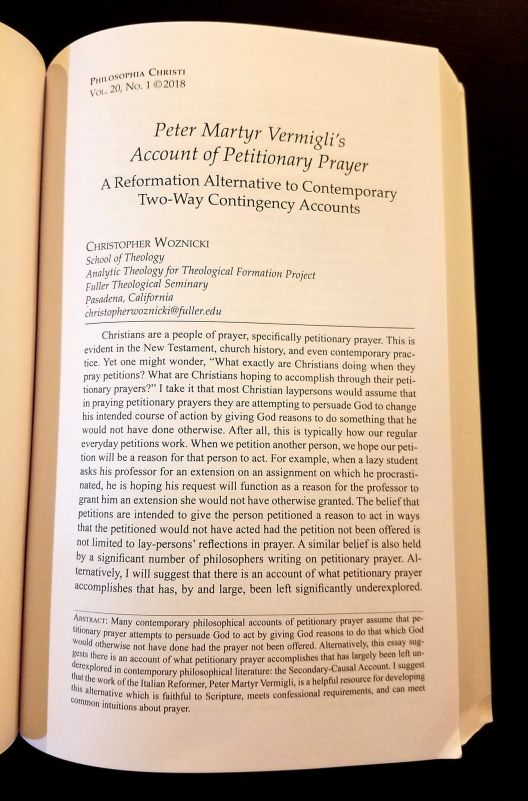
I received a copy of Philosophia Christi (The journal of the Evangelical Philosophical Society) in the mail today. It contains my article, “Peter Martyr Vermigli’s Account of Petitionary Prayer.” As wierd as it sounds this is the most personally significant essay I have ever published….

The year was 2007 and I was sitting in my pastor’s car (Neil Johnson’s black Expedition) telling him how my life was sort of falling apart. I had been a +4.0 student and had been accepted into UCLA. Now one year in I was facing academic probation. In the midst of that I found philosophy and fell in love with it. He told me about how some professors at Biola had a goal of raising up 100 christian philosophers and placing them in secular grad schools. Never in my life had I heard of Christian philosophers. That’s when I decided I wanted to do philosophy but as a Christian. The next 10 or so years took me on a different path. I didn’t end up doing philosophy but I still loved it and hoped that one day I could get back to doing it. Little did I know that around that time a little thing called Analytic Theology was starting to form. I would end up falling into the world of AT (as we call it) and because of that I have had the opportunity to dive back into philosophical things. Although I am by no means a philosopher, publishing in a philosophy journal for the first time marks the fulfillment of that goal I set back in 2007.


39999730_10108540469422636_7530690868194312192_o


Here is an abstract of the essay:

Many contemporary philosophical accounts of petitionary prayer assume that petitionary prayers attempt to persuade God to act by giving God reasons to do that which God would otherwise not have done had the prayer not been offered. Alternatively, this essay suggests there is an account of what petitionary prayer accomplishes that has largely been left underexplored in contemporary philosophical literature: The Secondary-Causal Account. I suggest that the work of the Italian Reformer, Peter Martyr Vermigli, is a helpful resource for developing this alternative which is faithful to Scripture, meets confessional requirements, and can meet common intuitions about prayer.

The Lord is Good (Review)

Christopher Holmes’ book, The Lord is Good: Seeking the God of the Psalter, is a unique book in that Holmes attempts to defend the doctrine of divine simplicity by engaging with the Psalms and the history of their interpretation. Among the people Holmes engages with, Aquinas gets most of the attention.

Although this book is great for a number of reasons, this book is highly significant for one particular reason: how it can be used to address critiques of divine simplicity.

Last year James Dolezal published a book titled, All That is in God in which he argued for the classical doctrine of divine simplicity. One author defines simplicity like this:

The simplicity of God means God is not made up of his attributes. He does not consist of goodness, mercy, justice, and power. He is goodness, mercy, justice, and power. Every attribute of God is identical with his essence, which also means that although the attributes of God are revealed to us as varied, they are (on the God-side of knowing) identical with one another.

Despite simplicity’s established place in traditional theology, a number of bloggers/theologians came after Dolezal’s book on the grounds that such doctrine is unbliblical. John Frame is representative of such critiques:

But until a better way appears (perhaps in the new Heavens and new Earth) I intend to follow the biblical depictions of the Father, Son, and Spirit as a holy family, both in Heaven and on Earth, analogous to (though certainly not identical with) our earthly families, with a unity far beyond what any society of human beings is capable of.

Holmes, in my opinion, does a fine job of showing that “Simplicity is an extrabiblical term [like Trinity]… that says something true about who God is.” (17) Moreover, it is a concept that “honors biblical patterns of speech.” This is because “The Scriptures ascribe many attributes to God, and teaching on simplicity enables us to see how the many attributes of God are wone with himself.” (11)

Aside from the academic significance of this book I want to share about the book’s personal significance to me. You see, when I read this book I was at sitting on an inlet in British Columbia. I was there serving at a Young Life Camp called Malibu.

35617778_1980285408953860_7208701589534539776_n
Students make their way to camp

Very few “academic” books lead me to the sort of moments of awe I experienced while reading The Lord is Good (T.F. Torrance’s books are an exception). But I had a genuine moment of feeling in awe of God and his goodness while I was reading. At times the way Holmes brought Aquinas in to talk about God’s goodness literally almost brought me to tears. There was one particular section of the book that not only had me yearning for the day when the knowledge of God covers the earth as the waters cover the seas but also had me thinking about the ministry I was doing at camp.

38236177_259476654873806_5529783634984173568_n
The lighthouse off the coast of Malibu Camp

Holmes writes,

The Psalmist looks forward to the day when the praise he offers “from you in the great congregation shall extend to the ends of the earth.” [Psalm 22:25-28] Indeed, “the ends of the earth shall remember and turn to the Lord; and all the families of the nations shall worship before him.” The key word is remember. What is to be remembered is not something foreign to the earth, summoned as it is to remember. What men and women forget “through sin” is what is natural to us, namely a “certain knowledge of God.” Just so, “some knowledge of God” is inserted into all the families of the nations. What the apostles do – Thomas cites Jeremiah as an apostle – is lead us “back to the remembrance of natural knowledge.” They do not lead us back to knowledge that is alien to us but rather to the one whom we have forgotten to worship due to our sin. (101)

As I read that section, I was reflecting on what I was doing at camp. I was taking part in God’s work to lead people back to Jesus. All those who were taking part serving at camp take part in this by pointing the students to Christ and hoping and praying that as we do that it “clicks” – they “remember” who they have been created to be. But some people have a hard time “remembering.” One of the students, during a cabin time stated “I don’t know how to make myself a Christian.” This is highly representative of the way a lot of people talk about faith. But the reality is that such things are not from ourselves, they are from God alone. You can’t make yourself a Christian – only God can do that. Only the Spirit can make us new.

This is exactly what John 3 is about. Nicodemus is basically asking “how do I become a Christian” and Jesus responds by saying you have to be born again. This makes no sense because you can’t make yourself be born again. How do you even start to do that? Its impossible. So, the question is how do you make yourself do something that is impossible? Well Jesus tells him: the only way to be born again is by God’s Spirit. But the Spirit does what he wants! You can’t make the Spirit make you be born again. The Spirit does what he wants. You won’t even know the Spirit is there until BAM! The Spirit strikes and regenerates you.

So what can we do to point people back to knowledge of God? What can I do as a Young Life leader at camp? I pray. That is all I can do. Pray…. Pray that God uses something we do, whether its club, cabin time, hiking, games, basketball, talking over coffee, etc. that awakens that part of them that knows God made them for himself, so that they can see the truth of what, or better yet, who they were made for.


The Brain, the Mind, and the Person Within (Review)

It might just be because of the time I have spent at Fuller Seminary or maybe it’s the work that I have done with Templeton funded projects but, it seems to me, that the intersection of neuroscience and theology is a very rapidly growing field. Given neuroscience is not an easily accessible field, good introductions to the topic are welcome by anyone interested in the brain for theology’s sake. That is what I was expecting to get when I received Mark Cosgrove’s book, The Brain, the Mind, and the Person Within: The Enduring Mystery of the Soul. Now, I’m not going to lie, the subtitle is a bit deceptive. One wouldn’t be faulted for thinking this was going to be a book introducing neuroscience/psychology while making a particular argument about the mind-body problem. That is not what this book does, at all. At the end of the day its hard to tell where Cosgrove lands on the issue of the soul. While he certainly affirms there is a part of us that cannot be reduced to our material parts, this doesn’t say much – especially if you are aware of the numerous positions regarding the existence of the soul.

connectome

If, like me, you can get past the assumption that this book was going to say something about the soul, you will find an interesting and informative introduction to a number of topics related to the brain and personhood. For example, there are chapters on free will, cognitive science of religion, personhood, transhumanism, the hard problem of consciousness, etc. These chapters are full of fascinating case studies. Some of the more fascinating ones include a retelling of Patient HM’s story, brain scans of Buddhists while meditating, the Libet experiment. Each chapter also highlights one contemporary or historical figure that speaks into the topic of each chapter. For example, the chapter on free will introduces readers to John Polkinghorne and the chapter on CSR introduces Augustine.

Overall, this book provides a helpful overview of issues that psychologist and neuroscientists are working on these days. If you are looking for an introduction to these topics that is not too technical then this might be a good place to start. However, if you are looking for a more philosophical/theological introduction to theology and neuroscience I suggest that you look elsewhere.

Note: I received this book from the publisher in exchange for an impartial review.