DiscipleShift – High School & College Coaching

In his book Discipleshift Jim Putman uses a sport illustration to explain two distinct approaches to discipling people. Even though its directed at pastors its true of any ministry position, whether you are a movement leader, lead pastor, small group leader, or apprentice. Check out what he has to say:

“The problem is that church leaders are looking for already-developed leaders. They don’t see the potential in their midst because its not yet visible. In my first book, Church is a Team Sport, I used an analogy of the difference between a high school coach and a college coach. A college coach goes all over the country looking for developed and talented players, then he offers them scholarships to come and play for him. But a high school coach needs to get his players from within his own district… If you want to win at the high school level, you must create a program that develops an athlete from the kids program to the junior high level and finally to the high school level.

Most pastors I know act more like college coaches. They are focused on looking for developed players rather than developing people in their own church because they are too busy playing every position on the team to develop anyone.”

Putnam is saying that there are two distinct approaches to leadership development: 1) Look for the best people and grab them when they are ready to lead and 2) See potential in a person before they have ever led and pour out your life into them. The first calls for little investment and little work. You get quick results and short term success. The second involves a lot of investment and possibly a lot of disappointment when the people you are walking with don’t live up to their potential. Two ways. One easy one hard. Looking at the way Jesus walked with the 12 disciples which one do you think is Jesus approach? I think the answer is pretty clear.

Here are some questions for you to think about:

  • In your own leadership journey which type of development have you experienced? The College Coach approach or the High School Coach approach?
  • In your own community (Life Group or Community Group) who are you developing?
  • Do you have a College Coach approach or High School Coach approach to developing leaders/apprentices?

Discipleshift

Celebrating the Sabbath – 7 New Testament Principles

Its Sunday! Perhaps you have skipped out on church so you could read my highly awaited blog. Maybe you were up all night waiting… waiting ever so patientily for the 7 principles for Sabbath from the New Testament. But you probably weren’t

Today we are doing part 2 of our Sabbath series. This time we will look at 7 principles about Sabbath that emerge from the New Testament which can help us formulate a robust theology of the Sabbath. Again thses principles come out of the work that Aida Beacon Spencer has done for us in her paper Seven Principles for the Seventh Day.

7 Principles

In the Gospels we have 6 different incidents revolving around the Sabbath, wrestling with OT teachings about the Sabbath. As you know Jesus and the Pharisees & Scribes were working with the same texts, but they had varying interpretations. Here are 7 principles that emerge out of Jesus’ teachings:

  1. Have Mercy (Matthew 12:7) – When the pharisees accused Jesus of harvesting on the Sabbath Jesus responds with a story from the Old Testament showing that mercy or steadfast love is the highest of all laws.
  2. Serve (Mark 2:27) –  Jesus says that Sabbath was made for mankind and not vice versa. In other words the goal of the Sabbath was to bless and serve humans. God does this for us so why wouldn’t we do it for others?
  3. Do Good (Luke 6:9) – Healing is never called a work in the Old Testament, but it is in the Mishnah. When confronted about healing Jesus turns the table on the putting them in a bind. They can’t deny the fact that Sabbath is for doing god and giving life.
  4. Liberate (Luke 13:11-16) ­– Only Luke records this incident, liberation is a form of giving rest. Jesus liberates this woman from the bondage of Satan. Thus this healing is an act of liberation.
  5. Heal (Luke 14:3-5) – In this incident the Pharisees are keeping a close eye on Jesus before he even does anything. Here Jesus heals a man and compares it to “emergency work,” if you could help an animal in the case of an emergency why not a human?
  6. God Works (John 5:17) – Healing comes from the Lord. The Lord heals on the Sabbath too… enough said.
  7. Worship Jesus (John 9:4-37) – Jesus highlights the Sabbath as a day of faith, but people put their faith in Jesus when he heals on the Sabbath.  In turn this shows that Jesus is the Lord of the Sabbath.

So this Sunday live knowing that our true rest has been found in Jesus and that because of him we can have mercy, serve, do good, liberate the oppressed, heal the broken, and worship Jesus.

Eucharistic Theology and Ecclesiology

A few weeks ago Fuller seminary’s book store was shutting down and having a 90% off sale. Yes 90% off. I had mixed feelings; I was ecstatic that I could buy books for 90% but I was also sad because another local bookstore was shutting down. There really is somethings special about picking up a book reading a few pages and buying it, as compared to going on a shopping spree on Amazon. Anyway…. One of the dirt cheap books I bought was Eucharist: A Guide for the Perplexed by Ralph McMichael. I looked at it saw the price tag (Originally $25 but now $2.50), thought about the fact that I am utterly confused by Eucharistic theology and decided to splurge and purchase this book.

All the churches that I grew up in were not sacramental (in any sense of the word). The Lord’s Supper (the Eucharist) was simply a memorial. Christ was not present in, on, over, around, under, anywhere near the bread.

Jokingly we might say that in the Lord’s supper we celebrated the Lord’s absence not presence.

Since then I have formed a more robust Zwinglian theology of the Lord’s Supper but admittedly I still don’t have a sacramental mindset. In fact the more I read about the Eucharist the more I realize that Eucharistic or sacramental theology really is another worldview. Its metaphysics are completely different than what most of us are used to….

So I picked up this book to help me understand that foreign worldview. McMichael is the director for the Center for the Eucharist, so its fitting that he would write an introduction on it. Today I want to share with you a section of this book. Although he is referring to the Eucharist I believe that its equally applicable to any form of worship.

“Gathering is the dynamic of the church because it is the dynamic of salvation. Being saved is being gathered in God’s presence and life, participating in God’s life of communion. The church gathers because the church is gathering, and the essential act of this gathering is worship of the gathering God: Father, son, and Holy Spirit. As such, we can speak of four dimension of this gathering as church for the Eucharist: gathering into, gathering with, gathering for, and gathered by. (113)”

McMichael is thinking about gathering to celebrate the Eucharist, but since I don’t have a Eucharistic theology I can’t buy into that claim. Neverthless, I completely agree with him if we simply replace “Eucharist” with “Christ’s Presence through the Holy Spirit.” Let me flesh out what this means for you.

  1. Gathering Into: The fundamental reality of our faith as Christians is that we are united to Christ by the power of the Spirit because of the atoning work of Christ on the Cross. As those who are united to Christ we are brought into the very life of the Trinity. We participate in God’s life. Now when we gather together as a church we gather as a community that is in Christ. We encounter Christ’s presence in worship, in the Word preached, and even in the Lord’s Supper. When we gather as Church we gather together into Christ.
  2. Gathering With: As the assembly we do not gather with Christ alone. We gather together with our brothers and sisters who are also united to Christ. You cannot have church by yourself. A church made up of you and Jesus is not a church. When we gather as the local church we gather with others who also share in the life of the Trinity. But “gathering with” the saints goes beyond the local church. In Christ the invisible church is always gathered because all Christians across time and space are gathered together in Christ. When we gather as Church we gather with our brothers and sisters in Christ.
  3. Gathered For: We do not gather for the sake of ourselves. We gather for the sake of Christ. Christ meets us when we gather. We gather to worship. We worship through music, through the faithful and attentive listening to Christ’s word, and through the grateful partaking of the Lord’s Supper. We gather for worship; but we also gather to encounter Christ. We gather to meet him. The point is we never gather for our own sake. Even when gathering is considered from an anthropocentric lens, we should say that we gather to encounter Christ so that we might be sent out on mission for Christ. We gather for the praise and glory of Jesus.
  4. Gathered by: The Ecclesia is the called out assembly. We are called out by Christ. The lost sheep of Israel were gathered together by the good shepherded. Jesus came to seek and save the lost. You get the point. The church is composed of those who have been called out by God from before the foundations of the earth (yes I am a Reformed). The Church does not create itself. Jesus creates the church by the power of the Spirit. The Spirit takes the gospel, applies it to people’s hearts, regenerates them, and brings them to saving faith. The Church is made up of people who have been called out by God and joined to Christ by God’s own hands. This is how the church comes to be; but at an even more basic level, God also gathers the local church. God calls his people together to meet, he gathers them up into a local body so that they might encounter his presence together, so that they might encourage one another, and so that they might be on mission together. The Church is gathered by God’s power, not by human power.

Jesus: The Church gathers into, with, for, and by Jesus.

The Great Gatsby 2013 – A “Cinematographic” Review

Over the next few days reviews for The Great Gatsby will begin to flood the blogosphere. Many of these blogs will lament the fact that the film has been unfaithful to the novel by the same title (accusations of unfaithfulness abound…especially within the storyline.) I’m tempted to join the bandwagon and decry The Great Gatsby as a being a big budget film that defiled the American classic all for the sake of profit. I’m even tempted to call the film the abomination that causes desolation among literary circles (by the way that’s a Biblical Studies joke), but I won’t.

The Great Gatsby

Instead of critiquing the rendition of this novel onto film, I want to consider the film on its own merits, and draw your attention to what I thought was the film’s greatest flaw and its greatest strength. It just so happens to be that its flaw and its strength is one and the same.

The Great Gatsby’s greatest flaw and strength is its cinematography.

As I was watching the film I couldn’t help but think to myself… “wow the film is visually stunning, but it lacks substance.” As I continued to watch I couldn’t help but feel nauseated (metaphorically and literally) because of what I was seeing.  Yes the lack of morality among the characters is sickening but that isn’t what I am referring to. The film feels clunky. The visuals are excessive. And Jay-Z ruins the score. It almost seemed as though this was an 11th grade English class project. I remember doing on of those; I had to visually represent the novel The Great Gatsby. I made a diorama…and I got an A. When receiving the assignment, there was a list of things we had to do. Make sure it meets these standards, use these techniques, use these materials, blah blah blah. The list of requirements went on and on. It almost felt like busy work. It was excessive. Watching this film reminded me of that English project. Its almost as though someone said to the director, Baz Luhrmann, “Hey here is a list of cinematic techniques. I want you to incorporate all of them into the film.” The result was that all these potentially impressive and rhetorically powerful, techniques lost their gravitas.  They say “more is less” and when it comes to story telling “more is really less.” All this to say that Gatsby’s biggest flaw is its cinematography.

But on the flipside, Gatsby’s biggest strength is also its cinematography. Am I simply contradicting myself? No.

The Great Gastby made great use of lighting, filters, and CGI to create a surreal dreamlike feel which is appropriate because every character is out of touch with reality living out their own deluded dreams.

Tom Buchanan lives out his in his own little hedonistic irresponsible dreamworld, where he doesn’t have to conduct himself according to social mores and ends up hurting Daisy and Nick. Daisy lives in a dreamworld that places romance and passion at the center, she ends up destroying her husband, Gatsby, Nick, and Tom’s mistress (literally). Jay Gatsby also lives in a dreamworld. He believes that life centers around him and his own desires, his love for Daisy isn’t real love. His love for daisy is actually his love for himself. Daisy is a part of his dreamlife and he doesn’t care who he hurts in order to get her. And Nick is the worst of all. Nick holds on to the hope that Jay Gatsby is really a good guy, he holds on to the hope of romance, and he holds on to the hope of living a pleasure filled life. Jay lives in a dreamworld and his moral compass gets reversed. He no longer is able to see the fact that he is complicit in bringing these dreamworlds into reality.  So all of the characters live in a sick twisted dreamworld where all sense of goodness and morality have gone out the window and have been replaced with self-centered egotistical dreams. The audience gets a taste of this dream world when they see the character’s excessively colorful world through a hazy but crisp filter that almost looks “too real to be real.”

I have said that The Great Gatsby’s greatest flaw and strength is its cinematography. I said that I was nauseated by the excess in color, actions, details, and sounds. Perhaps this is a flaw but perhaps it is actually what Luhrman intended. If he indeed intend the audience to feel nauseated because of the excessiveness of the film then he has accomplished his task. But why would Luhrman want to nauseate his audience? What’s the point? I think the point is that: The excessive, clunky, and rushed feel of the film helps the audience feel what they should be feeling when seeing the characters live their twisted lives.

The nauseating nature of the film reflects what the audience should feel about the characters: revulsion.

Yes, that is pretty “meta.” But think about it. Excess in sounds, colors, and visual effects. This is a film of excess. The era is an era of excess. The characters live excessive lives. The cinematography helps create within the audience a feeling of revulsion about the excess the runs throughout the film. If this really is what Luhrman intended to do the Luhrman has pulled it off.

The Great Gatsby Party

Celebrating the Sabbath – 7 Old Testament Principles

Its Sunday! For most of us that means its our Sabbath. It’s the day when we go to church, eat lunch, and be lazy — because that’s the way God intended it. Right? Well not really.

If you do a quick word study on the word “Sabbath” in the Old Testament certain principles emerge which can help us formulate a robust theology of the Sabbath. Thankfully you and I don’t have to do the word study ourselves. Aida Beacon Spencer has done it for us in her paper Seven Principles for the Seventh Day.

This Sunday we will take a look at what she finds in the Old Testament. Next Sunday we will take a look at the New Testament.

  1. Finish Work (Genesis 2:2) – When God works he finishes work. On the 7th day of creation God rests because he has finished his good work.
  2. Rest (Exodus 20:9-11) –  God’s rest becomes a model for all human beings. Hebrews, Gentiles, men women, employers, employees, animals, and even the land are called to rest.
  3. Be Holy (Gen 2:3) – The 7th day is set apart, it is selected or set aside. It is made holy.
  4. Praise (Leviticus 23:2-44) ­– God’s rest isn’t idleness and neither is ours. The OT records the fact that praise and worship occurs on the Sabbath.
  5. Have Faith (Exodus 16:16-30) – While in the wilderness the Hebrews were taught to wait on bread on the 6th day and have faith that it would last two days. Sabbath is about having faith, its about having faith in god to provide for you, you express this faith by being willing to stop working for a day.
  6. Remember the Sign (Exodus 31:13-17) – Godly rest is a testimony or a sign of God’s having made the world in six days. It is also a sign or reminder of the covenant that the Israelites had made with God.
  7. Liberate (Deuteronomy 5:12-15) – The fiftieth-year Sabbath required liberation and offered hope for all. It was also a time for the Hebrews to remember that they were once slaves in Egypt but that they had now been liberated by God.

So this Sunday remember the fact that Christ has finished his saving work of the cross; rest in his finished work. Be Holy because Christ has purchased the Holy Spirit for you. Praise Christ for your salvation. Have faith in the fact that Christ’s work was enough. Remember Christ’s atoning work through the Eucharist. Celebrate the fact that Christ has liberated you from the power of sin, death, and Satan.

DiscipleShift – Making the Shift to a Discipleship Culture

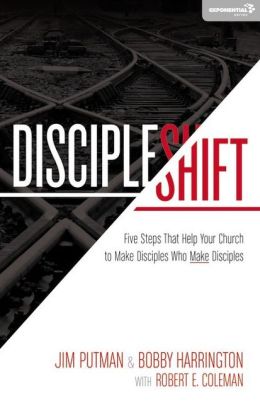
Over the next few days I will be posting some insights that I have gotten from reading DiscipleShift: Five Steps That Help Your Church to Make Disciples Who Make Disciples by Jim Putman & Bobby Harrington w/ Robert Coleman.

Check out what Robert Coleman (author of the classic The Master Plan of Evangelism) has to say about making the shift to a discipleship culture:

What would I say to any pastor or church leader who may be beginning the process of shifting his church to a discipleship model? Keep your heart warm and your vision clear. Everything in this world is passing away, so set your affection on things above. Get your eye on the glory of God. Look to the day when the nations have finally heard the gospel, and the redeemed of the Lord are gathered around the throne to praise the Lamb forever. This is eternal reality. Anything that does not contribute to this destiny is an exercise in futility.

Discipleshift

Some Thoughts on Colossians: Community and the Word of Christ

In this passage Paul tells us to clothe ourselves with compassion, kindness, humility, gentleness, patience and love. At this point you should ask yourself what if we as individuals did this? Then ask yourself what if we as a community put on these virtues and lived in such a way that displayed these things? How attractive would we be to non-Christians? How much would we help one another grow? Paul seems to think that the community would take leaps and bounds in its walk with Jesus if it did these things….

In 3:13-16 Paul tells us how to live in community. These are the kinds of things that a Christian community will do. Then he tells us how we are to get it done. We are to get it done by putting on these virtues. We are to clothe ourselves with these things. We are to put on  compassion, kindness, humility, etc. So how about we do this? How about we try really hard to put these things on? Even if these items of clothing don’t necessarily “fit” lets force them onto ourselves…. Does that sound like a good idea? Of course not! Because if those things are not a part of who you are, if they aren’t a part of your identity, it won’t work! So how is it that we are supposed to put on these things? Paul says that we put these things on as God’s chosen people “holy and dearly loved.” Its only when you find your identity in Christ that you can do these things. When you realize how much God loves you and how holy you are in Christ, then you will walk these things out because our doing flows from our being.

When reading this pass age you could focus on any of the seven things that Paul says that we are to do, but I want to focus on one: Teach and admonish one another with the word of Christ. Think about this for a second… Notice that:

Out of our identity as God’s sons and daughters words of encouragement will flow out to our brothers and sisters.

This verse (3:16) is about encouraging one another with the word of Christ. Naturally the question is “so what is the word of Christ?” The Word of Christ could mean the Word from Christ or Word about Christ. Option 1: Word of Christ = literally his words his teachings. So Paul is saying Encourage one another to stay faithful to his teaching. Option 2: Word about Christ = The gospel stories: Matthew Mark Luke John. These are the words about Christ. Finally Option 3: Word about Christ = The truths of what Christ has done for us/The Gospel. Paul is telling the Colossians to speak all of these things over one another! Speak Christ’s teachings to one another, speak the stories of Jesus over one another, speak the gospel over one another!

As this action becomes a part of our everyday lives in community we will become more and more attractive to the lost. Imagine the possibilities! Consider the following scenario: a non-Christian walks into a small group and is blown away by the fact that people are affirming one’s value and worth in Christ, and showing grace and forgiveness towards one another because of the gospel. I have seen that happen first hand… and whats the result? The non-believer comes back, because this community is so different than the communities they have been a part of in the past. Do we want to be a communities like that? I know I do. And I know that Christ himself wants that for us even more.

This week consider the following things:

  1. Are you as an individual putting on these virtues?
  2. Are you grounding yourself in the word of Christ (i.e. his teachings, the stories of his life, the gospel?)
  3. Who can you speak the word of Christ over this week?

If You Want to Know… Look at Jesus

Check out what N.T. Wright has to say about knowledge:

If you want to know who God is, look at Jesus. If you want to know what it means to be human, look at Jesus. If you want to know what love is, look at Jesus. If you want to know what grief is, look at Jesus. And go on looking until you’re not just a spectator, but you’re actually part of the drama which has him as the central character.

So the point is…If you want to know, look at Jesus!

Ezekiel: Your Idols are Blind! (Pt.3)

Mortal, you are living in the midst of a rebellious house, who have eyes but do not see, who have ears to hear but do not hear for they are a rebellious house. – Ezekiel 12:2-3a

Last time we looked at “The Dimmer Switch Principle” and how our own individual sin/idolatry makes us blind to the light that God gives us today we are going to look at idols in ministry.

Ministry is your idol.

That’s a bold statement (no pun intended). And if you are perfectly honest you will probably resonate with it. C’mon be honest with yourself for a second, has your ministry never become an idol for you? I know it certainly has for me. There are times when I will ignore people for the sake of my ministry (how ironic right?) There are times when I will be studying or doing sermon preparation at Starbucks and someone from my congregation will come up to me and try to talk to me and I just blow them off. Its so ironic that the very person I am preparing a message for is the same person that bothers me the most. If I’m honest with myself my ministry is an idol.

But its not just ministry that that can be a idol:

Models are your idol.

Again lets be honest… have you ever thought that your way of doing ministry or your method of ministry or your model is God’s way? Have you gotten to the point where you will divide over or become angry with someone because they don’t believe in your model? I know I certainly have. That’s because at times my models are my idol. Or maybe it hasn’t even gotten to the point where you have had conflict over models, maybe everyone has bought into your model, and maybe just maybe you feel special because you created the perfect model. Maybe just maybe you found the model that is the be-all-end-all model. You have found the secret to ministry models. If that is you then Congratulations! Your model is your idol.

Your ministry and your models are your idols.

The reason I bring this up is because our idols make us blind to what God is doing in the world around us.  Ed Stetzer often says “Hold on to your models loosely but hold on to Jesus firmly” (or something to that extent). I think Ed is right, we are to hold on to Jesus tightly, like our lives depended upon it (because it does). We are to hold on to our models loosely because ultimately our models are created by us. Our models are fabricated by human beings, much like so many of the other idols we worship. As a human creation they have no power whatsoever. Sure God can choose to use them by his own power, but if you place your trust in those models rather than in God and his power you have simply created an idol for yourself.

Check out what Colin Marshall and Tony Payne have to say about “traditions,” this applies just as much to “models” as well:

“We are all captive to our traditions and influenced by them more than we realize. And the effect of tradition and long practice is not always that some terrible error becomes entrenched; more often it is that our focus shifts way from our main task and agenda which is disciple-making. We become so used to doing things one way (often for good reason at first) that important elements are neglected and forgotten, to our cost. We become imbalanced, and then wonder why we go in circles.”

So be warned. Don’t let your models or traditions become an idol because they will come back to destroy you.

Here are some questions to think about:

  • Is your ministry or model an idol?
  • What is the deeper root idol behind this smaller idol?
  • How does Jesus address this idol?
  • How has your idolatry hurt your ministry?