Thomas F. Torrance and the Problem of Universalism

If you have access to the Scottish Journal of Theology (probably through your school library) and are into T.F. Torrance then I recommend that you take a look at Paul Molnar’s article Thomas F. Torrance and the problem of universalism.

You can find it in the May 2015 issue. Here’s the abstract:

While Karl Barth and Thomas F. Torrance both believed in the possibility of universal salvation, they also rejected the idea that we could make a final determination about this possibility prior to the second coming of Jesus Christ. Hence, both theologians rejected what may be called a doctrine of universal salvation in the interest of respecting God’s freedom to determine the outcome of salvation history in accordance with the love which was revealed in and through the death and resurrection of Jesus himself. This article explores Torrance’s reasons for holding that ‘the voice of the Catholic Church . . . throughout all ages has consistently judged universalism a heresy for faith and a menace to the Gospel’. Torrance expressly believed in the ‘universality of Christ’s saving work’ but rejected ‘universalism’ and any idea of ‘limited atonement’. He considered both of these views to be rationalistic approaches which ignore the need for eschatological reserve when thinking about what happens at the end when Christ comes again and consequently tend to read back logical necessities into the gospel of free grace. Whenever this happens, Torrance held that the true meaning of election as the basis for Christian hope is lost and some version of limited atonement or determinism invariably follows. The ultimate problem with universalism then, from Torrance’s perspective, can be traced to a form of Nestorian thinking with respect to christology and to a theoretical and practical separation of the person of Christ from his atoning work for us. What I hope to show in this article is that those who advance a ‘doctrine of universalism’ as opposed to its possibility also have an inadequate understanding of the Trinity. Interestingly, Torrance objected to the thinking of John A. T. Robinson and Rudolf Bultmann because both theologians, in their own way, separated knowledge of God for us from knowledge of who God is ‘in himself’. Any such thinking transfers our knowledge of God and of salvation from the objective knowledge of God given in revelation to a type of symbolic, mythological or existential knowledge projected from one’s experience of faith and this once again opens the door to both limited atonement and to universalism. Against this Torrance insisted that we cannot speak objectively about what God is doing for us unless we can speak analogically about who God is in himself.
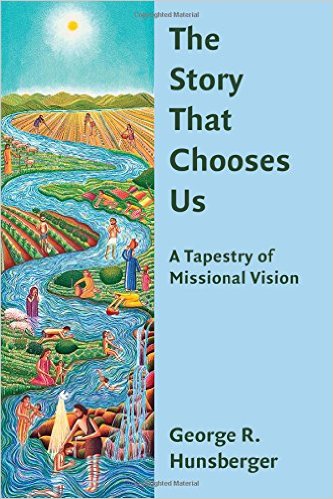
 

The Story That Chooses Us (Themelios)

The new issue of Themelios is now out – you can download it for free as a pdf or (for a short time) free for Logos. In this issue you will find a lot of engagement with Adam, the Fall, and Original Sin. You will also find reviews of some interesting books like Thomas F. Torrance and the Church Fathers: A Reformed, Evangelical and Ecumenical Reconstruction of the Patristic Tradition and Advancing Trinitarian Theology: Explorations in Constructive Dogmatics and of course my review of George Hunsberger’s The Story that Chooses Us: A Tapestry of Missional Vision.

Here is an excerpt but you can read the rest on the Themelios website:

“The Chinese character for crisis, we are told, is a combination of the characters for ‘danger’ and ‘opportunity’” (p. 118). Many missiologists would agree that the church is currently presented with both. It will have to decide how it will face those dangers and opportunities. Over the last several decades missiologist George The Story that Chooses UsHunsberger has written many essays in order to help the church face this crisis of missional identity and practice. The Story that Chooses Us collects some of these. Covering topics like calling, community, and formation, these essays contain a number of reoccurring themes that weave cohesively into what Hunsberger calls “a tapestry of missional-ecclesial vision” (p. ix). The overall scope of this project is wide and the topics addressed are diverse, yet these reoccurring themes bring a sense of cohesion. Instead of addressing individual chapters in this review, I will cover some of these themes (the current crisis of the church, the current shape of the church, the identity of the church, the mission of the church) and offer some critical thoughts about this collection of essays…..

Ed Catumll – Creativity Inc: Interview – GLS15

Brian Catmull is co-founder of Pixar Animation Studios and president of Walt Disney Animation Studios. Ed has been honored with five Academy Awards, including a Technical Achievement Award, two Scientific and Engineering Awards, and one Academy Award of Merit for his work. In 2009, the Academy of Motion Picture Arts and Sciences awarded Catmull with the Gordon E. Sawyer Award for his lifetime of technical contributions and leadership in the field of computer graphics for the motion picture industry.

He he was also interviewed by Bill Hybels at the 2015 Global Leadership Summit. Here are some highlights!

Global Leadership Summit

Highlights

One of the great misconceptions of our time is that art and science are incongruous – but creativity is the same on both sides.

A lot of people misconceive stories… they think of them as entertainment a way to wind down etc. but stories are the way we communicate with eachother. i.e. parent to child, in school, etc.

The Good stories are the ones that connect with the emotions.

You aren’t going to tell a good story till you learn to communicate with people on a deeper level.

The Braintrust

  • Peers talking to peers
  • In that room – there is no power structure (people already feel vulnerable if they feel like someone is already going to override them they won’t expose themselves.)
  • They have a vested interest in eachother’s success

Creativity is about solving problems. Coming up with solutions is a creative act.

Fail early, fail fast, it’s a part of the creative process. (We aren’t saying you NEED to fail, just that we need to make it safe to fail – because in doing this you will progress faster.)

Stories are what going to be what change our world. (Education, Marketing, Movies, etc.) You can abuse it but you can also use it for good.

Jim Collins – Seven Questions: Beyond Good to Great – GLS15

Jim Collins – THE Jim Collins – asks us 7 questions that help us move from “Good to Great” and beyond great.

Global Leadership Summit

1-What Cause do you serve with Level 5 Ambition?

  1. The essence of leadership is service – service to people/cause
  2. Ambition channeled outwards to a cause/something bigger/more important than we are
  3. Level 4 leaders inspire people to follow them but Level 5 leaders inspire people to follow a cause.
  4. Infuse your enterprise with some greater purpose – commitment to service is not a sector choice but a life choice.
    1. To serve is to live.

2-Will you settle for being a good leader or will you grow to become a great leader?

  1. Leadership is not personality, position, power.
  2. Leadership is the art of getting people to want to do what must be done. – Eisenhower
    1. You need to know what must be done
    2. Its an art.
      1. Most great leaders GROW into their leadership – they don’t start that way

3-How can you reframe failure as Growth in pursuit of a BHAG?

  1. “I am not failing, I’m growing…”
  2. What is the other side of the coin of success? Its not failure, its growth.
  3. Have you ever felt a profound sense of inadequacy? If so – how do you reframe that for growth?

4-How can you help others succeed?

  1. We succeed and are at our very best when we help others succeed.
  2. Three Key things
    1. Service, Success, Growth
    2. If you could build a culture that has service/cause/purpose that you are willing to sacrifice for and has challenges in the forms of BHAGS that help you grown, and communal success – that is how you build meaning.

5-Have you found your Hedgehog – your personal hedgehog?

  1. Three circles: Passion, What You Are Made For, Economic Engine
  2. When you lead out of your hedgehog – you lead out of the wellspring that allows you to persist.
  3. True creators stay in the game. We cannot control/predict every hand we get dealt in life.
    1. Refuse to leave the game – play every hand you get to the best of your ability.
  4. How many of you have in some point in life just been flat out decked? That’s when you have to stay in the game.

6-Will you build your unit – your minibus – into a pocket of greatness?

  1. How did the good-to-great leaders do it? They didn’t focus on their career? They focused on their “unit” and developing their unit around them.
  2. Being a “first-to” leader not a “first-what” leader. Figure out who should be in the key seats in the bus.
  3. Be rigorous – not ruthless. Take care of your people.
  4. Take care of your people not your career.
  5. Greatest leaders – find a way to make an impact and contribution on PEOPLE

7-How will you change the lives of others?

  1. How will some people’s lives be better and different because you were here on this earth?
  2. Life is people…. Be useful

This is my planet! I claim it in the name of the cross!

Check out this vintage video of Gordon Fee teaching on Eschatology:

He really starts preaching at around 4:40-5:40! SO GOOD!

Gordon Fee, in this short video clip, provides a brief master class on the effectiveness of using a historical illustration to teach a Biblical principle, namely, a lesson on D-Day, the Allied invasion of Normandy on June 6, 1944 that signalled the death knell of Nazi Germany in WWII, which eventually was consummated on May 8, 1945 (V-Day), eleven months later. Fee ties these events to an illustration with the Kingdom of God.

At one point during this stirring clip (about the 4:16 mark) Fee exclaims:

In the coming of Jesus, God planted his flag on this enemy turf and said “This is my planet! I claim it in the name of the cross!”

HT: New Testament Perspectives

Tim Keller’s Opinion of Disney’s “Frozen” (and the Identity Narrative)

In his latest book Preaching Tim Keller addresses five narratives the modern mind tells itself that function almost as self-evident indisputable truths. Among these are:

  1. The Rationality Narrative
  2. The History Narrative
  3. The Society Narrative
  4. The Morality/Justice Narrative
  5. The Identity Narrative

The “Identity narrative” says that we must discover our deepest desires and longings and then do all we can do to realize them, regardless of constraint or opposition. Interestingly enough – he uses Disney’s Frozen as a prime example of this Identity narrative.

The new late-modern, narrative, however goes beyond merely understanding and directing our own passions to enthroning them. Its essence is captured by the words of the song “Let it Go” in the Disney movie Frozen. The song is sung by a character determined no longer to be the “good girl” that her family and society had wanted her to be. Instead she would “let go” and express what she had been holding back inside. There is “no right or wrong, no rules” for her. This is a good example of the expressive individualism (Robert) Bellah described. Identity is not realized, as in traditional societies, by sublimating our individual desires for the good of our family and people. Instead  we become ourselves only by asserting our individual desires against society, by expressing our feelings and fulfilling our dreams regardless of what anyone says. (134)

FrozenObviously there are some problems with this late-modern/post-modern narrative. First it assumes that our desires are coherent or good. Second, identity built on ebbing and flowing desires is very unstable. Third, Our desires are often conflicting. Fourth, our desires when not fulfilled lead to crushing feelings of failure because we couldn’t “self-realize.”

That’s why we need the biblical account of identity. The biblical account of identity says that we certainly have deep desires in our hearts, but some of those desires will actually prevent us from being our “true selves.” Our true self is only found in the identity that God bestows to us because of Christ.

Why do we Preach to People With Really Bad Memories?

Studies show that we will forget about 40% within the first 24 hours of learning something. If we wait another 24 hours before reviewing the information, we lose about 60% of it.  So if we were taking a test we could go from a grade of ‘A’ (100%) to ‘D’ (60%), to ‘F’ (40%) in just 48 hours. Now…. imagine how much the people you are preaching to might be forgetting? Kinda sucks right? Yeah it does. So if people forget 60% of what you say within two days, and a lot more by the end of the week, then why do we keep preaching? That’s the question that Brad Wheeler asks over at the 9Marks blog:

What good do all those sermons do, if we proceed to forget most of what we heard shortly thereafter? Well, we don’t forget everything we hear. I trust most of us can remember sermons that challenged how we thought about God, marriage, money, etc.—and we were forever changed. So let’s not write off the whole enterprise.

But beyond that, the weekly word in our morning messages is only meant to get us to next Sunday! In God’s weekly rhythm, he seems to grasp that come Sunday, we’re famished, and we need to be filled yet again.

My sermons, your sermons, they don’t have to remain with our people throughout eternity. It’s not meant to change their lives in that sense. They’re meant to sustain them until next week. One week at a time. Until heaven. And there, the word made flesh will dwell with us forever, and the need for sermons will be no more.

Mark Dever on the PhD and the Pulpit: “On Having a Doctorate in the Pastorate”

Should a pastor have a PhD? Is it helpful? Is it necessary? Mark Dever spoke on the assigned topic: “Why a PhD is Needed in the Pulpit” (mp3) but changed the title to “On Having a Doctorate in the Pastorate.” I outlined his brief remarks below and included some quotes from the questions and answers segment I found helpful.

Here’s the archive description: “Opening remarks and question/answer session conducted at the Feb. 27, 2002 meeting of the Graduate Club in the President’s Reception Room, Southern Baptist Theological Seminary.”
Five Reasons a PhD May be Helpful for Pastoral Ministry

  • It may be helpful for the matter of what you study. If you pick something you’re edified by it can assist and help your ministry.
  • It may be helpful from the very form of the studies. Doctoral studies should improve your ability to research and at best your ability to think.
  • It may be helpful for the ministry you have while you’re in your doctoral studies.
  • It may be helpful for the connections you make through your studies. Consider the community and relationships you’ll build which may serve your ministry in the future.
  • It may be helpful for the credibility you may have with non-Christians and carnal Christians and Christians you don’t know very well.

A PhD is Certainly Unnecessary for Pastoral Ministry

  • Great learning can be ill-used.
  • You can become prideful.
  • You can do people little good – you may speak above people’s comprehension.
  • Little learning can be well-used
  • John Owen on John Bunyan – “If I could possess that tinker’s abilities for preaching I would most gladly relinquish all my learning.”

Conclusion: “Involvement in a good church is unquestionably far more helpful in the pastorate than a doctorate. But a doctorate can be useful in the pastorate. To say less would be misleading, but to say more, any more, would be false.”

For more of this post see Slavepj.com

pjtibayan's avatarPJ's personal blog. For articles see gospelize.me

Should a pastor have a PhD? Is it helpful? Is it necessary? Mark Dever spoke on the assigned topic: “Why a PhD is Needed in the Pulpit” (mp3) but changed the title to “On Having a Doctorate in the Pastorate.” I outlined his brief remarks below and included some quotes from the questions and answers segment I found helpful.

Here’s the archive description: “Opening remarks and question/answer session conducted at the Feb. 27, 2002 meeting of the Graduate Club in the President’s Reception Room, Southern Baptist Theological Seminary.

Five Reasons a PhD May be Helpful for Pastoral Ministry

  1. It may be helpful for the matter of what you study. If you pick something you’re edified by it can assist and help your ministry.
  2. It may be helpful from the very form of the studies. Doctoral studies should improve your ability to research and at…

View original post 491 more words

What is Distinctive about Christian Analytic Theology?

I’m starting to engage in a project on the value of Analytic Theology for spiritual formation. In light of that I have been reading a lot about Analytic Theology lately (as a meta-subject). Anyway, I came across an interview with Rea and Crisp where Crisp answers the question: What is distinctive about Christian Analytic Theology:

Crisp: I have already said something about what analytic theology is, and I suppose that gives some indication of what makes an analytic approach to theology distinct from much contemporary theology which draws upon more ‘continental’ modes of philosophical thought. So the ‘analytic’ component to analytic theology will be distinctive to the extent that it is appropriating the modes and methods of an analytic approach to the subject matter of theology. It is certainly distinctive for the Christian theologian to be engaged in an analytic project qua theologian, that is, from within the bounds of the Christian tradition, pursued in a faith-seeking-understanding manner, rather than qua philosopher, as someone with an interest in these issues coming at them from the ‘outside-in’, as it were. Someone from another faith tradition might also be an analytic theologian. I do not doubt that one could do analytic theology in Judaism or as a Muslim – and there might be a good case for doing so. But that, it need hardly be said, is a rather different enterprise than Christian analytic theology. I am not responsible to the Jewish or Muslim community. But I am responsible to the Christian community. And, for obvious reasons, that shapes the sort of issues I want to deal with as an analytic theologian.

The Johannine Prologue

Jey Kanagaraj says this about the Johannine prologue and how the gospel is encapsulated within it:

The whole Gospel according to the prologue evolves around one theme: the revelation of the one God in his glory and his encounter with all human beings in the life and mission of Jesus, the pre-existent God-become-flesh, to found and nurture a witnessing new covenant community.

John: New Covenant Commentary (9)