The Meaning of Love – 5th Annual CCT Conference

A week from today I will be over at Biola’s campus for their 5th Annual Center for Christian Thought conference.

loveconference-mega_hbmfzs2_mega_banner

This year’s topic is “The Meaning of Love.” The conference will be exploring questions like:

  • What is love?
  • What are the ethical implications of Jesus’s love commands?
  • What should be made of the Christian notion of enemy love?
  • What can be learned from recent scientific work on love about intentional practices likely to conduce to a loving character?
  • What light do ethical theories shed on the moral dimensions of love?
  • What is the relationship between love and justice?

To top things off they have a great line up of keynote speakers including:

  1. George Hunsinger – “Agape and the Long Defeat”
  2. Nicholas Wolterstorff – “Love and Justice – and Beauty Too”
  3. Thomas Jay Oord – “Love’s Essential Aspects and Diverse Forms”
  4. Lynn G. Underwood – “Perspectives on Compassionate Love: Science, Spirituality, and the Arts”

Hunsinger’s paper looks to be especially interesting. He will be comparing Karl Barth’s work to J.R.R. Tolkien’s work. In this paper he will be comparing Tolkien’s Nazgul’s to Barth’s concept of das Nichtige (the power of nothingness). Sounds fun!

In addition to the keynote speakers there are over 30 breakout sessions. These include papers by friends of mine, Thomas Ward and Jordan Wessling. Thomas was my T.A. in my medieval philosophy class when I was a sophomore at UCLA. Jordan is one of two post-docs on our Analytic Theology team at Fuller. And of course, yours truly, will be presenting a paper titled: Amo ut Intelligam (I Love so That I May Understand): The Role of Love in Religious Epistemology. Its a riff on “I believe so that I may understand.”

Overall the conference looks like a lot of fun. So if you are free next Friday and Saturday come down to Biola’s beautiful campus for what seems to be the makings of a really interesting conference. Register here.

Johnny Mac on Developing Leaders

Now – if you know me, you know that I am not John MacArthur’s biggest fan. (Surprise surprise!) However, this short video by him about leadership development is so good, I can’t help but share it. MacArthur is absolutely right, strong churches will have a huge influence for God in this world, but strong churches begin with strong leaders…

Missions Insights with Dr. John MacArthur: Why Invest in Training National Pastors? from TMAI on Vimeo.

An Invitation to Analytic Christian Theology

Analytic theology is one of the cool, sexy hip things happening. – Michael Bird

Summary

What is analytic theology? I’ve written quite a bit about that question on this blog before. And honestly, a lot of people have throw in their two cents regarding this question. But what we have in Thomas McCall’s An Invitation to Analytic Christian Theology is probably the clearest most concise, most accessible introduction to the topic. As Oliver Crisp says in a blurb “until now it [analytic theology] has had no introductory text…McCall provides a stellar volume for this purpose.” 41muf9-ot5l-_sx331_bo1204203200_

McCall begins this introduction with a brief history of analytic theology, chronicling its emergence from analytic philosophy to analytic philosophy of religion to what we have now, analytic theology. He notes that there is no single decisive settled meaning for the term, but we could say that:

Analytic theology signifies a commitment to employ the conceptual tools of analytic philosophy where those tools might be helpful in the work of constructive Christian theology. (16)

He then addresses some of the common objections people have made about the movement including: “analytic theology relies on a univocal account of religious language,” “analytic theology is an exercise in natural theology,” “analytic theology is naïve with respect to the history of doctrine,” “analytic theology is only apologetics for conservative theology,” and “analytic theology isn’t spiritual edifying.”

[It should be noted that the last objection in particular is an objection that hits close to home for me. I’m a part of Fuller Seminary’s Analytic Theology project whose stated purpose is to focus on three Big Questions as case studies to road test the value of analytic theology in a vocational context: prayer, divine love, and the theological implications and engagement of the sciences of human origins…. The project hypothesizes that Analytic Theology (AT) provides a rigorous intellectual framework for the training and formation of church leaders. Our team will approach this in two ways. First, by “thickening up” AT theologically, providing examples of work that showcases the virtues of AT in written outputs and publications on the three Big Questions of the grant. These are prayer, divine love, and theological anthropology in conversation with the sciences. Second, we will bring together theologians and scholars with pastors and church leaders to explore the ways in which theology, and AT specifically, may be of service to the life of the church.” So yeah, I do think it can be spiritually and pastorally edifying.]

The work McCall does in laying down the foundations of Analytic theology will be very helpful for those seeking an introduction to the topic. But for those who are sort of familiar with analytic theology the later 4 chapters will be of greater interest. In these chapters he addresses the relationship between analytic theology, Scripture, the history of doctrine, and culture. The final chapter addresses how analytic theology stands in relation to theology’s proper posture and approach to its ends. McCall ends with some suggestions about how the analytic theologian may relate to modern theology, the theological interpretation of scripture, global Christianity, and pastoral concerns. In McCall’s opinion, the future of analytic theology is quite promising, precisely because it represents a renewal of older ways of doing theology.

Case Studies

One of my favorite things about this book were the “case studies” that McCall did over the course of each chapter. In the chapter on Analytic Theology and Scripture McCall uses Analytic theology to help bring clarity to what we mean when we say X is biblical. The term “biblical” and “unbiblical” often gets thrown around without sufficient precision. This actually makes for some poor arguments when arguing that one’s position is “biblical” and an opponent’s position is “unbiblical.” McCall places the term “biblical” on a spectrum between stating that: The Bible explicitly asserts P –> the Bible includes sentences that assert p and sentences that assert (not)P. This set of distinctions is important and is helpfully brought to the forefront of our theological work with the help of analytic theology which places a large amount of importance on clarity.

Besides the ctommccall-005ase study on the term “biblical,” McCall applies the virtues of analytic theology to put D.A. Carson’s use of the term “compatibilism” under the microscope. This is an excellent example of how analytic theology can help us to do even biblical theology. In his chapter on historical theology he uses analytic theology to address several contentious Christological controversies: 1) the metaphysics of the incarnation and 2) physicalist Christology. In his chapter on culture McCall takes on recent discussions about creation and evolution. This is likely McCall’s least innovative case study. Nevertheless, this is probably one of the most “practical” of the studies. What the creation/evolution debate really needs is clarity, as the debate suffers from proponents on both sides speaking past one another in broad generalities about the opponents supposedly held position. Consider even how some of those involved in the debates tend to make it an all or nothing issue: evolution or creation, with no clear working definition of what exactly these terms mean. If the dialogue is to go forward these sides need nuancing, and McCall helps bring this to the table.

Some Thoughts

As Mike Bird said – Analytic Theology is one of the cool, sexy hip things happening. He is absolutely right. However the future of analytic theology will be determined by how well it can weave its way into the life of the church. If analytic theology is to stay insider game, played by a small group of experts, the movement will likely die. However, if analytic theology is to become something more than a mere fad it will have to do something… it will have to prove that it has something to contribute to the life of the church. McCall’s work in this introductory text shows that Analytic Theology has what it takes to become more than a mere fad – if done well – analytic theology will become a staple part of the church’s task of thinking and speaking about God in a way that honors the Christian faith.

Note: I received this book this book from IVP in exchange for an impartial review.

The Nature and Value of Faith: Four Problems

Last week Dan Howard Snyder (Western Washington University) came to the Analytic cfyvn_euyaabdtqTheology seminar to throw out some ideas about the nature of faith. Here are some notes….

  • The Problem of Trajectory – Typical College Student
    • Doubt to getting “out”
    • If I lack faith (i.e. doubt) maybe I should just drop out of this whole Christianity thing
    • Problem: Stay in or get out
    • Supposedly: You can’t have Christian faith if you have doubt (to be a Christian is to be a “believer”
  • Theorizing About Faith
    • Claim: You have Christian faith only if you believe in BCS (Basic Christian Story)
    • Distinction between “Faith in” vs. “Faith that” (person/relations vs. propositions)
      • Maybe Third: Global Faith – Ability to Bring a narrative together
    • Claim: You can have Faith that the BCS is true only if you believe that it is true.
      • Which of these 3 kinds of faith apply to this claim?
      • This claim is true only if “Faith entails Belief”
        • Necessarily S has faith that p only if S believes that p.
      • Two part view – Necessarily S has faith that p only if (1) S has a positive conative orientation toward p and (2) S believes that P.
      • Three Part View (Doxastic Version) – Necessarily S has faith that p only if (1) S has a positive conative orientation toward p and (2) S believes that P, and (3) S is resilient in the face of challenges to living in light of the good S sees in the truth of what she believes.
  • Faith Without Belief
    • Thesis – Faith entails belief: Necessarily S has faith that p only if S believes that p.
      • Issue: Ignores Seeming vs. Believing
      • Specificity problem: Makes “p” too specific, that’s not how it is with other complex cognitive attitudes
      • Alternatives Problem
        • Case: The Defensive captain example
      • Three Part View (Non-Doxastic Version) – Necessarily S has faith that p only if (1) S has a positive conative orientation toward p and (2) S has a positive cognitive stance towards p, and (3) S is resilient in the face of challenges to living in light of the good S sees in the truth of what she believes.
  • Faith and Resilience in the Christian Life
    • Resilience in the face of counter-evidence
    • Resilience in the face of contrary emotions (dryness, diminution of desire)
      • No longer desiring, but still intending
    • Application to the problem of Trajectory
      • Apply these 3 requirements to faith to the student
        • Believing is out of the question right now, but for now let “assumption” be the leading cognitive state
  • Problems for this account of faith:
    • Unity Problem – two versions
      • Faith is defined in many ways, there isn’t anything which unifies them, so we can’t define “faith” in this one way.
      • What unites these 3 aspects into one attitude?
    • Fictionalist Problem
      • If you think you can have faith in BCS without believing it then you have to believe that a religious fictionalist could have faith as well. (Religious Fictionalist – acts on/engages on story that she doesn’t believe but sees pragmatic value in it)
    • The Bible Says Problem
      • This theory is just not what the Bible says about faith.
      • Can’t have faith w/o propositional belief, can’t please him if you don’t believe he exists.
      • In Bible Faith and Doubt are contrasted
    • The Problem of Practice
      • How can a skeptical Christian engage in Christian practices with integrity?
      • What will prayer be like for her? All her prayers will be insincere or malformed…

Pannenberg on History and Truth for Method

Having given a brief overview of Chapter 1 of ST1 I would now like to highlight two key themes in this section of Pannenberg’s work. These two themes also play a key role in the rest of ST1. These themes are 1) truth and 2) history.

History

history-title

First regarding the theme of “history.” In the Foreword to ST1 Pannenberg mentions the reluctance of some theologians to focus on the historical nature of Christian doctrine. Yet Pannenberg believes that Christian doctrine rests on “the historical revelation of God in the historical figure of Jesus Christ and on the precise evaluation, by historical interpretation alone, of the testimony that early Christian proclamation gives to this figure.” Pannenberg’s focus on the importance of history is evident throughout ST1 but it becomes especially important in his discussion of the truth of Dogmatics. In section 1.2 Pannenberg says that “all the NT authors bear witness in their different ways to the act of God in Jesus of Nazareth.” Christian faith rests upon the confession of Jesus of Nazareth and the act of God in him which we come to know through the historical witness of the NT authors. His emphasis on history is also seen in his detailed discussions of the history of Dogmatics. He often goes into long details outlining the history behind a certain doctrinal position. Here he shows the importance of the fact that doctrine does not just materialize, rather is has a history which develops and eventually matures.

Truth

truth

Now regarding the theme of “truth.” Pannenberg stresses that Dogmatics attempts to articulate the truth of God. As it relates various themes of doctrine, the goal is to present these themes in light of the reality of who God is. Theology which does not attempt to be grounded in the truth of God is not theology in the true sense of the word. Any sort of theology which simply attempts to find coherence with other Christian doctrine or with the world, yet fails to be done in relation to the object of theology cannot be called true theology. The fact that his theology pursues truth is also displayed in the fact that Pannenberg explains that there is a difference between human theology which copy and imitation of that which is true divine archetypal theology. Pannenberg’s emphasis on truth as a theological category is also evident in his discussion about the truth of dogma in which he lays out various theories of truth and argues that coherence and consensus are not enough to establish the truth of Christian dogma.

Wolfhart Pannenberg’s Theological Method

Earlier this year I spent two weeks in a Christian university Uganda, I saw these students work through some questions like: “What is theology?” “What role should the Bible play in our doctrinal formulations?” “How can the church be a faithful witness to Christ in the world?” Although Pannenberg was far from the minds of these African students, his Systematic Theology: Volume One addresses precisely these sorts of questions. Though Pannenberg does not answer these questions for those who find themselves in an African context he claims that this volume, which addresses part of the spiritual heritage of all Christians, quite simply addresses “the truth of Christian doctrine and the Christian confession.” Over the next few days I will be examining Pannenberg’s theological method – in all of its strengths and its weaknesses.

Overview of Method in Systematic Theology Volume One

Section 1 of Chapter 1 begins by considering the nature of theology. Having described various trends in usage of the word over time Pannenberg gives us a provisional definition of the term. He claims that theology is not solely or primarily a human activity, rather “it is the declaring of God that is proper to the divine logos and disclosed by him.” The basis of this theology is revelation, that is, it is knowledge of God which is made possible by God. Without acknowledging this basic condition of theology one cannot properly do theology. Pannenberg goes on to nuance this position by introducing a thesis of Reformed theologian Franz Junius which explains the human role in theology. Junius says that human theology is possible only as a copy and imitation of the divine archetypal theology. Suffice it to say that our knowledge of God is only possible through God’s revelation, though this knowledge only approximates God’s knowledge of himself.

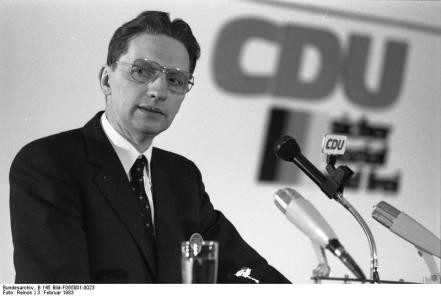
Bonn, CDU-Friedenskongress, Pannenberg

Having stated what theology is, Pannenberg now addresses what the proper object of theology is. Following Albertus Magnus, Thomas Aquinas, and countless others Pannenberg argues that God is the single, all embracing object of theology. The upshot of this proposition is that this object can only be known if it gives itself to be know. Though Christian theology addresses many things, all those things which are covered in theological discourse find their place in relation to God, i.e. God is the unifying subject of all theological topics. This particular view is contrasted with Schleiermacher’s position which considers human needs and experiences of God to be the proper objects of theology. Pannenberg rejects this notion and stresses that theology is discourse about God that God himself has authorized. It is not discourse about God grounded in human needs or interests or even ideas about the divine. In order to truly be “Christian” theology, theology must have as its theme the truth about God as he has revealed himself.


The centrality of truth as a part of Christian theology leads Pannenberg to consider the nature of Dogmatics. He begins with a very simple definition of Dogmatics as “the science of Dogma or of Christian doctrine.” This definition is not very helpful so Pannenberg engages in a short historical study regarding the nature of Dogmatics. Here he takes on biblical as well as early Christian materials and concludes that if the dogmas of Christians are true, they are no longer the opinion of humans, rather they are divine revelation. These dogmas are divine truth.

Pannenberg realizes that talk about dogma in our modern context is likely to bring us some harsh feelings for many would consider dogma and religious coercion to go hand in hand. Pannenberg is quite right since many would indeed say that dogmatic religious claims attempt to force consensus about these positions and thus establish these positions as the only truth. That is supposedly contrasted with a consensus, which arises out of a free agreement regarding these religious claims. Yet Pannenberg argues that neither coercion nor consensus can serve as an adequate criterion of the truth of a doctrine.[4] It is tempting to believe that consensus, even universal consensus, would establish the truth of a doctrine but this is simply not the case for some ideas and convictions might be deeply rooted in the whole species, though these convictions may turn out to be false. Though consensus does not establish the truth of a doctrine it nevertheless plays a significant role in our understanding of Christian doctrine. For instance within the Lutheran tradition, confessions aim at achieving a total church consensus regarding evangelical doctrine. Although consensus does not establish or create the truth of a doctrine it nevertheless helps the church to provide a normative function in the church’s reading of the word of God. As Scripture is read and interpreted through the lens of these confessions the result is that the Christian reader ends up confession Jesus of Nazareth and the act of God in him. This is the purpose of confessions, to help Christian readers in their reading and interpretation of Scripture.

Having considered the way that Dogmatics unfolds the content of church teaching and how dogma relates to truth Pannenberg goes on to explain the task of presenting a comprehensive and coherent presentation of this doctrinal content. This coherent and comprehensive presentation of dogma is called “systematic theology.” This term which is first found in the early 18th century deals with the matters of theology in a comprehensible manner and it explains, proves, and confirms its content in detail. One thing that systematic theology entails that the things which are regarded as true will not contradict one another, in other words there must be some sort of coherence in this system. Though coherence is not necessarily the thing which determines the truth of any one system, the fact that the doctrine corresponds to the object/reality determines the truth, it is nevertheless a crucial aspect of any proper system.

41yrbvsp98l-_sy344_bo1204203200_Having spent most of this chapter establishing some key concepts, such as the nature and object of theology, the meaning of dogma, and the criteria for a systematic theology’s truth, Pannenberg now moves on to discussion some “problems” of prolegomena to Dogmatics. He says that traditionally Protestant prolegomena would include the following five themes: “1) the concept of theology; 2) the Christian religion as the general object of theology; 3) scripture as the guiding principle of theology; 4) the articles of faith; and 5) the use of reason.” Most often the third theme commands the greatest attention in protestant prolegomena. This makes sense for its is part an parcel of reformation theology that the authority of Scripture as a norming norm for theology is based on the fact that it is God’s own words. Yet there has been a problem in regards to this third theme regarding where the authority of Scripture comes from. Does this authority come from the sole fact that it is God’s inspired word or does it involve the Christian’s personal experience of belief in God’s word? This issue was further complicated when the concept of religion took on a more fundamental role in understanding the nature of theology. This is especially poignant in the work of Schleiermacher who grounds his methodological foundation of Dogmatics in the concept of religion or piety. So the theme of scripture as the guiding principle of theology has broken out into two different camps, the one camp which situates scriptures’ authority with faith (subjective) and the other which situates its scripture’s authority in its inspiration (objective). Given the demise of a general belief in the authority of Scripture it makes sense to try to ground the authority of scripture in an appeal to faith. However the problem with this is that it does not provide an objective ground for guaranteeing its truth.
In his final section in chapter 1 Pannenberg takes issue with recent Christian Dogmatics that make the truth of Christian doctrine a presupposition rather than declaring it a theme of inquiry. In Pannenberg’s opinion the fact that the revelation of God is a part of the reality of world means that it is inherently debatable and up for testing and confirmation. He argues that since truth is not purely subjective, rather that truth is a public thing, the truth of Christian Dogmatics ought to be able to be deliberated about and debated. Christians fail to do the world a service when they engage in theology as though the truth of the matter can be assumed. Instead Christians ought to engage in theology in such a way that the unbelieving public can be faced with the truth and make a decision regarding its feasibility.

In this section Pannenberg relates theology to a scientific hypothesis which can be tested and tried. Yet to call theology a hypothesis or to say it is provisional should not alarm Christians whatsoever since the truth of Christian theology is grounded in eschatology. The Christian knows that the decision regarding the truth “rests with God himself. It will be finally made with the fulfillment of the Kingdom of God in God’s creation.”


He’s Risen!

heisrisenbanner-960x350

They cannot go to the tomb in the darkness, partly because they shrink from handling a dad body in pitch blackness, and partly because it would be difficult to carry out the anointing without light. But as soon as the sun rises off they go. And then they remember the stone. Who will roll it away? They have no idea, but they press on regardless. Something will turn up. When they get there the stone has already been rolled away, but as they enter the tomb the see a terrifying sight: a figure in white seated. He tries to calm their fears, pointing to the place where the body of Jesus had lain. There is nothing there. “He’s not here! He’s risen!” They flee, terror-struck; and with that word Mark ends his Gospel.

It is, surely, the most remarkable ending in the history of literature: ephobounto gar, “for they were afraid”. Enigmatic though it is, it strikes a keynote. In the resurrection we are in the presence of the uncanny; of the irreducibly holy; of that for which we can offer no explanation.

-Donald Macleod (Christ Crucified, 68)

Strong and Weak

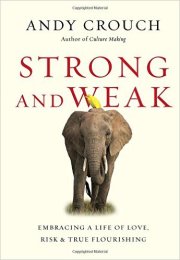
Strong or weak? Which would you rather be? The answer seems like a no brainer – DUH – strong of course! Andy Crouch, author of the classic book Culture Making, says that if we want to truly flourish (and if we want to be effective leaders) we must embrace both. We must be Strong and Weak.

davidandgoliath
Strong vs. Weak – Big vs. Little – Young vs. Old

Crouch’s thesis is quite simple, weakness and strength are not opposites. They are actually meant to be held together simultaneously. When we learn this forgotten truth, then we will truly be able to be the people we were made to be. This is a countercultural message. Most people would say embrace strength and hide weakness. On the other hand there have been some that have recently been calling for a return to “vulnerability” masked as public weakness (though this is often a power play trading on the act of manipulation).

If you look at the life of Jesus you will see both strength and weakness. Exaltation and humiliation. Ascension and crucifixion. In fact when we celebrate Easter we actually celebrate this paradox of weakness and strength. It was in the moment of greatest weakness and vulnerability (the cross) that the almighty Son of God was coronated. Easter celebrates the King’s Cross.

In this short book Crouch explores cultural conceptions of strength and weakness. He exposes false weakness and authoritative strength. He encourages hidden vulnerability, that is the willingness to bear burdens and expose ourselves to risks that one one else can fully understand (25). He shows us that if we want to truly be strong we need to be willing to enter into brokenness, whether our own or the suffering of others. Only once we embrace this hidden vulnerability and descent into suffering will we be able to be the kind of people who can be entrusted with true power. Power that is both vulnerable and authoritative – weak and strong.

41xwtnbrpyl-_sx343_bo1204203200_The book is filled with powerful stories, the story of Angela is brought me to tears – especially since my wife and I just had our first daughter. Stories of racism and of Crouch’s own selfishness really bring the message home. But the story that underlies all of this, though its never made too explicit, is the story of Jesus – the Gospel. The Gospel is what shows us what it means to be both Strong and Weak….

Overall I would highly recommend this book for leaders. Embracing both of these “virtues” is critical to leadership. In fact there are a few leaders in my ministry to whom I will have them read some of the chapters in this book.

Good Friday (Thomas Aquinas)

Aquinas on the Death of Christ:

1. To make our redemption complete. For, although any suffering of Christ had an infinite value, because of its union with His divinity, it was not by no matter which of His sufferings that the redemption of mankind was made complete, but only by His death. So the Holy Spirit declared speaking through the mouth of Caiaphas, It is expedient for you that one man shall die for the people (John xi. 50). Whence St. Augustine says, “Let us stand in wonder, rejoice, be glad, love, praise, and adore since it is by the death of our Redeemer, that we have been called from death to life, from exile to our own land, from mourning to joy.”

the-apotheosis-of-saint-thomas-aquinas-francisco-de-zurbaran
The Apotheosis of Thomas Aquinas (1631)

2. To increase our faith, our hope and our charity. With regard to faith the Psalm says (Ps. cxl. 10), I am alone until I pass from this world, that is, to the Father. When I shall have passed to the Father, then shall I be multiplied. Unless the grain of wheat falling into the ground die itself remaineth alone (John xii. 24).

As to the increase of hope St, Paul writes, He that spared not even his own Son, but delivered him up for us all, how hath he not also, with him, given us all things? (Rom. viii. 32). God cannot deny us this, for to give us all things is less than to give His own Son to death for us. St. Bernard says, “Who is not carried away to hope and confidence in prayer, when he looks on the crucifix and sees how Our Lord hangs there, the head bent as though to kiss, the arms outstretched in an embrace, the hands pierced to give, the side opened to love, the feet nailed to remain with us.”

Come, my dove, in the clefts of the rock (Cant. ii. 14). It is in the wounds of Christ the Church builds its nest and waits, for it is in the Passion of Our Lord that she places her hope of salvation, and thereby trusts to be protected from the craft of the falcon, that is, of the devil.

With regard to the increase of charity, Holy Scripture says, At noon he burneth the earth (Ecclus. xliii. 3), that is to say, in the fervour of His Passion He burns up all mankind with His love. So St. Bernard says, “The chalice thou didst drink, O good Jesus, maketh thee lovable above all things.” The work of our redemption easily, brushing aside all hindrances, calls out in return the whole of our love. This it is which more gently draws out our devotion, builds it up more straightly, guards it more closely, and fires it with greater ardour.