Pastoral Position Opening: Minister of Word and Sacrament in Geneva

The following is a lighthearted (and facetious), but historically realistic, job opening advertisement for a pastoral position in Calvin’s Geneva.

Position Focus:
Minister of Word and Sacrament in Geneva

Why This Position Is Needed

John Calvin’s alternate at St. Pierre’s had recently fallen ill. Although the other ministers in Geneva visited our colleague to pray for him on his deathbed, Pastor Abel Poupin, passed away on March 5th into the Lord’s presence.[1] Thus he leaves his position vacant. In addition to the passing away of Pastor Abel, another pastoral position has opened up. Pastor Jean Fabri has been deposed of his position. There have been claims made that he was making sexual advances (if not actually seducing) a married woman and also accusations have been made against him saying that he has gotten his serving girl pregnant.[2] After further investigation, the consistory has decided to dismiss Jean Fabri. Thus, we have two pastoral positions open.

The Church

The churches in Geneva are a multi-generational, multi-site network of churches located on the banks of of Lake Geneva at the mouth of the Rhone River. Our springs are wonderful, and our winters are bitterly cold. During the summer you and your family can spend time at the lake, but make sure to stay away from it during the winter. Many have died due to hypothermia! If you can ignore the fact that the Bernese, The Savory, and the French are always at odds with each other because of us, and the inconvenience that the plague brings, this is a great town to raise a family.

If you take this position you may be one day be appointed to serve as the pastor of St. Pierre’s Cathedral, Magdeleine, or St. Gervais (though in all likelihood you will probably begin by being appointed to pastor one of the countryside churches.)

Primary Responsibilities

‘The Scriptural office of the Christian minister involves nourishing and instructing God’s people on the divine Word by means of sermon, sacraments, catechism, spiritual conversation, and corrective discipline.’[3] Thus your job is divided into several categories:

Ministry of the Word

  • Preaching and teaching will form a bulk of your weekly work. In accordance with most others within the Reformed tradition your sermons ought to be expository, working through a single book, verse by verse (i.e. lectio continua).
  • Your particular parish will have at least four Sunday services. One of these Sunday services will be a catechesis service. This will mostly consist of children, though some adults who are converting Catholicism or Anabaptism will also attend this service. (You may also get some adults who are technically reformed, but are horribly misinformed about their faith).
  • You will also preach during weekday services (Monday-Saturday) and direct the Wednesday Prayer liturgy.
  • As one of eight pastors in Geneva you will be paired up with another pastor. You will alternate preaching duties with this pastor. On occasion you may be moved to another parish to fill needs.
  • There is an expectation that you will continue your theological and ministerial education. John Calvin lectures at 2pm on a book of the bible, verse by verse in Latin. All ministers are invited to be there.[4] There will also be a gathering of the congregation each Friday. Here you will have the opportunity to preach in front of the other pastors. You will receive feedback on your preaching from the other pastors and hear Calvin give his exposition of the text.
  • You are also expected to meet with the Company of Pastors on Friday afternoons.[5] There you will take part in the business of organizing services, making preaching assignments for specific pulpits at specific hours, examine candidates for ministry, etc.

 Ministry 0f Sacrament

  • The Lord’s Supper happens four times per year (even though we wish it could occur more regularly). The Lord’s Supper is to be celebrated at Christmas, Easter, Pentecost, and the first Sunday of September.
  • All those who have reached the age of discretion and are able to satisfactorily articulate the basic doctrines of the faith are invited to participate in the Lord’s Supper. Thus the week before the Lord’s supper you must examine the catechumen regarding their understanding of the Genevan Catechism.
  • The week before the celebration of the Lord’s supper it is your duty to visit all your parishioners for spiritual examination and preparation. (Some of your parishioners will likely not want to talk to you, they may not even open the door for you! But you should find a way to examine them prior to the Lord’s Supper.)
  • It is your duty to ensure that certain people do not receive the Lord’s supper. For instance, those who wear ostentatious or provocative clothing, those who are insane or mentally impaired, and those who have been excommunicated cannot participate in the Lord’s supper. However, those who are demon possessed can participate as long as they behave peaceably.[6]
  • You will lead the rite of baptism before services. You must not use any superstitious elements which rob baptism from its true meaning (i.e. oil, salt, spittle, wax papers, etc.)
  • You ought to follow the baptismal liturgy which is published in the Genevan Psalter. First you should ask who is presenting this child to be baptized. Then you ought to deliver a five minute baptismal exhortation summarizing the gospel and the meaning of baptism. You also ought to give a defense of infant baptism. Once this is done, sure that those presenting the child for baptism recited the Apostles Creed and promise to instruct the child in Christian doctrine. You shall conclude by sprinkling the child on the forehead in the name of the Father, Son, and Holy Spirit.[7]

 Pastoral Services

  • Funerals
    • Burials generally take place in the afternoon. You ought not do anything which would approximate Roman Catholic masses for the dead. Funerals ought to be austere.
    • Burial must take place within twenty four hours of the death.
    • There is no specific church service, but by custom you ought to visit the home of the deceased before the procession of the gravesite. There you are free to speak some words regarding the faith of the person being buried.
  • Marriages
    • Marriage ceremonies occur prior to services. You must announce the banns for couples seeking to marry. If everything is in accordance with the rules you will follow the marriage liturgy and then begin the time of worship. Please ensure that the wedding party stays for the whole service.
  • Pastoral Visitation
    • The Venerable Company expects that all of Geneva’s ministers would pray for their parishioners…offer them spiritual counsel and consolation, correct their sinful behavior through discipline, and visit them in their homes.[8]
    • The Ecclesiastical Ordinances stipulate that every year before Easter pastors ought to visit all the households of the parish in order to examine the members of the household for the Lord’s Supper. As Beza has taught, ‘As a minister of the gospel it is our duty to fulfill all the duties that our office required, which includes chiefly the consolation of poor sick people.’[9]
    • You are also expected to conduct less formal visits throughout the year, especially when parishioners are suffering bereavement and extreme poverty. (The family of those suffering are expected to notify a pastor of any pressing needs.)
    • You are also expected to join a rotation of pastors who visit our local prison, the Evesche, on Saturday afternoons. Here you will preach a brief sermon, and help take care of the needs (spiritual and physical) of the inmates.
    • You are also expected to visit the sick and dying in the hospital, even though they may be suffering from the plague. We understand this can be a frightening thing. Some of our pastors have contracted the plague and died after visitations. However, we believe this is part of our pastoral duty.
  • Pastoral Services Towards Exiles & The Oppressed
    • At times you may have to follow Calvin’s lead in offering pastoral care to those who are suffering for their faith. This includes exiles who escaped from persecution and are seeking refuge in Geneva. You may also have to write letters to Christians undergoing persecution. You ought to encourage these brothers and sisters[10] reminding them of the great call that is upon their life to suffer for Christ. Remind them that he will give them strength to fulfill their duty.
    • Although Calvin was in the habit of writing letters to government officials and even going on journeys to other cities to lend support to persecuted protestants we do not expect you to go to the same lengths as Calvin did in offering these brothers and sisters pastoral care.[11]

Prior to Being Hired:

In addition to having the ability to fulfill the duties prescribed above you must be able to sign on to (with good conscience) the Genevan Catechism and the Ecclesiastical Ordinances. Also you must meet the following requirements, based upon Calvin’s theology of calling and ordination, prior to being hired:

All Christians have received a calling to glorify God and seek the well being of their neighbors. However this does not mean that Christian ministers do not receive a special calling in which they are entrusted with being “the chief sinew by which believers are held together in one body.”[12] Those who are called are ordained to govern the church through the act of preaching the gospel and administering the sacraments. These are the means by which God’s people are instructed and nourished. In order to take this job, you must agree that this is your primary vocation. You also must be able to describe the subjective aspect of your twofold calling. All those who are called to be ministers receive a conviction in their heart that one ought to aspire to ministry, not for personal gain, but out of a fear for God and a desire to edify the church. If you can testify that you have received such a call, the Church will determine whether you are objectively called as well. Once this is met, your theology and way of living will be examined by your fellow ministers. Second, the magistrates will give their approval of your ordination. Third, the congregation will give consent to our choice. Fourth, you will take office by the laying of hands. We sincerely believe that the church should seek the candidate, and not the candidate seek a church,[13] thus if we have a sense that you are the right candidate for this job we will extend an offer to you.


[1] McKee, “A Week in the Life of John Calvin”, 69.

[2] McKee, “A Week in the Life of John Calvin”, 74.

[3] Manetsch, 72

[4] McKee, “A Week in the Life of John Calvin”, 65.

[5] McKee, “A Week in the Life of John Calvin”, 73.

[6] Manetsch, 279.

[7] Manetsch, 258-9.

[8] Manetsch, 280.

[9] Manetsch, 287.

[10] McKee, 321 and 330.

[11] McKee 315-20.

[12] Manetsch, 71.

[13] Manetsch, 81.

The Herzl Institute – Young Scholars Workshop

Today I got word that I was accepted to be a participant at the Herzel Institute (Jerusalem) Young Scholar’s Workshop and Conference on Revelation at Mt. Sinai:

It is with great pleasure that I am writing to inform you that we are able to offer you a place at our Young Scholars Workshop which will take place in Jerusalem on June 12-22, 2017. The workshop will involve a week of classroom seminars and discussions, visits to key sites in Jerusalem, as well as an international conference at which leading scholars in Jewish Philosophical Theology from around the world will present. Our program includes lunches and informal meetings, and plenty of time to engage others in conversation.

During the workshop, participants will present a 15-20 minute symposium paper in response to reading materials that will be sent out prior to the workshop. The paper will be presented in a classroom seminar for discussion by workshop participants and scholars.

We will be discussing topics such as: “The Bible as Philosophy?” “The Metaphysics of Hebrew Scripture”; “Is the Biblical God Perfect Being?”; “What Does It Mean for God to Speak?”; “Bible as a Tradition of Inquiry”; “Approaching God Through Metaphor”; “God’s Plans, Failures and Alliances”; “Should God Be Our King?”; “Discovering a Name of God”; “Who Makes Things Happen in the Bible?”

I would never have imagined I would be going to Israel for a theological conference, let alone have the expenses covered by a scholarship. This is such an amazing opportunity. If you are wondering what the Herzl Institute is, here is some info:

screen-shot-2017-01-25-at-10-31-27-pm

The Herzl Institute will serve as a hub of collaboration, research and joint learning for Jewish scholars, clergy, lay leadership and students who seek better answers to the challenges ahead through a more rigorous engagement with the riches of Hebrew Scripture and rabbinic sources.

The Herzl Institute welcomes the participation of Christian and other non-Jewish scholars and students who see the sources of Judaism as offering an opportunity for foundational renewal within the context of their own nations and faith traditions. The Herzl Institute will conduct an array of intensive outreach activities, including public events, publications, and new media platforms aimed at bringing the fruits of its work to a broad public in Israel and abroad.

Divine Love and Personality

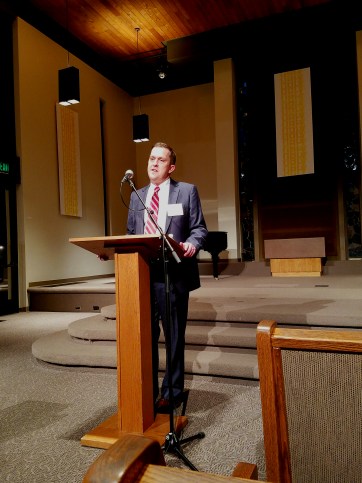
On 1/18 the Analytic Theology Seminar was treated to a talk by Michael Rea. Rea, who is giving this year’s Gifford Lectures presented the seminar with a version of one of the lectures he will be presenting in that series. Here are some notes from his talk.

20170118_154104
Oliver Crisp (Left), Michael Rea (Middle), along with Daffy Duck making a Cameo (back, center)

Divine Love & Personality

Goal: Examine the nature of divine love with an eye to the problem of divine hiddenness.

  • The fact that God has a personality give some reasons to doubt the divine hiddenness problem.


Main premise: If a perfectly loving God exists then there is a God who is always open to a personal relationship with everyone.

  • There is no non-resistant non-belief (God will always do something the remove all obstacles for non-belief/relationship.)
  • Schellenberg – the minimum God could do is give people evidence that he exists.
  • There should be no one who is non-resistant and non-believing. But there is non-resistant non-belief. (i.e. I wish I could believe, but I can’t)
  • Therefore there is no perfectly loving God


Support for the Main Premise

  • Divine love is an idealized version of some important kind of human love
    • (Transcendence undercuts our reasons for accepting this claim)


Thesis

  • Divine Love is not ideal human love


Love

  • Focusing on the best kind of human love, whatever that is… specifically whatever kind is most apt to be identified in its ideal form, with divine love.
  • Eleanore Stump ID’s two desires as being part of love:
    • Desire for the good of the beloved & desire for union with the beloved
  • Two Stipulations:
    • God desires union with human beings
    • God desires our good
    • At least one of these desires is essential to the best forms of human loves
  • Divine Love = whatever kind of love a perfect being would have for a person or group
  • Ideal love = kind of love 1 person would have for another if she were to have an ideal way the property of loving that particular person


Idealization

  • Idealization of simple traits – removal of relevant limitations
  • Idealization of complex traits – removal of relevant limitations + idealization of competent properties


Ideal Love

  • Limitless desire for the good of the beloved, desire for union with the beloved, or both.
  • Limitless desire – One who limitlessly desires something desires it in a way that eclipses in priority and strength desires focused on anyone or anything else


Ideal Human Lovers

  • We have limited capacity to endure interpersonal union
    • So…. Desire for union with someone can conflict with desire for their good.
  • We have limited cognitive and causal powers
    • So…
  • In the divine case these are not a problem


Divine Love as Ideal Love

  • If God loves us ideally, God is maximally oriented toward our good or maximally oriented toward union with us or both.
  • Wessling on Supreme Love
    • When God has supreme love for a person, He desires her highest good, and his character generates no contradictory desire of equal or greater strength….God therefore does all that is morally permissible and metaphysically possible to fulfill this desire.
  • Susan Wolf on Moral Saints
    • Someone maximally devoted to improving the welfare of others to the exclusion of the promotion of her own interests – (sainthood is not rational or desirable for human beings)
  • Could God be a Moral Saint?
    • God has unlimited resources
    • God has unlimited cognitive capacity
    • God does not need anything
    • So what is the problem?
      • The Problem is Divine Personality
    • Sainthood Implies Self-Annihilation
      • “The pursuit of Moral sainthood seems to require either the lack or denial of the existence of identifiable, personal self.”
      • IF God is genuinely personal, and has distinctive personality, it stands to reasons that God has interests, desires, and projects not necessarily oriented around he interest of others.
      • IF God has personality, then divine interests might conflict with human interests.
    • Opportunistic Sainthood?
      • If God is devoted to our good just so long as there are not conflicts between divine and human interests, then God is not maximally devoted to our good.
    • God is Not a Saint
      • If divine & human goods do conflict, it is no more rational, good, or desirable for God to pursue sainthood than for human beings to pursue it…. In fact, it would be bad for God to pursue sainthood. It would be irrational.
    • Maximal Devotion to Union?
      • Could God be limitlessly devoted to pursuing union with each of us?


Second Objection

  • There is no reason to think we are fitting objects for unlimited desire for union
  • Even if we are fitting objects, we are not maximally fitting objects for such a desire


Main Conclusion

  • A perfect being would not be maximally devoted to pursuing our good or our union
  • A perfect being would not love human beings in an ideal way
  • In fact, we have good a priori reason to think that a perfect being would priorities our good or union with us at all.
  • That God loves human beings at all is an article of faith, not philosophy.


An Unexpected Conclusion?

  • The Christian tradition never affirmed that union with human beings is the proper object of maximal devotion… or of human goods either.
  • Is the conclusion unpleasant? A God who prioritizes divine good over human goods doesn’t seem like a God who loves us enough.


Whence the Conflict?

  • What divine projects might take priority over the promotion of our good? We can speculate, but this is precisely the corner of space of possible goods about which we can most expect to be in the dark.


No Possible Conflict?

  • It is by no means obvious that the best interest of one person can conflict with another, because love creates a common set of real interests. – Thomas Talbott
  • If Talbott is right, then lovers quite literally lose themselves in their relationship. So this seems implausible.


How non-ideal can divine love be and still be called love?

  • There have to be some boundaries on what behavior can plausibly count as loving.
  • Why think we can identify those boundaries a priori?
  • We should ask instead what signs of love can be identified in God’s (alleged) ways of relating to various kinds of people, and what narratives can be told about these relationships to support positively valanced analogies.


“God is justified in permitting Divine hiddenness even if it doesn’t promote any human good.”

Love, Obedience and Moral Obligation: Reflections on Scotus

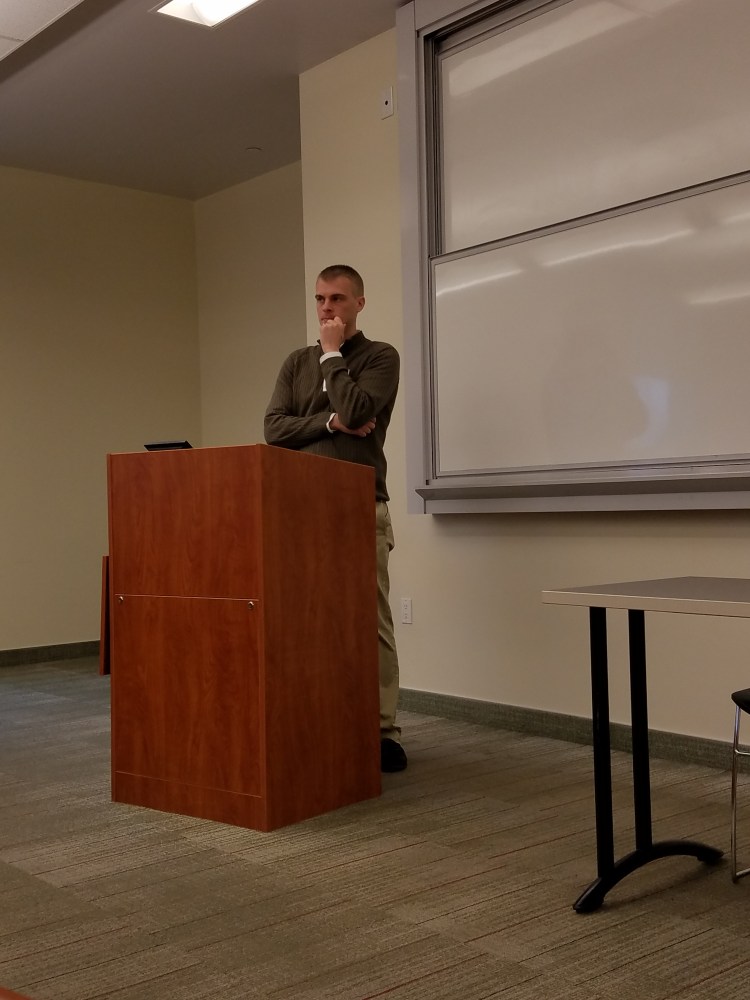
Last week at 2016 Analytic Theology Seminar Series at Fuller Seminary Thomas Ward presented a paper on love for God in Duns Scotus’ works. For interaction with this paper

ea01b454b18d7999e8c7788ca4acd66b1473908485_l
Tom Ward is Assistant Professor and Graduate Director of Philosophy at Loyola Marymount University (CA)

see a forthcoming blog post by JT Turner on Fuller’s Analytic Theology Blog. In the meantime here are some notes on Thomas Ward’s Lecture.


Love, Obedience and Moral Obligation: Reflections on Scotus

1.Contesting Voluntarism

  • Scotus – Divine Command is not the source of our obligation to Love God above all things. Love of God entails an obligation to obey his commands.
    • This might not be a actually a divine command theory
  • Scotus – so widely believed to be DCT & V
    • Scotus’s views do not comfortably bear these labels
  • Quinn: V – thesis that morality depends on the will of God
  • Murphy some moral status M stands in dependence relationship D to some act of the divine will A
  • If this is true – Scotus is not V – some moral obligations that don’t dpend on God’s will, i.e. the moral obligation to love God.
  • Scotus & Ockham were more liberal about what they thought it was logically possible to do.
  • According to Kent he is V, Williams he is not, Under Quinn & Murphy he is not, According to Evans he is not either.
  1. A Mitigation Interpretation
  • A mitigating interpretation – giving reasons why God legislated what he did, etc.
  • Thomas William’s unmitigated – God can do whatever is logically possible
  • Scotus – there are necessary moral truths over which God has no control:
    • Necessary moral truths – are logically necessary
    • This affects how we should think of the claim that God can do logically possible for God to do (as opposed to logically possible simpliciter)
  • Scotus – God must be loved
    • This is independent of the command to love him
    • From this obligation to love God, we can derive an obligation to obey God’s commands

3.Scotus on the Natural Law

  • If its part of natural law: first practical principles known in virtue of their terms or as conclusions that necessarily follow from them. If some precept p is part of the natural law then p is necessary in a very strong sense: God cannot make P false
  • Loose sense natural law – not entailed by but highly consonant with natural laws
  • He thinks some of the 10 commandments are part of natural law – the first table belong to the natural law in the strict sense, the second table belongs to the natural law in the loose sense
  • Augustine – we love our neighbor for God’s sake. Scotus might be seen as continuing the Augustinian intstrumentalization of the great commandments.
  • Second Table – If that good were not commanded, the ultimate end could still be attained and loved (beatific vision), the attainment of the ultimate end would still be possible.
    • Second table conformity is at best contingent upon achieving the ultimate end
    • Second table is contingent in the fact that God could have put forth other commands or none at all
  • First table commands describe precisely what natural law requires

4.The logical necessity of the practical necessity that God must be loved

  • Deus est diligendus… is a practical truth preceeding any act of the divine will
  • Conclusion: Scotus thinks that God’s doing or willing anything in any way contrary to Deus est diligendus “includes a contradiction” and is therefore impossible.

5.Logical Modalities a la Scotus

  • Real possibility: something is really possible if there is a power to bring it about
  • Logical Impossibility: defined in Scotus’s terms as a certain way in which terms cannot be combined by the mind because of the relationship of terms in a proposition, namely that they are opposed to one another
  • Logical Necessity IFF its contrary (or subcontrary) and contradictory are logically impossible.
  • God must be loved is necessary in this sense.

6.God must be loved

  • A logically necessary practical necessity
  • What should be loved the most is the best – so God should be loved the most
  • If we grasp the meanings of these terms we just “see” that God should be loved the most
  • There is a normative connection between love and the good
  • God has not choice but to be the highest God, thus he has no choice to be the object of greatest love

7.Logically Possible for Whom?

  • Its logically possible to hate God, but God can do anything which does not entail a contradiction, God should be able to hate himself. Why not?
    • A command to hate or to fail to love God is prima faciaie logically possible
  • Needs to be qualified: Humans, robots, elepthans can kick a soccer ball but pens and parameciums can’t. So do determine logical possibility we need to consider the PHI-ing in relation to the x.
  • Hating God is logically possible for humans and angels, but for God it is logically impossible.
  • The terms God & failing to love God are opposed to eachother.
  • God’s power means – God can do whatever is logically possible for God to do

8.God must love God

  • His radical voluntarism is more moderate if understood as “God can do whatever is logically possible for God to do.” Vs. “God can do whatever is logically possible.”
  • God by nature has intellect and will & is therefore capable of happiness + God has no potentiality, so he is happy. Only by knowing God can a person be happy. So God loves God.

9.God can’t command you to hate God

  • Also God cannot dispense anyone from their obligation to love God.
  • Where God to issue a command – never love me
    • Either it would generate a moral obligation or it wouldn’t
    • JERK MOVE
      • If so, he would have a moral obligation to love him and NOT love him. This would be an command in which one would be determined to fail
        • This is a jerk move, so God cannot possibily will to obligate some never to live him
      • OR… FRUSTRATION MOVE
        • God would be frustrated in his legislative obligation
        • But God cannot be frustrated: he gets what he wants
      • So He could not possibly issue a command which could not generate a moral obligation
  1. From Love to Obedience
  • Loving God, is “to repeat in our wills… God’s will for our willing. But willing what God wills for our willing is obedience. So it is necessarily true not just that God is to be loved, but that God is to be obeyed.”
  • One of the problem of DCT – is that they can’t show there are obligations to obey the command
    • What we need then is some other obligation to obey divine commands
    • We are required to love God, but not simply because it is commanded, but because it is logically necessary.
    • We have this moral obligation that does not depend on God’s will, because it is logically necessary that we love God.
  • This helps w/certain objections to DCT
    • God could command horrendous things
    • DCT is circular

LATC 2017: Dogmatics & Systematic Theology – Scott Swain

Here are some notes on Scott Swain’s plenary lecture at LATC 2017….

Introduction

Bavinck: Dogmatic Theology is the knowledge God has revealed in his word to the church about the world and creatures as they stand in relation to him.

  • Dogmatics exists because of the gospel of the glory of the blessed God.20170112_203913

Some concerns of Systematic Theology

  • Concerns for unity – NT & OT, Theological Knowledge and other Knowledge
  • Scope – all of scripture
  • Proportion – science of everything, but not about everything
  • Relations – between different areas of Christian theology

B.B. Warfield found that it was necessary to defend the disciplines right to exist. Barth later on concluded that “nothing we are producing now can stand with the achievement of medieval, post-reformation, etc. dogmatics”

  • 20170112_203913Though it hasn’t reached its glory days, it holds some degree of prominence again today

The recent ascendency of ST hasn’t necessarily received a strong welcome from evangelicals. BB Warfield even acknowledges some think that Biblical Theology has replaced ST.

BT’s resistance to letting ST rule has grown. Evangelicals have questioned ST’s ability of ST… it tends to impose a structure not transparently given in scripture. “ST doesn’t encourage the exploration of the Bible’s plotline.”

BT seeks to seek out the rationality and genius of each genre and to ground stuff in unfolding drama of redemptive history.

More recently Missional theology also wonders whether ST needs help. Missional theology would direct ST to attend more to the missional nature of Scripture, and direct itself towards the church’s missional end.

Aim: commend a particular conception of ST as theoretical, contemplative, wisdom.

Thesis One

  • God presents himself to us in his word under the mode of a vision of glory, theological vision is therefore a wonder to be held, a truth to be known, a doctrine to be believed.
    • Vermigli – contemplative wisdom holds first place over practical wisdom
      • The end of Christian godliness is that in us should be repaired that image…. That everyday we may grown in the knowledge of God.
      • Speculative knowledge prior to action

Thesis Two

  • Dogmatic theology has a mixed character, but is still a unity
    • Some disagree – theoretical and practical
    • The unity of the object is not in the material of the object….
    • Because holy scripture speaks of doctrines and morals and describes the principle of unity
  • JI Packer’s illustration of balconeers watching people travelling below. They are onlookers….. travelers, face problems which are essentially practical. They may think over the same area, but their problems differ. The theology of travelers has a theoretical angle. Packer seems to suggest that any concern that unprocessed theory is arcane and uninteresting, engaged in the vice of curiosity.
  • Speculation… a viscous mode of contemplation.
  • We should be anti-speculative but we cannot afford to be anti-theoretical or anti-speculative.
  • Does thinking of theology as “contemplative wisdom” encourage idolatry?
    • Luther: sinful human and the God who justifies
    • Bayer – thinks that it suffers from a totalizing problem, and a de-historicizing problem.
    • With Bayer we can agree that it is susceptible to these mistakes – but the many errors of Hegel aren’t addressed by abandoning ST but modifying it (perhaps under a Pilgrim context)
    • This allows us to insist upon the limited nature of our contemplation
    • Directs us to expecet perfect contemplation only in the beatific vision
    • Some problems w/Bayer – his view undermines God’s self-presentation of his word. Yes God is the justifier, but it does not exhaust God’s action.
  • Dogmatics desrives its character from its primary object: the Triune God
  • Bavinck: God is independent, not only in his existence but in all his attributes and perfections
  • God does not exist for any reason that exists outside of himself. From him and through him and to him are all things
    • Thus while the study of God produces all kinds of practical ends, but it is not exhausted in its service towards practical ends
    • Godliness prepares us for contemplation of God
    • God is Wisdom’s goal

Thesis Three

  • Theology is not a view from nowhere
  • Dogmatic theology occupies itself with God, it is a view of God
  • Theology’s object is twofold – God’s being, wisdom, and power ALSO the unsearchable depth of God’s works
    • It is the thrice holy God almighty and all things relative to God
  • It contemplates objects contemplated by other objects as well, what distinguishes dogmatic theology is not the uniqueness of its objects or what it knows, what distinguishes it is the prespective from which it knows God, humanity and the lilies of the field…
    • From the perspective of God’s self revelation, his naming of humanity, his care for the lilies of the field
  • Dogmatic theology is a view of God from God
    • How? Cuz God has revealed himself to us as he himself is
  • This is why dogmatics does not follow the method of so many science of reasoning from effects to causes. The method of dogmatic theology is to begin from God. That is because that is how God has revealed himself in his word.
  • It is also a view of God from the presence of God
    • Our theology, ectypal, contemplates it from a humbler vantage point. To profess theology is a priestly ministration
  • It is the view of God from God in the presence of God

Thesis Four

  • It takes a systematic shape in commending its work of contemplation
  • What shape might a modest system of dogmatic theology take?
    • Astonished contemplative wonder of Paul, also John’s sketches
  • Following a brief introduction, a system of theology might first treat the depths of the riches of the triune God in his unfathomable being
    • This is not very popular in modern theology
    • “Protestant Theology for Liberals” as an example – it treats God exclusively in relation to creatures.
    • While its true of pilgrim theology that creaturely mediation is a fact, something more is required. Treating God before his relation to creatures takes seriously that God is who he is apart from anyone else. He is who he is.
    • Treating God himself before treating his relation to creatures – allows us to treat his relationship’s mixed nature. One of absolute benevolence, marvelously disinterested interest in us.
    • It may treat secondly, the works of God. Nature, Grace, Glory. Each of these three works are related. Grace restores and perfects nature.
    • Third – connect each individual topic to God as cause. It is due to the fact that strictly speaking, the nature, ends and activities of God’s creatures only exist in relation to God, and therefore creatures can only be understood in relation to God, their supreme author and end.
  • In following this method ST proves itself true to its name as Theology – God, always God from beginning to end (Bavinck)

Dogmatics is a mixed discipline…contemplative understanding of dogmatics might inform the organization of theology. How might such a conception relate to theological and academic disciplines?

Dogmatic theology has the capacity for functioning as an inclusive discipline. Because of its attention to the supreme object and its concern to order all thing in relation to him, it can provide a framework to organize the other disciplines. For these disciplines are finally ordered to the glory of the Triune God and our wellbeing in him.

LATC 2017 – Knowledge Puffs Up, But Love Builds Up

Some notes on Chris Tilling’s break out session at LATC 2017…

20170112_162633

1 Corinthians 8:1-7

  • Contains the epistemological issue
  • Paul creates the contrast that structures what follows
    • Knowledge puffs up, love builds up
    • Knowledge as possession puffs up, he is not anti-intellectual. He is against a particular way of knowing.
    • Paul articulates a relational/covenantal way of knowing, expressed in our love of God
    • The necessary knowing in 8:2 is expressed as knowing God and being known by God in 8:3 – this is a covenantal knowing
      • Monotheism = within context of covenant refers to a rigorous exclusivity of relationship.
    • In Paul’s idiom covenant and knowledge go hand in hand
  • Verse 4-6 repeat and elaborate the contrast that proceeded
    • Two propositions (Corinthians)
      • We know that no idol in the world really exists
      • There is no God but one
    • Paul’s Response
      • Even though no idol exists (as real divine beings)
      • But for us there is one God the Father, etc.
      • Corresponding w/ love for God, he uses the words of the Shema b/w God and Jesus
      • This is a love-oriented understanding of “knowing”

Paul, The Task of Dogmatics, and “Barthian” Theology

  • Barth means by revelation – a concrete relation to concrete humanity
  • For Barth the criteria and possibility of dogmatics is described in personal terms
    • The Word of God is a success word
    • Revelation is not simply over there, but includes the entire correspondence of man’s side
    • The personal word becomes a relational or participatory one

Stephen Holmes & Katherine Sonderegger

  • Sonderegger
    • If Paul claims knowledge of God is bound up in loving God, and as such cannot be a possession or abstraction
    • In the first couple of chapters of her ST, there is an imposition of non-relational abstract knowledge. She presses the distinction between the who & what of God, and narrative/metaphysics. i.e. to look beyond the genre of scripture to its subject matter
    • Problem – she deploys an abstract concept, speaking of the WHATNESS of God. In contrast to this, Pauline epistemology, ONENESS is not just a brute theological fact, it’s a relational fact explained in relational terms.
    • Sonderegger’s project lands on the wrong side of the Pauline contrast
      • Question – Can you come to know certain things on the “right side” of this contrast, but explain it in such a way that when it is articulated or communicated it looks more like the “wrong side?”
    • Certain theological facts cannot be abstracted/divorced from God’s relationship from his people.
    • “Almost every attempt to articulate a metaphysical truth, lands on the wrong side of the structural contrast.”
  • Stephen Holmes
    • The doctrine of the Trinity is necessarily and precisely “useless” – knowledge of the divine is a highest end, it is the nature of the highest end that it is of no instrumental use.
    • Knowledge of God that is not discipleship/lived is not theological knowing at all, it is a mere puffing up.
    • He is allowing an abstract concept to order his God-talk. It is a means-end schema.
    • Also problematic, Christ is talked about in Scripture as both means and end

Conclusion

  • Paul had a controversy about knowledge /w the Corinthians who had an intellectualized understanding of knowledge, Paul highlighted participations and relational nature of knowledge. Barthian theology resonates deeply with this. It locates theological knowledge in the wider grammar of faith, love, and repentance. Recent trends in theology are losing this Barthian sensibility, and are allowing abstract knowledge to drive them. If this continues unchallenged, the gap b/w Systematic Theology and Biblical studies will continue to widen.

LATC 2017: Why Should Protestants Retrieve Patristic and Medieval Theology? – Gavin Ortlund

Some notes from Gavin Ortlund’s Breakout Session….

Retrieving the Leavened Bread out of the Unleavened

  • Warfield on Augustine: Doctrine of Grace is Augustine’s greatest legacy. A new Christian piety comes from Augustine. He is the author of grace and the “Father of 20170112_144711evangelicalism.”
    • Warfield calls Augustine the found of Roman Catholicism too
    • Shows broader attitude: Evangelical doctrines and bad Catholic doctrines, two children struggling in his mind, but the REAL Augustine is the “evangelical Augustine.”
    • He was a proto-protestant who would have eventually become a “protestant” had he lived longer
  • Method: The last 500 years are the “good years”, we construct theology and see older theology through the lens Protestantism
    • Easy to take sola scriptura and make it sola reformationae
    • In Warfield’s account it never comes into view where Protestantism may be stretched and challenged by Augustine’s theology.
  • There are good reasons for including the entire 2000 years of church history, as a part of protestant’s theological community. We have a good example in the works of the Reformers
  • Reformers where engaged in a work of theological retrieval
    • Defended their cause against the charges of novelty
  • Warfield saw the church as having experienced a fall that needs to be recovered from. Luther and Calvin by contrast saw the early church as a tool to be recovered and retrieved.
  • Calvin and Luther both affirmed the continuation & preservation of the true church in every generation. The last thing they intended was a denial of the first 13 centuries. They saw themselves as attempting the establishment of a proper Catholicism.

How Patristic & Medieval Theology Can Resource Protestant Theology

  • Four ways….
  • First – P & M can help bulk up PT where it is weak and underdeveloped.
    • Metaphor: Child attending a school
    • One need not regard church tradition as infallible, simply recognize that each generation of the church has a unique gift towards the church
    • Medieval theologians saw creation, fall, relationship to angels as theological topics with important consequences
  • Second – can help shape theological sensibilities and values
    • Metaphor: visiting the grand canyon doesn’t just give you information
    • Example of sensibilities: Doctrine of God had different instincts/sensibilities in P&M, like divine simplicity or univocity/analogy or hiddenness
  • Third – can help provide perspective on modern theological debates (liberal/conservative spectrum)
    • Metaphor: Going to see a counselor to get perspective on something
    • Example: Augustine’s doctrine of creation. There are concerns he has that are very different than ours. Favored an approach to the text which provides a helpful model of humility, wants to learn from natural sciences
  • Fourth – can help bring about synthesis
    • Metaphor: A Guide
    • Example: Doctrine of Atonement. Approaching this doctrine helps you see ways of holding things together that in the modern literature seem to be at odds with one another.

Three Case Studies of Patristic & Medieval Retrieval

  • Boethius’s Consolation of Philosophy
    • Philosophy functioned as a handmaiden to not a replacement for theology. Can help w/doctrine of God: creation/Creator, simplicity, foreknowledge, God’s relation to time
  • Gregory the Great’s Book of Pastoral Rule
    • Capable administrator but Gregory regarded himself primarily as a religious leader. Calvin called him the last good Pope. He lived in a Latin district of Constantinople, thus he was shaped by eastern theology. Gregory is the only Latin Father whose works were translated into Greek in his lifetime. How to benefit: practical focus – how to speak differently to different kinds of people
  • John of Damascus Writings on the Iconoclast Controversy
    • The preeminent representative of the Byzantine Tradition. Was practically unknown in the West until the 12th Protestant iconoclasm didn’t even refer to John of Damascus. The ancient eastern church included more than just Greek churches (Syriac, Coptic, Slavic, Armenian, etc.). All human thought about the divine is pictorial. As a result – they were encouraged to develop a rich theology of art. For evangelicals, his work may challenge what embodiment would mean for us.20170112_144711

LATC 2017: Can I Get a Witness? Analytics, Poetics, and the Mission of Dogmatics – Kevin Vanhoozer


Here are some lecture notes from Kevin Vanhoozer’s plenary session at LATC 2017kevinvanhoozer1200x1800

A-Introduction – the discourse of dogmatics: saying what is “in Christ”

  • Who God is and what God is doing – “in Christ”
  • For most of the 20th century Dogmatics is in the doghouse
  • Which comes first in dogmatics? A experience, community, language?


B-The issue: experiencing/thinking/speaking-of/living-to God


1.The Man Who Saw Infiinity

  • “The Man Who Saw Infinity” – Poetics vs. Analytics in Math
    • A feeling for form – poetic sensibility
  • What about dogmatics?
    • Where should we locate it on the spectrum? Analytic or Poetic?
      • Perfect being theology
      • Apophatic theology
      • Cataphatic theology
    • Dogmatics is a response to a prior divine communicative initiative
      • It exists under the domain of the Word
      • The communicative agency of the Triune God is what makes theological reflection possible. Christ is the human surface who mirrors the Father.


2.Dogmatic Discourse: the task

  • Barth: Dogmatics about how well church proclamation lines up with Revelation of the Word. The church must embody and proclaim the truth of the gospel. It was a science of the Word of God whose form and content is JC. It is scientific in the sense that it is the object that determines the practice.
  • Bavinck: Distinguishes symbolics from dogmatics (what it actually confesses and what it should confess). Dogmatic theology dogmatizes.
  • Webster: Focus is still on God’s communicative agency. Identity b/w God’s inner and outer works. Theology was under house arrest of modernity. Webster doesn’t deny the ectypal nature of human knowledge of God, yet this does not necessarily result in the deconstruction of dogmatics. Rather it acknowledges the limitations of human intellect, but places them under the sphere of God’s communicative action.


3.Dogmatic Discourse: The Challenge

  • Not all God talk constitutes dogmatic discourse
    • e. Jesus’ encounter w/demons. When demons speak. True, but not dogmatics.
  • Dogmatics not only involves words, but a doxastic attitude
  • The Latinization Thesis
    • Language change was crucial in refashioning the mentality of eurpoean thought process
    • Goal: have a humanist schoolboy speak and think like ciceronian Latins
    • Should we say something similar about dogmatics? i.e. to train to speak, write, and think as if they were in the same speech community as Athanasius and Calvin
  • The Globalization Thesis
  • The modern barrier to the thing-in-itself and God-in-himself

D.Dogmatic Discourse, part 1: Analytics

1.Dogmatic Discourse, Part 1:analytics

  • Language as a tool or language as what makes inter-subjectivity possible in the first place
  • Webster sounds an analytic note
    • Dogmatics is a species of reasoning. It involves viewing reason as created, fallen, redeemed. Caught up in an economy of grace. Dogmatic reasoning yields a conceptual representation to what reason has learned from following the exegetical text.
  • Is Webster an analytic theologian?
    • What is AT?
    • Its clear that Webster makes use of conceptual distinctions: i.e. Creator and Creature.
    • Dogmatics begins with economic works, and traces back to God in himself.
    • Webster insists again and again that theology proper is directed towards things unseen, but not necessarily unheard. It offers conceptual analysis of biblical discourse.

2.Linguistic Phenomenology

  • Webster may be a kind of phenomenlogist of the Triune God. Not the “thing in itself” but God in himself. Attempt to ID the essential components of phenomena. Webster even sounds like Husserl when he speaks of reducing elements to their founding principles. Webster – contemplation requires the mind to move through created things to the Trinitarian things themselves.
  • JL Austin compared his method to a phenomenology of ordinary language. Is dogmatics a sort of phenomenology of biblical language? It sort of resembles this.
  • Is analysis the task of dogmatics?

3.Warnings to reducing dogmatics to analytics

  • Webster’s Warning
  • Vos – Biblical theology considers the form and content, Systematic theology examines these same contexts as the material for a human work of classifying and systematizing according to human principles.
  • Webster: says this suggest two problems
    • Makes Bible raw material, hence the idiom of systematic theology drifts away from Scripture. It operates at a distance from the idiom of scripture.
    • Gives rise to the dangerous idea that dogma is an improvement upon Scripture.
    • Webster prefers a more “light-weight” understaning of the dogmatic task


E.Dogmatic Discourse, part 2: Poetics:

1.The Poetics of Dogmatics: a brief historical sampling

  • Not just content, but Form
  • David Tracy describes theology as the triumph of logos over theos.
  • Some examples:
    • Gregory of Nazianzus: Poemata Arcama
    • Schleiermacher: Christmas Eve Celebration: A Dialogue
    • Von Balthasar: Theo-Drama
    • Vanhoozer: Theodramatics

2.The Poetics of Dogmatics, part 2: biblical reasoning revisited

  • Webster’s exhortation to not let dogmatics drift away from the idioms of scripture
  • The imagination is a cognitive capacity: its important then to harken to the different ways Scriptures speaks of Christ. Given recent critiques of the designative function of language, we ought to pay more attention the the shaping of a biblical imagination, which includes also forms and content. Stories are not just delivery systems for delivering propositional content. They do something else too.
  • We needs poets and novelists, how much more do we need biblical narrative, to not only cultivate right opinion but also right affections.
  • What’s the moral for dogmatics? Should dogmatic theology look more like a science textbook or a story?
    • Lets not confuse propositional content and form
      • Some forms i.e. analytic excel at form
      • Some forms i.e. narrative excel at content too
    • Lets not think that dogmatics needs to adopt the styles of biblical discourse in order to think biblically
  • Gunton – Dogmas are summary of gospel material
  • Dogmas provide direction for doing, seeing, tasting, everything that is the drama of relation
  • The dogmatic imaginary is the social imaginary of the church generated and governed by the biblical imaginary

F.The Mission of Dogmatic Statements

  • Dogmatic indicatives: statements on a mission
    • Task: say what is happening in the mission of the F, S, HS
    • Dogmatics bears witness to this
    • Saying of what is in Christ, that it is
      • Many forms of IS (metaphorical, eschatoalogical, poetic, eternal)
    • Dogmatics guides the church in saying what “is” in Christ.
    • Dogmatic theologians are part of the cloud of witnesses
  • Dogmatics at Jerusalem: a mission(s) statement
    • Acts 15 – an example, Luke even uses DOGMATA to describe what happened in Acts 15
      • Judgement about “fittingness” of action to what we know is true about what God is doing in Christ
    • Dogmatic discourse and confessional statements
    • Confession is responsive and not spontaneous

G.Conclusion – the discourse of dogmatics and the gestures of discipleship

  • Why is there dogmatics rather than nothing?
  • Importance of including gestures in dogmatic discourse. Saying what IS in Christ involves action too. Action of what is true in Christ. The evangelical task is not just a finger pointing to Christ, but a whole BODY gesturing towards Christ.
  • Gestures are language too.
  • Dogmatics helps the church make Christly gestures.

Is Analytic Theology REALLY Systematic Theology?

logo-full

Last week Oliver Crisp kicked off the 2016 Analytic Theology Seminar Series at Fuller Seminary. He gave a wonderfully precise and clear lecture on the relationship between Analytic Theology and Systematic Theology. Basically he answered the question:

Is analytic theology really systematic theology or is it really just ersatz theology?

The way that Crisp approached this question was to examine the works of three different exemplars of systematic theology. Scholars whom nobody would doubt their pedigree as analytic theologians. First he examined the purpose and project of John Webster, followed by Brian Gerrish, and concluding with Gordon Kaufman. All very different types of theologians, but systematic theologians nonetheless.

In examining the works of these theologians he came up with a “shared task” of systematic theology. Think of it as a minimalist account of systematic theology:

Shared Task: Commitment to an intellectual undertaking that involves (though it may not comprise) explicating the conceptual content of the Christian tradition (with the expectation that this is normally done from a position within that tradition, as an adherent of that tradition), using particular religious texts that are part of the Christian tradition, including sacred scripture, as well as human reason, reflection, and praxis (particularly religious practices, as sources for theological judgements.

What jumped out to me about this minimalist account of ST is that it involves to main claims. One claim is about the task and the other is about the sources. The task is one of explanation, the primary sources are religious texts (broadly construed) and other secondary sources.

To me this seems like a fairly minimal account of what systematic theologians do. Naturally some may have a more robust account than this, but none will have something less than this. It seems to me, and it certainly seemed to Crisp that Analytic Theology does what is described in “shared task,” however it does it in a way that uses the tools, methods, and sources of the tradition of philosophy we have come to call “analytic.”

So is Analytic Theology truly Systematic Theology? As long as it keeps to the shared task, I have no reason to say why not.

Practicing Scripture, Christ, and the Church: John Calvin’s Agenda for the Eucharist

What is “practical” theology? Often, practical theology is thought to consist of the explicit practices of the church, such as church discipline, preaching, leadership, types of worship, etc. Is this the sort of practical theology Calvin is engaged with in his Eucharistic theology? Although a good portion of Calvin’s practical theology of the Eucharist surely is focused on explicit practices, such as those mentioned above, Calvin also concerns himself with at least three implicit practical consequences that emerge from Eucharistic theology. These three concerns revolve around: 1) faithfulness to scripture, 2) Christology, and 3) ecclesiology. Here we shall see how these three themes emerge in Calvin’s work and result in a theology of the Eucharist that is eminently practical. But first we shall begin by outlining some of the explicitly “practical” comments Calvin makes regarding this sacrament.

lords-supper2

The final twelve sections of 4.17 are Calvin’s theological reflections on how to practice the Eucharist. Here he emphasizes the necessity for communicating the communal implications of this sacrament. He points to Augustine’s work as a precedent for using this practice as a goad to arouse mutual love in a local church. (1415) Calvin also teaches that the sacrament must be offered together with the preaching of the word. To do otherwise is to promote superstition. He also addresses the topic of who ought to be able to take communion. He then devotes several pages on the proper celebration of the Eucharist, explaining how often it should ideally be taken (often) and in what manner (in both kinds). A cursory reading of this section reveals how concerned Calvin is with the actual practice of this sacrament. This sort of reading would prove instructive to those wanting to emulate Calvin’s practice; however, to simply read these twelve sections and ignore the thirty-seven sections that precede them would mean ignoring other important reasons why Calvin is so concerned with practicing the Eucharist properly, namely, his scriptural, Christological, and ecclesiological concerns.

Calvin’s thought regarding the importance of reading Scripture faithfully emerges in the section where he deals with the basis of the doctrine of transubstantiation. Thus the battle over how to practice the Eucharist appropriately appears to be a battle over how best to read scripture. He cites his Roman Catholic opponent’s use of the Exodus story in which Moses’s rod is changed into a serpent as an example of reading scripture improperly. He also cites their reading of Jeremiah as evidence that they misread scripture. According to those who argue for transubstantiation, the fact that the prophet complains that wood is put in his bread signifies that Christ’s body was allegorically affixed to the wood of the cross. (1378) Calvin  disdains  this “disgraceful” sort of allegorical reading because it occludes the prophet’s true meaning. (1378) In fact, Calvin calls those who read these passages this way “enemies” of the prophet’s true meaning. Hermeneutical concerns are not reserved to his Catholic opponents alone, he also takes aim at Lutheran readings of Scripture. In a section dealing with the use of the word “is” in the words of institution he shows his hand again, revealing how he feels about those who accuse the reformed of reading scripture improperly. Here Calvin says,


Now I think I have made my point, that to sane and upright men, the slanders of our enemies are loathsome when they broadcast that we discredit Christ’s words, which we embrace no less obediently than they, and treat with greater reverence… our examination of the matter ought to be a witness of how much Christ’s authority means to us. (1387-8)

Later on he says that his opponents imbue the “simpleminded with the notion that we discredit Christ’s words, when we have actually proved that they madly pervert and confound them but that we faithfully and rightly expound them.” This passage reveals something important about Calvin’s Eucharistic theology, namely, that a faithful reading of scripture is at the forefront of his mind when doing Eucharistic theology. Knowing Calvin, this should come as no surprise. However, this observation has far-reaching practical implications beyond the Eucharist. In Calvin’s mind the authority of Christ comes to us through scripture, and to read scripture in a way other than it was intended to be read discredits Christ’s authority. To read allegorically or to add to scripture diminishes the authority of Christ, which is something Calvin is loathe to do.

Another one of Calvin’s concerns is also related to Christological features, not necessarily Christ’s authority, but the metaphysics of Christ’s presence. Concern with the metaphysics of the Eucharist would seem to be a theoretical concern rather than a lords-supper1practical one, but it is eminently practical, for the very gospel hinges upon it. The metaphysical issue Calvin is concerned with is the Lutheran doctrine of the ubiquity of Christ. The Lutherans, according to Calvin, want to enclose Christ under the bread, and “to meet this necessity they have introduced the monstrous notion of ubiquity.” (1401) Calvin counters this “monstrous notion of ubiquity” by showing from Scripture that Christ’s body is circumscribed by the measure of a human body, thus he is not in all places. (1401) We may read this as another battle over Scriptural authority, however it is much more than this.[1] According to Calvin, the doctrine of ubiquity (which is grounded in Eucharistic theology) is “plainly in conflict with a nature truly human.” This has profound soteriological implications. If Christ does not have the same sort of human nature that we have how can we say that Christ took on our “true flesh,” suffered in our “true flesh” and also took up that same “true flesh” in his resurrection and brought it up to heaven? (1399) To say that Christ has a different sort of flesh than our own undermines the vicarious work of Christ for us; it also undermines our eschatological hope. As Calvin says, “how weak and fragile that hope would be, if this very flesh of ours has not truly been raised in Christ, and had not entered into the kingdom of God.” (1400)

The final theoretical agenda (if we can call it that) in Calvin’s Eucharistic theology is ecclesiological. In a famous passage in which Calvin argues that participation in the Eucharist makes all who partake  participants in the one body of Christ, Calvin explains how the nature of bread shows us that this is so. He explains that just as bread is made of many grains so that one cannot be distinguished from the other, it is the case that the body of Christ (i.e. the church) is joined and bound together so that “no sort of disagreement or division may intrude.” (1415) This has profound implications for local congregations. In fact, Calvin highlights this, saying that we cannot injure, despise, reject, abuse or offend other believers and not do the same to Christ; we cannot love Christ without loving other believers, and we cannot give ourselves to Christ without give ourselves to one another. However, these ecclesiological implications go beyond the local congregation (though Calvin certainly had local concerns in mind), and the call to unity is a call for the universal church to live in a united manner. This is a matter that seems to be understood across the reformation as a whole. Most efforts that were made to encourage unity throughout the magisterial reformation revolved around the Eucharist. For instance, consider Wolfgang Musculus’s writings on the Eucharist. Craig Farmer argues that substance of Musculus’s Eucharistic theology (i.e. the notion of an exhibitive presence) remains relatively stable, but that he was willing to abandon certain controversial terms in making efforts towards finding a middle ground between Wittenberg and Zurich. (Farmer, 310). Similarly, throughout they years Calvin, makes adjustments to his Eucharistic theology in order to promote Eucharistic concord. According to Wim Janse one would not realize this simply by reading the 1559 Institutes. (Janse, 37) In his article “Calvin’s Eucharistic Theology: Three Dogma-Historical Observations” Janse argues that Calvn’s development of his Eucharistic theology goes through Zwinglian, Lutheran, and spiritualizing phases. The source of these changes came from his desire to find consensus. Thus in Calvin’s development of Eucharistic theology we see a series of compromises and conciliatory formulations. (Janse, 40) Not only do we see his goal of church unity through the Eucharist manifested in his theological development, we see in his actions, for instance the signing of the Augsburg Variata and the Consensus Tigurinus, as well as his cultivation of relationship with Melanchthon.

Calvin’s practical theology of the Eucharist extends far beyond typical “practical” concerns. His Eucharistic theology has far reaching implications for how scripture is read, how the gospel is understood, and how the church expresses its unity. Given that these are not the typical concerns of many practical theologians today, those doing practical theology would do well to pay attention to how Calvin’s “theoretical” theology does not lend itself to the tidy separation between theoretical and practical theology.


[1] For instance, see where Calvin says “They cannot show a syllable from Scripture by which to prove that Christ is invisible.” (1398)