This guy epitomizes what it means to come from Simi Valley.

Just kidding… but not really.
Scattered Thoughts on Theology and Ministry…
This guy epitomizes what it means to come from Simi Valley.
Just kidding… but not really.
Joe Thorn (@joethorn) gave me the great idea of blogging about cool beards. At this moment, I am beardless, but its okay its coming back soon! So I thought it would be cool to put up a picture of some pastor/missionary/theologian that I admire for his beard and for his ministry. This week’s beard is Hudson Taylor.

James Hudson Taylor (Chinese: 戴德生) (21 May 1832 – 3 June 1905), was a British Protestant Christian missionary to China, and founder of the China Inland Mission (CIM) (now OMF International). Taylor spent 51 years in China. The society that he began was responsible for bringing over 800 missionaries to the country who began 125 schools[1] and directly resulted in 18,000 Christian conversions, as well as the establishment of more than 300 stations of work with more than 500 local helpers in all eighteen provinces.[2]
Taylor was known for his sensitivity to Chinese culture and zeal for evangelism. He adopted wearing native Chinese clothing even though this was rare among missionaries of that time. Under his leadership, the CIM was singularly non-denominational in practice and accepted members from all Protestant groups, including individuals from the working class and single women as well as multinational recruits. Primarily because of the CIM’s campaign against the Opium trade, Taylor has been referred to as one of the most significant Europeans to visit China in the 19th Century.[3] Historian Ruth Tucker summarises the theme of his life:
“No other missionary in the nineteen centuries since the Apostle Paul has had a wider vision and has carried out a more systematised plan of evangelising a broad geographical area than Hudson Taylor. [4] ”
Taylor was able to preach in several varieties of Chinese, including Mandarin, Chaozhou, and the Wu dialects of Shanghai and Ningbo. The last of these he knew well enough to help prepare a colloquial edition of the New Testament written in it.[5] (Wikipedia)
Check out : http://www.joethorn.net/2012/02/27/bearded-gospel-men-hudson-taylor/
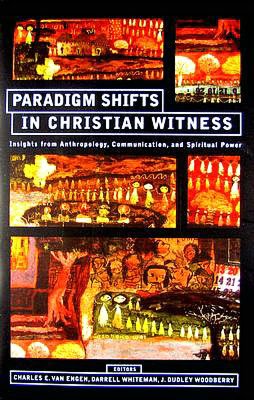
Van Engen, Charles and Darrel Whiteman, and Dudley Woodberry editors. Paradigm Shifts in Christian Witness. Maryknoll, NY: Orbis Books, 2008.
Paradigm shifts in Christian Witness consists of essays written about Charles Kraft’s contributions to missiology. Eighteen different authors contributed to this volume. These authors focused on three areas in which Charles Kraft made a significant contribution to missiology: cultural anthropology, communication theory, and spiritual power. Each of these areas of missiology is studied in an in depth manner by the different contributors. Three questions are asked about each of these areas: how did Kraft make this area an important part of missiology, how is Kraft’s contribution affecting missiology now, and how is missiology in the future going to be affected by this contribution? By asking these questions the reader discovers the gravity of Kraft’s influence which can only be described as a paradigm shift.
This book does a great job of bringing together a diverse group of scholars in order to present a well rounded account of Kraft’s contributions. With authors coming from different countries, schools, and denominations we are able to see that Kraft’s work has affected not only a small circle of scholars but the practice of missiology worldwide. The variety of perspectives that are represented serve to show that Kraft’s work has truly contributed to a “paradigm shift.”
This book might be improved by bridging the gaps between the three areas of study. The studies of cultural anthropology, communication theory, and spiritual power seemed a bit disconnected. How do these different areas of study affect each other? How are they related? These are the questions that might be asked by a reader. It would have been enlightening if some of the contributors tackled these kinds of questions.
Within the context of Biblical Theology of mission, this book fulfills the function of introducing the student to the different aspects of missiology. Since missiology is a multidisciplinary discipline which consists of disciplines like: leadership, sociology, statistics, urbanization, and psychology, it was helpful to see three disciplines tackled in light of the missiological task. One section of the book which was particularly enlightening for me was the section on spiritual power. In my own experience, this is an area which has often been overlooked. Through this book we see that Kraft has brought this area of study to a position of importance in missiology.
Overall this book was an enjoyable and informative read. The essays which describe the future effects of Kraft’s work in missiology were encouraging. These essays focused on how missiology affects the work of missionaries. As a student that plans to go out into the mission field it was these types of essays which spoke the loudest to me. They presented me with issues to think about as I fulfill God’s mission as well as information which will assist me in fulfilling God’s mission in a more effective manner. I hope that Kraft’s influence will extend far beyond the work of the contributors, that it will extend to those who are reading this work done in honor of Kraft. By reading this book, and taking what I have learned from it I can honestly say that Kraft’s influence will be felt wherever God’s mission takes me.

For it is by grace you have been saved, through faith—and this is not from yourselves, it is the gift of God— not by works, so that no one can boast. Ephesians 2:8-9


New Movie coming out about Abraham Lincoln. It really makes me think whether what I was taught in class about America was actually true.

Jefferson Bethke remakes Rob Bell’s ‘Love Wins.’ However, the good news is Jesus Wins.
(Credit to: Grace For Sinners Blog)
 CWoznicki Think Out Loud