Some Thoughts on Ephesians Three and the Christian Community

Just as he did in Chapter 2, in Chapter 3 Paul continues to elaborate on the Jew-Gentile relationship that exists within the Church. The Gentiles were once without hope and without God, and the Jews were trapped under a Law they could not fulfill. These two groups were once divided, but in Christ God has broken down the dividing wall between Jew and Gentile, making these two groups one new group. This new group, formed of Jews and Gentiles, are fellow heirs, members of the same body, and partakers of the promise in Christ Jesus.

Last time when we looked at Chapter 2 we saw that Paul uses various images to describe this new group, for instance temple, dwelling place, family. Yet in discussing the fact that God though Christ has formed a new humanity, which we call the Church, we need to remember why God does this. God didn’t break down the dividing wall so that we could all get along and sing kumbaya around the campfire. The reason why God brought these two groups together was so that through the Church the manifold wisdom of God might be made know to the rulers and authorities in the heavenly places.

That sounds pretty ethereal, but if you sit for a second and dwell on that it actually becomes very concrete. Think for a second about how this world deals with differences among groups of peoples. Now think of some words that describe how the world deals with those things. Do happy thoughts come to mind? Probably not. The words that come to my mind are: anger, pride, pain, injustice (and the list goes on.) The way of the world is a way that leads to pain, suffering, marginalization, and anger. Yet God, by revealing this mystery, shows the rulers and authorities that this way of doing life has come to an end. A new age has begun, or better yet a new age has broken in. The key to understanding this is to understand that the church is an eschatalogical community. The church is a community that lives in the now/not yet of history. So as the church lives in unity, across cultures, sub-cultures, races, etc. it shows the heavenly rulers and authorities (as well as their earthly counterparts) that God has the final word and that the future is secure. By living in unity the Church shows the world that in the end its not division, anger, and pain that wins the day rather its the way of new creation that wins the day.

As you think about Ephesians chapter 3 this week spend some time thanking God for revealing the “mystery” and for the incredible riches he has given you in Christ. Also spend some time thinking about the diversity of people and cultures in his Church. Pray that this diversity might grow to fulfill its purpose of making God’s wisdom known around the world. Spend some time praying for unreached people groups. Pray that God would bring them into this family too, so that his wisdom might be made known among the rulers and authorities in the heavenly places.

If you are interested in learning about how diverse the global church really is I would recommend picking up the following two books by Mark Noll:

  1. The New Shape of World Christianity
  2. Clouds of Witnesses: Christian Voices from Africa and Asia

If you want a good place to start learning about unreached people groups so that you can pray for them I would recommend checking out http://joshuaproject.net/

The Next Pope Will Be…

A few weeks ago Pope Benedict XVI resgined from his positions as the Cardinal of Rome. To a certain extent this makes sense (though its virtually unprecedented). Here are some reasons why that made sense:

  • He is old: He is the fifth oldest person to have been elected pope.
  • He is an academic at heart: Ratzinger became an academic theologian. He had a long career as an academic, serving as a professor of theology at several German universities, before being appointed a cardinal in 1977. Prior to the promotion Ratzinger had relatively little pastoral experience. Now I’m not knocking academics, I too am an academic at heart, neverthless God does grant people certain skills and passions and Academia was one of Ratzinger’s (I mean Pope Benedict XVI’s) passions.
  • He was worn down by the sexual abuse scandal: According to John L. Allen, “Ratzinger was punctilious about studying the files, making him one of the few churchmen anywhere in the world to have read the documentation on virtually every Catholic priest ever credibly accused of sexual abuse.” Having to read the horrific accounts of sexual abuse will most certainly wear you down and sap you of all the spiritual energy you might have.
  • He wants to write more: This is just my speculation but, Ratzinger is the author of 66 books, I can only imagine he wants to continue his writing ministry.
  • He never really wanted to become the Pope: According to the Gospel Coalition – “In 1997, at the age of 70, he asked Pope John Paul II for permission to become an archivist in the Vatican Secret Archives and a librarian in the Vatican Library, but the pope refused. At the time of his election to pope, Ratzinger had hoped to retire peacefully and said that “At a certain point, I prayed to God ‘please don’t do this to me’ . . . Evidently, this time He didn’t listen to me.””

So its now evident that Pope Benedict XVI will be stepping down, so the questions is:

Who will be the next Pope?

Let me speculate a bit. There are a couple of things we need to take into account when asking this question, for example we need to keep in mind that tradition and historical precedence will certainly play a huge role in choosing the next pope. For instance, only until recently all the Popes were Italian. We also need to take into account the composition of the college of cardinals, the majority of the cardinals were appointed by Benedict XVI or John Paul II. Both popes were conservative thus the next pope will also likely be conservative.  These are two important factors we need to keep in mind when speculating about who the next pope will be, but I think there is one factor that outweighs both of these factors. Namely that:

Christianity is no longer a “Western” religion.

Or as Mark Noll would put it, there is a New Shape to World Christianity. Consider the following facts from his book:

  • On an average Sunday, Roman Catholics in the US worshiped in more languages than at any previous time in American history.
  • On an average Sunday there were more Roman Catholics at worship in the Philippines than in any single country of Europe, including historically Catholic Italy, Spain, or Poland.
  • The largest chapter of the Jesuit Order is found in India.

My point is, that the Catholic church is changing. Roman Catholicism is still strong in Latin America and its growing significantly in Africa and Asia. All the while church membership is dwindling in the Western countries. And even when Catholicism exists (in a “vibrant” way) in Western countries it is a more liberal/humanistic version of Catholicism. This type of Catholicism does not capture the hearts of adherents in the global south. So what does this all mean for who will be the next pope? It means that

The next Pope will come from the “Global South.”

Catholicism is changing, its strength lies in the “Global South,” in the continents of Africa and Latin America especially. If the college of cardinals does not take this into account they will be making a grave mistake. If they choose someone from the West, it will certainly be because they have succumbed to the idols of tradition and precedence. So my guess is that the next Pope will come out of Africa.

Pope Benedict XVI
Pope Benedict XVI

Why Should I Learn Greek and Hebrew?

Listen to Martin Luther’s encouragement to learn the original languages of the Bible:

“In proportion then as we value the gospel, let us zealously hold to the languages. For it was not without purpose that God caused his Scriptures to be set down in these two languages alone–the Old Testament in Hebrew, the New in Greek. Now if God did not despise them but chose them above all others for his word, then we too ought to honor them above all others. … And let us be sure of this we will not long preserve the gospel without the languages. The languages are the sheath in which this sword of the Spirit is contained; they are the casket in which this jewel is enshrined; they are the vessel in which this wine is held; they are the larder in which this food is stored; and, as the gospel itself points out, they are the baskets in which are kept these loaves and fishes and fragments.”

Greek NT

What Lent is Really About

Lent….its that Catholic thing where you punish yourself by not eating chocolate.

I grew up in a mixed household, my Dad was Roman Catholic and my Mom grew up Presbyterian but eventually became a charismatic evangelical (notice I didn’t say pentecostal). Although my Dad was Roman Catholic, his Catholicism had very little effect upon the daily life of our family. In fact, at times it seems like I knew more about Catholic theology and doctrine than he did. My upbringing was certainly affected more by my Mom’s spirituality than my Father’s… and my Mom’s spirituality was birthed in Guatemala. Guatemala is one of the most Protestant countries in Latin America. As a result of being so Protestant, it was often the case that Protestants tried very hard to distinguish themselves from the Roman Catholics. One of the ways they did this was by refusing to celebrate Lent. Afterall, Lent is a Catholic thing….. and Catholic things are bad. Right? Wrong!

Lent is a Catholic thing….. and Catholic things are bad.

That statement is wrong on so many levels… But today I only want to tackle one, namely that Lent is a Catholic thing. Lent is certainly not only a Catholic thing. Protestants including Lutherans, Methodists, Presbyterians, and Anglicans celebrate Lent (it is usually only a High Church thing though….) Lent lasts 40 days, not counting Sundays. It begins on Ash Wednesday and ends on Easter Sunday. It is done in commemoration of the 40 days that Jesus spent in the wilderness being tempted by Satan. So during Lent you fast from something for 40 days, just like Jesus fasted for 40 days. Most people give up easy things. Chocolate seems to be a popular thing to give up. Other times people give up really important things, like coffee. And yet other times people don’t get why they give things up and they give up really stupid things. For instance, when I was in 5th grade I had an Episcopal friend who was giving up sinning for 40 days. Really man? Sinning? Anyway, Lent is about fasting from something for 40 days.

Many people give things up as an act of self-discipline. Lent becomes an act of self-mortification. The thought process is “I’m going to give up something I like because that makes God happy.” It becomes a moralistic exercise of self discipline. But here is the catch

Lent isn’t a moralistic exercise of self-discipline, its a celebration of our union with the one who resisted temptation on our behalf.

When you give something up for Lent and you are tempted to choose that thing over your commitment to God you get to experience (in a very conscious way) temptation. When you are tempted to mess up your fast you are reminded of the fact that you are incapable of choosing what God desires over your own desires. When you are tempted to grab that Candy bar and throw away the past 30 days of Lent you are reminded that you do the same thing each time you sin. Each time you sin you choose yourself over God. If Lent were simply about reminding us of our hopelessness in light of temptation then this would mean that Lent is a very negative celebration. If this were the end of the story Lent would be one of the most depressing seasons of the year.

But Lent isn’t depressing. Lent is a celebration!

Remember what Lent commemorates? It commemorates the fact that Jesus spent 40 days in the desert being tempted by Satan, yet Jesus never succumbed to that temptation. Jesus was victorious over Satan and the temptations that human beings face. Here is the good news: If you are a Christian then Christ’s victory over temptation is your victory over temptation. It is a vicarious defeat of temptation. It is a vicarious defeat over Satan. Christ defeated temptation on our behalf because we simply could not do it ourselves.

So every time you feel tempted to give up on Lent remember the fact that when you are weak, Christ was strong. And if you are in Christ then Christ was strong on your behalf. Use this season to remember the basic truth of the Gospel, namely that Jesus took our place and did for us what we could never do on our own.

The Sinai Peninsula
The Wilderness

Some Thoughts on Ephesians Two and the Christian Community

And you were dead in the trespasses and sins in which you once walked, following the course of this world, following the prince of the power of the air, the spirit that is now at work in the sons of disobedience— among whom we all once lived in the passions of our flesh, carrying out the desires of the body and the mind, and were by nature children of wrath, like the rest of mankind. But God, being rich in mercy, because of the great love with which he loved us, even when we were dead in our trespasses, made us alive together with Christ—by grace you have been saved— and raised us up with him and seated us with him in the heavenly places in Christ Jesus, so that in the coming ages he might show the immeasurable riches of his grace in kindness toward us in Christ Jesus. For by grace you have been saved through faith. And this is not your own doing; it is the gift of God, not a result of works, so that no one may boast. 10 For we are his workmanship, created in Christ Jesus for good works, which God prepared beforehand, that we should walk in them.

11 Therefore remember that at one time you Gentiles in the flesh, called “the uncircumcision” by what is called the circumcision, which is made in the flesh by hands— 12 remember that you were at that time separated from Christ, alienated from the commonwealth of Israel and strangers to the covenants of promise, having no hope and without God in the world. 13 But now in Christ Jesus you who once were far off have been brought near by the blood of Christ. 14 For he himself is our peace, who has made us both one and has broken down in his flesh the dividing wall of hostility 15 by abolishing the law of commandments expressed in ordinances, that he might create in himself one new man in place of the two, so making peace, 16 and might reconcile us both to God in one body through the cross, thereby killing the hostility. 17 And he came and preached peace to you who were far off and peace to those who were near. 18 For through him we both have access in one Spirit to the Father. 19 So then you are no longer strangers and aliens, but you are fellow citizens with the saints and members of the household of God, 20 built on the foundation of the apostles and prophets, Christ Jesus himself being the cornerstone, 21 in whom the whole structure, being joined together, grows into a holy temple in the Lord. 22 In him you also are being built together into a dwelling place for God by the Spirit.

John 3:16 is probably the most famous passage in Scripture, whether or not you are a Christian the fact is that everybod knows it, or at least knows that John 3:16 is significant for Christians. Another famous passage is found in Ephesians 2:8: “For it is by grace you have been saved, through faith, and this not from yourselves, it is the gift of God.” The truth is that we can become so familiar with this verse that its hard to understand how radical it really is. We can become so familiar with this verse that its hard to imagine what it would be like for 1st century Christians to hear these words.

Reading this entire passage, 2:1-10, one thing jumps out at me in particular…. namely the fact that its so radically different from our individualistic gospel. In this passage Paul makes much of the plural “you” and “we.” Who is this “you” and who is this “we?” The answer to that question comes in 2:11-22. Paul tells us that Christ has broken down the dividing wall and that he has made Jews and Gentiles one. Christ has taken these two radically different groups and has created one new group. Notice what this means, it doesn’t simply mean that now Jews and Gentiles can now get along, it means that Jews no longer find their identity in being Jewish and Gentiles no longer find their identity in being Gentiles. This new group’s identity is found in Christ alone. This is a brand new group who is identified in Christ alone.

This chapter which so eloquently describes God’s plan of son ship for his people through Christ simply cannot be read through an individualistic gospel lens. This passage shows us that salvation is not merely to be understood in individualistic terms, nor as a private decision;  it does something to us corporately. Paul tells us that salvation brings us into God’s family, it makes us part of God’s holy temple.

Bringing this notion, that God has given his people a new identity, one that goes beyond any racial/cultural/socioeconomic lines, forward into our own day we need to make a couple of observations. First, the Church no longer faces the question of the integration of Jews and Gentiles into one group. Paul is vehemently opposed to a church that experiences division along racial/cultural/socioeconomic lines. Since Paul was so insistent on the fact that those who are in Christ form a completely new group, no longer identified by their cultural identity markers, we must ask ourselves if our churches today are still divided in any way along racial or cultural lines. If they are then we don’t have an adequate grasp of the gospel. If they are then we have not really grasped one key aspect of what Jesus’ death means for humanity.

The following are some questions based off N.T. Wright’s Ephesians For Everyone Bible Study Guide:

  • Consider how those receiving this letter from Paul might have reacted to these verses. How easy or difficult do you think it was for them to live out the oneness they were called to as fellow believers in Christ?
  • What challenges often come up when groups of people who used to be separate come together to form one group?
  • Is there a modern parallel to this issue of Gentile-Jew problem that Paul is facing?
  • Is your Christian community divided along racial/cultural/socioeconomic lines? Or better yet do you see people from different races/cultures/socioeconomic within your community?
  • Paul describes our equality in Jesus by using three images: citizens, family, and building. What are the implications for being citizens of God’s Kingdom? How should our interactions with each other be different because we are members of God’s family?

For the Sake of the World

“For from the rising of the sun to its setting my name will be great among the nations, and in every place incense will be offered to my name, and a pure offering. For my name will be great among the nations, says the Lord of hosts.”  – Malachi 1:11


I’m laying down my life
I’m giving up control
I’m never looking back
I surrender all
I’m living for your glory on the earth
This passion in my heart
This stirring in my soul
To see the nations bow
For all the world to know
I’m living for your glory on the earth


Chorus:
For the sake of the world burn like a fire in me
Light a flame in my soul for every eye to see
For the sake of the world burn like a fire in me


Bridge: For every knee to bow down
For every heart to believe
For every voice to cry out
Burn like a fire in me
For every tongue to confess
You alone are the king
You are the hope of the earth
Burn like a fire in me
For the Sake of the World - Bethel
For the Sake of the World – Bethel

New Creation and the Glory of God

For the earth will be filled with the knowledge of the glory of the Lord
as the waters cover the sea. -Habakkuk 2:14

This is God’s intention for his creation. The earth was created to be, a place that displays all of God’s glory.

This verse expresses the culmination of all of history. “Heaven” isn’t the end. Heaven isn’t the goal. The goal is the recreation/reformation of the earth so that it can contain the full glory of God. But catch this, God’s glory isn’t some hard to understand ethereal concept. Scripture is very very clear about what God’s glory is. Hebrews tells us that:

The Son is the radiance of God’s glory and the exact representation of his being, sustaining all things by his powerful word.

Jesus is God’s glory! So the day that Habakkuk (and Isaiah) is (are) predicting is actually the day when all of creation will know Jesus. That day is the day when Jesus is fully revealed as Lord. Until that day Christians catch small glances and glimpses of that coming reality. So whenever Jesus is glorified, whenever Jesus is sung about in our churches, whenever Jesus is preached about in our sermons, whenever Jesus is revealed in our love for our neighbor we catch a small glimpse of the day when the earth will be filled with the knowledge of the glory of the Lord. Whenever anything points to Jesus we participate in that coming day.

So here is the challenge: live today in a way that shows proleptically that this day has is a reality. Live in such a way that points to and reveals Jesus, because the revelation of Jesus is the end of all things.

Church - Ocean

Heaven and New Creation

So on Wednesday of this week I was asked by our High School pastor if I have ever preached on heaven. I thought about it for less then 1/10th of a second and said “No I have not. Why?” He let me know that they were wrapping up a series on Revelation and they unexpectedly needed someone to close up the series by speaking on Heaven. I told him I would think about doing it. After engaging in some prayer and worship I felt led to tackle the challenge. I have never preached on Heaven but there is a first for everything… right?

One of the things that I am very big on is “New Creation.” That sounds vague and ethereal, but the concept begins with the idea that the world, starting with us humans, is not as it ought to be. You don’t have to look far to know this is true. In fact if you look at yourself you know this is true. You probably have believed that you “should” do one thing but actually end up not doing it. And chances are the majority of your life is like this. So the world isn’t as it ought to be, and everybody knows it. But we all hope that one day it will be as it ought to be. We all hope that one day all the wrongs in this world will be set to right. That’s where “Heaven” enters the discussion. Many of us have placed our hope in heaven. In Heaven we will escape all the bad things in this world. At least that’s the hope. But that isn’t the way the Bible talks about heaven…. in fact the Bible doesn’t talk about heaven much. There are a few references to Heaven here and there (Paul might be talking about Heaven when he talks about departing and being with the Lord in Philippians). But what the Bible does talk about a lot is new creation. New Creation is creation as it ought to be. Its the world in its perfect state. The OT is full of New Creation references (think of all the prophecies people refer to as millennial Kingdom prophecies, these are probably new creation prophecies). The NT, especially Paul’s writings, heavily focuses on New Creation. Paul is pretty insistent on the fact that the resurrection of Christ is the first act of new creation, followed by the conversion of believers. So according to Paul each Christian is a little piece of the new creation. As a Christian you are a foretaste of what is to come! You are a coming attraction…. you are a preview! You get to model it for the world to see. But more than that you are also an agent of New Creation. Jesus calls us to come alongside him as he works to make his kingdom come. When you are doing Kingdom work you are doing new creation work. Because all work that is done for the sake of Christ and the Kingdom will last. It will last for eternity. It will reverberate into new creation.

So here is the challenge: today live out the truth. Live out the fact that you are a preview of New Creation. Live in light of the fact that New Creation is coming and that you are a part of it.

What You See is What You Get

If you really know me, you will know my Father as well. From now on, you do know him and have seen him.”             -John 14:7

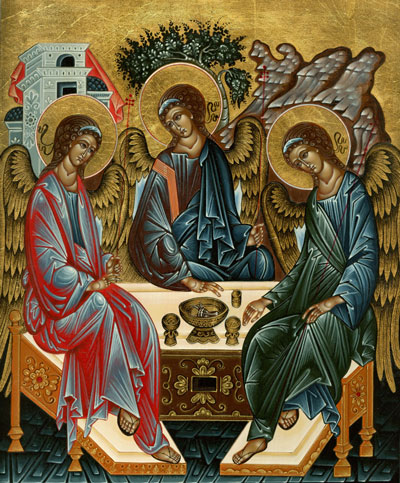
Rhaner’s Rule is one of the most encouraging “doctrines” there is. Rhaner’s Rule is the “rule” that says that the economic Trinity is the immanent Trinity and the immanent Trinity is the economic Trinity. In other words, the Trinitarian God we see revealed in history is the same Trinitarian God that exists outside/beyond history. In more simple terms. And what we see is Jesus.

When we see Jesus at work  we see the fulness of God. Jesus is God’s self-revelation of himself. That means that we don’t have to worry about a hidden God hiding behind a veil. We don’t have to worry about Jesus loving us, but the Father not loving us. We don’t have to worry that Jesus is a God of love and the Father is actually a God of wrath. What you see is what you get.

So why does this matter? It matters because it means that we can take God at his word. If Jesus says God loves us then God loves us. If Jesus says the Father is pleased with us then the Father is pleased with us. If he says that we can ask the Father for anything in His name then we can ask the Father for anything in his name. It means that what Jesus says and does can be trusted to fully reveal the Father. It means that the Father, whom we cannot see, is fundamentally for us, he is “pro nobis,” because that is the God Jesus self-reveals. Jesus is “pro nobis” thus the Father is “pro nobis.” What you see is what you get. If you have seen Jesus you have seen the Father.

The Rublev Trinity Icon