N.T. Wright on Reading the Psalms Pneumatologically

Last time we saw that N.T. Wright challenges us to read the Psalms Christologically. Wright builds upon this theme and challenges us to read those same temple psalms Pneumatologically:

Sing them also pneumatologically, that is reflect as you sing, on the New Testament’s vision of the church as the new Temple, indwelt by the Spirit of the living God.

This challenge certainly has a biblical basis. Ephesians 2 unabashedly teaches the doctrine that the Church is the Temple of God:

In him the whole building is joined together and rises to become a holy temple in the Lord. And in him you too are being built together to become a dwelling in which God lives by his Spirit.

So I challenge you to try reading Psalms in this way. Try it out by reading Psalm 100, understanding the we the Church are God’s Temple. How does doing that change the way you read this Psalm?

Shout for joy to the Lord, all the earth.
    Worship the Lord with gladness;
come before him with joyful songs.
Know that the Lord is God.
It is he who made us, and we are his;
we are his people, the sheep of his pasture.

Enter his gates with thanksgiving
and his courts with praise;
give thanks to him and praise his name.
For the Lord is good and his love endures forever;
his faithfulness continues through all generations.

N.T. Wright on Reading the Psalms Christologically

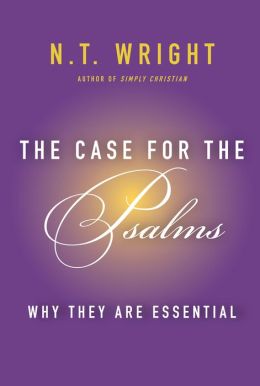
N.T. Wright recently came out with a book titled, “The Case for the Psalms.” In it he argues that the church needs to recover the practice of using the Psalms in our worship. In order to show the relevance of the Psalms to the life of the Christian he teaches us to read the Psalms in light of the New Testament. This leads him to read the Psalms Christologically, Pneumatologically, and through a Kingdom Lens. Its way too good! So let me quote him for you….

Reading Psalms Christologically

Wright makes use of his own work on the study of Jesus to show that Jesus saw himself as being the “True Temple” of God. He challenges us to read the Temple Psalms in light of Jesus:

Suddenly those great Temple psalms burst into fresh flower: On the Holy Mount stands the city he founded; glorious things are spoken of you, O city of God. How lovely is your dwelling place, YHWH of hosts; one day in your courts is better than a thousand elsewhere. Here is the challenge of those who take the New Testament seriously: try singing those psalms Christologically, thinking of Jesus as their ultimate fulfillment. See how they sound, what they do, where they take you…. (CFTP 110)

So I challenge you to try it out, read Psalm 122:1-5, and see how it changes when you see Jesus as the true fulfillment of the Temple in the Old Testament. How does this change the way you value the Psalms?

case for the psalms

Paul and Introverted Pastors

“Do not go beyond what is written…” Paul says this in regard to assessing servants of Christ.  He tells us that he cares very little if he is judged by the Corinthian church, or even himself. His conscience is clear but even that doesn’t matter because ultimately it is the Lord who judges the motives of men’s hearts.

Through ought this letter (but especially 2nd Corinthians) Paul finds himself defending himself against the accusations and judgments of this church. He isn’t charismatic enough, he isn’t a polished orator, he isn’t a brilliant philosopher, he isn’t a beautiful man…. Paul was a man of “middling size, and his hair was scanty, and his legs were a little crooked, and his knees were projecting, and he had large eyes and his, eyebrows met, and his nose was somewhat long….”

Basically Paul looked like a hobbit with a unibrow.

He wasn’t pleasing on the eyes, and according to the Corinthians his teachings weren’t pleasing on the ears either.

But notice what Paul says…. “Do not go beyond what is written.” We are not to judge God’s servants according to criteria beyond what is written in scriptures. We don’t know their motives, we don’t know their hearts, we don’t know whether they are being faithful to God’s call. We don’t have access to their internal life, but what we do have access to is their ministry in light of God’s revealed word. That is what ought to be basis of our judgement.

A lot of blogs and magazine articles has been written about introverted pastors in the past year, and for good reason. Our celebrity pastors have created a false image of what a pastor ought to be like (interestingly enough most of these pastors are actually heavy introverts, but their stage personas don’t reveal this).

These pastors have become the standard by which we judge the work of God’s servants.

We have gone “beyond what is written” when we do this. I will be the first to admit, I have succumbed to this as well. I judge other pastors based off the personality and “success” of these other pastors. In fact I judge my own ministry as a college director based of these super pastor’s personality and success. It’s a real struggle…. I feel inadequate because I don’t have the gift of gab. I feel inadequate because hanging out for long periods of time tires me out. I feel inadequate because some people in my congregation perceive me as cold or as a jerk because I am not friendly (and because I don’t hug people…. What can I say, I’m not a huge fan of affection). However If you ever catch me preaching, you would never be able to tell that I am an introvert. All this to say, being an introverted pastor can be difficult in our day of podcasts and books where the we only have access to celebrity pastor’s public persona.

However congregations have real needs. They need to feel loved. And for a lot of people feeling loved will require stepping out of our introverted shells and treating people a certain way. So for those of you who are introverted pastors/community group leaders/Life Group Leaders/servants I present to you Thom Rainer’s 7 tips for introverted pastors (note: the following was written by Thom Rainer for his own blog):

  1. You just have to mingle sometimes. I really don’t like small talk. When you mingle before or after a worship service or some other church event, you hear a lot of small talk. My temptation was always to avoid mingling so I could avoid such conversations. Unfortunately, pastors are perceived to be unfriendly and uncaring if they don’t mingle. Force yourself to get out among the members frequently for short periods of time.
  2. You just have to counsel people sometimes. I avoided counseling for more than one reason. First, I never felt like I was equipped or trained to counsel. Second, I am task oriented with the temptation to advise someone on three easy steps to get their lives in orders. Third, my introversion pushes me away from conversations with people I don’t know well. But pastors can’t avoid all counseling. My counseling load tended to diminish over time because people left our sessions feeling worse than when they arrived.
  3. You just have to attend a few social events. I’m probably wearing out the introverted pastor with these first three tips. But pastors who avoid all mingling, all counseling, and all social events tend to be viewed as impersonal and uncaring. While an introvert should never plan too much interaction, that pastor must be involved to some level.
  4. Be transparent about your introversion. Church members will understand you better. Many will be more forgiving about some of the introvert’s more annoying traits. Some will identify with you and be glad you were willing to address your introversion publicly.
  5. Use the power of social media to be your voice. Introverts don’t like small talk conversation, but they typically don’t mind writing. The more people can “see” you on Facebook, Twitter, Google+, or a blog, the more they will feel like they know you, even though you don’t have one-on-one interaction with them.
  6. Be accountable to an extrovert. I still am today, even though I no longer serve as a pastor. He reminds me of when I am sinking into extreme introversion. He sees me when I don’t see myself. He tells me how my actions or lack of actions may be perceived.
  7. Book time on your calendar to recover. If you have been expending lots of energy mingling, counseling, or socializing, you need some down time to recover. Put it on your calendar so you can be intentional about it. And for an hour or so, go to a place by yourself. Read, relax, or do nothing.  No one is there to talk to you for those minutes. Enjoy your blessed aloneness for a brief season.


Gospel Theology (Pt. 4) – Dyothelitism

Today we continue our discussion of “Gospel Centered” theology by looking at the doctrine of dyothelitism. This is a doctrine that you have probably never heard of, so let me give you a little bit of background.

In A.D. 680, the Council of Constantinople convened. This was one of the 7 ecumenical councils of the church, that is, the 7 councils that all orthodox branches of the church (Roman Catholics, Eastern Orthodox, Protestants) recognize as authoritative and binding in some sense.  This council debated two distinct positions concerning the will of Jesus.  The Monothelities (mono = one, thelo = I will) argued that in Jesus Christ there was only one single will. The Dyothelitites (duo = two, thelo = I will) argued that Jesus Christ possessed a divine will as well as a human will. After much discussion and debate the council settled on Dyothelitism as the orthodox doctrine. This seems like a trivial discussion, but really it isn’t.

The gospel hinges upon this doctrine!

This doctrine provides us with a perfect illustration of the fact that the gospel can help to settle debates over doctrine. To understand why this is so we need to remember two key pieces of the gospel: 1) Humans owe God perfect obedience, 2) Humans are sinful and hence are incapable of offering God that which God deserves. Enter Jesus, fully God, fully man. Jesus lives the perfect life on humanity’s as humanity’s representative and substitute. He can only live that perfect life because he is God.  In order to be humanity’s representative and substitute, Jesus must offer up perfect obedience as a human. He must offer up perfect obedience flowing out of the human will, or else he has no right stand in our place. If Jesus’ perfect obedience didn’t flow out of the human will, then his perfect obedience could not count as our own obedience. Jesus also had to act out of his divine will, or else it would have been impossible for him to live out that life perfectly.

(Let me get technical for a second, skip this section if you so feel led: T.F. Torrance says that justification is twofold. On God’s side it means to judge or condemn in order to put right and it means to deem right. On humanity’s side there are also two actions that must be performed, there must be confession of God’s righteousness and there must be obedience to it. Torrance suggests that these four things are all fulfilled in Christ. In Christ humanity (in virtue of anhypostais) acknowledges its sinfulness. In Christ, God judges humanity as sinful and puts it in the right therefore revealing his own righteousness. At the same time, in Christ, humanity (enhypostasis) offers up perfect obedience and faithfulness to God. Finally in Christ, God deems humanity as being in the right. Thus Jesus is the judge and the judged in one person.)

So far we have said that in order for atonement to be made Jesus must carry out action from his humanity and from his divinity. This simple fact is why we choose dyothelitism over monothelitism. To choose monothelitism is to make Christ’s atonement ineffective. The divine will must be at work in Jesus, the human will must be at work in Jesus; to have only one will at work is to remove a part of this important gospel equation. Hence dyothelitism.

Gospel Theology (Pt. 3) – Original Sin

Today we continue our series on “Gospel” or “Evangelical” theology, that is theology that flows out of the truths of the gospel. Last time I said that there certain key doctrines that are decided by or settled on or strengthened by the gospel. Some doctrines are the logical consequence of the gospel, one such doctrine is the doctrine of original sin.

What is Original Sin?

Briefly, what is the doctrine of Original Sin. Well in church history the term has been used in a pretty muddy and sloppy way. First off it has been used to refer to the original sin, that is the sin that Adam and Eve committed in the garden (Augustine calls this peccatum originale originans). It has also been used to refer to the condition of sin in humankind caused (somehow) by the transmission of Adam and Eve’s sin to all (this is to be distinguished from original guilt). The Augustine calls this latter “original sin” peccatum originale originatum. Its this second understanding of Original Sin that we are concerned with, the sin that is inherent by all of us sons and daughters of Adam.

Original Sin and the Gospel

Now what I am about say about orignial sin  will certainly be controversial but I am going to say it anyway.  I believe that the doctrine of original is found in the Bible. (That is not controversial) Here is the controversial part,

I believe that the strongest case for the doctrine of original sin is that it is a logical consequence of the gospel.

In our day people are quick to dismiss the doctrine of original sin as something that is archaic or too pessimistic. Yet the doctrine of original sin is a doctrine that we can’t easily throw away or dismiss. Without this doctrine, the gospel become nonsense. What happens to the gospel when the doctrine of original sin is discarded? Well the gospel loses all meaning and purpose.

Tatha Wiley, a theology professor who teaches in Minnesota sheds some light as to why this doctrine flows out of the gospel:

The idea of original sin first arose as an answer to the very question of redemption. For the early church theologians, the burning question was not about the character of evil but of the need of Christ. What they asked, makes Christ’s redemption universal? Why do all persons need Christ’s grace and forgiveness? The emergence and development of a theology of original sin are one response. Because of Adam and Eve’s sin, humankind is sinful. All then, are in need of Christ’s redemption. (OS)

She explains that Original Sin is necessitated by the gospel. The gospel is our starting point for theologizing about sin. Its pretty clear from the gospel that Christ died for the redemption of humanity. Those humans cannot redeem themselves, all humans are incapable of doing that, hence all humans need Christ’s atoning death. Now the question is, why do all humans need to Christ’s death to rescue them? Why are all humans incapable of saving themselves? The answer is that there is something fundamentally wrong with us humans, we call that original sin.

The Logic of Original Sin and the Gospel

Here is the “logic” behind the doctrine:

  • Claim: All humans need to appropriate Christ’s atoning death
  • Question: Why do all need Christ’s death?
  • Answer: All have original sin

Hence the doctrine of original sin flows out of the gospel.

Next time we will take a look at the rather obscure doctrine of dyothelitism.
Gospel Theology (Pt. 2) – Incarnation

In my last post I mentioned the fact that certain key doctrines are decided or settled on or strengthened by the gospel. Some doctrines are the logical consequence of the gospel, a great example of this sort of doctrine is the doctrine of the Hypostatic Union: In Christ the fullness of deity and the fullness of human nature are united as one without mixing, without confusion, without one superseding the other. Christ is the union of divine and human nature.

This union forms the basis for the doctrine of the incarnation:

The doctrine of the incarnation holds that, at a time roughly two thousand years in the past, the second person of the trinity took on himself a distinct, fully human nature. As a result, he was a single person in full possession of two distinct natures, one human and one divine. (SEP)

So how exactly does this doctrine logically flow from the gospel? In Cur Deus Homo Anselm shows us how.

So what is the Gospel for Anselm? The Gospel for Anselm begins with an explanation of the end of man. Anselm believes that “human nature was created in order that hereafter the whole man, body and soul, should enjoy a blessed immortality” (112). He does not elaborate much on what this blessedness is supposed to be like, nevertheless, this is the sort of state for which God created humans, and this is the goal they were supposed to achieve.

However, something went wrong. Something prevented human beings from attaining this blessedness. What happened was that human beings sinned. Human beings have failed to render God his due. What God is due is all honor, glory, and praise, but human beings have turned in on themselves and have robbed God of these things. In order to attain blessedness for which they were created humans must not simply return what was taken away, they “must give back more than he (they) took away.” So it could be said that humans owe God a debt of honor… In order to be made right, humans must repay this debt of honor. However the satisfaction must be proportionate to the offense. The offence was infinite, so the repayment must be infinite. Humans are incapable of making this sort of payment, only God can make this sort of payment. On the flip side, only God is capable of making this payment, but only humans have the duty to make this payment. So the only solution would be that a God-Man makes satisfaction.

This is the gospel according to Anselm, that humans have dishonored God and owe him a debt which is impossible to repay by anyone besides someone who is fully God and fully human, thankfully the God-man repays the debt and acquires honor that is due to him but is given to the elect. So for Anselm his gospel hangs upon the incarnation, that there is someone who is a God-man.

Here is where the doctrine of the incarnation gets gospel centered:

In order for our atonement to count, the incarnation is necessary.

Without the incarnation, without the union of divine and human nature in the man Jesus Christ, there would be no gospel. So we can say that the gospel necessitates a doctrine of the incarnation.

Gospel Theology (Pt. 1) – Introduction

A few days ago I wrote a short blog about Michael Bird’s forthcoming systematic/biblical theology, Evangelical Theology. I am honestly excited to read it, because from the looks of it, it is truly going to be a “Gospel-Centered” Theology.

Here is what Bird has to say about this:

What we need, as a matter of pastoral and missional importance, is an authentically evangelical theology — that is, a theology that makes the evangel the beginning, center, boundary, and interpretive theme of its theological project.

He says that a truly evangelical theology

Should be a working out of the gospel in the various loci of Christian theology (i.e., the topics in theology like the nature of God, the person and work of Christ, the church, last things, etc.) and then be applied to the sphere of daily Christian life and the offices of Christian leaders. The gospel is the fulcrum of Christian doctrine. The gospel is where God meets us and where we introduce the world to God.

He says that his task is to lay out what a theology driven and defined by the gospel looks like. In the past, others have attempted this task. I think of Karl Barth’s Church Dogmatics which sought to do dogmatic theology fully in light of God’s revelation of himself in Jesus Christ. The Church Dogmatics are a Christocentric attempt at dogmatic theology, it centers theology around the work and person of Jesus Christ. I think of T.F. Torrance’s dogmatic theology which is also centered around the person-work of Jesus Christ. For Torrance every doctrine springs forth from the reality which is the hypostatic union. All this to say, Bird finds himself in good company in his attempt to formulate a truly evangelical theology.

Over the next few days I will post a few blog posts showing how “Evangelical” or “Gospel-Centered” theology ought to be done (maybe “ought” is too strong of a word, maybe we could use “could.”) I will illustrate how certain key doctrines are decided or settled or strengthened by the gospel. I will show that some of the doctrines we take for granted are in fact the logical consequences of the gospel.

Over the next few days I will cover the following doctrines:

  1. Incarnation
  2. Original Sin
  3. Dyothelitism

What is Evangelical Theology?

I am pre-ordering Michael Bird’s Evangelical Theology because it looks really interesting, and because I really think he is on to something. I firmly believe, correct me if I am wrong, all of our systematic theology should begin with God’s ultimate revelation of himself: Jesus Christ. I believe that systematic theology should be Christological. It should begin and end with the person and work of Christ (which are, by the way, inseparable). Christ is the gospel, Christ is the “Evangel.” Having said that I wonder whether Bird’s book will be evangelical in that sense, or whether it will be evangelical in the “gospel-centered” (i.e. a reduction of the gospel to justification by faith + penal substitution) sense.

I have seen several blogs coming from “Gospel-Centered” people claiming that this is a truly gospel centered systematic theology, what I want to know is: “what ‘gospel’ Bird will be using as the lens through which he does theology?”

Note: I have no qualms with “Gospel-Centered” theology, I consider myself “gospel-centered” but I refuse to reduce the gospel to the doctrine of justification by faith or penal substitution, which is what so many people tend to do. Maybe its better to call myself “Person and Work of Christ-Centered.” But then again that doesn’t have a nice ring to it.

God is Simple…..

God isn’t complex, God is simple.

I didn't say God is easy, I said God is "simple!"
I didn’t say God is easy, I said God is “simple!”

Let me explain, or better yet, let me have the Stanford Encyclopedia of Philosophy explain:

According to the classical theism of Augustine, Anselm, Aquinas and their adherents, God is radically unlike creatures in that he is devoid of any complexity or composition, whether physical or metaphysical. Besides lacking spatial and temporal parts, God is free of matter/form composition, potency/act composition, and existence/essence composition. There is also no real distinction between God as subject of his attributes and his attributes. God is thus in a sense requiring clarification identical to each of his attributes, which implies that each attribute is identical to every other one. God is omniscient, then, not in virtue of instantiating or exemplifying omniscience — which would imply a real distinction between God and the property of omniscience — but by being omniscience. And the same holds for each of the divine omni-attributes: God is what he has. As identical to each of his attributes, God is identical to his nature.

Notice, the “A-Team” believes that God has no parts, hence he is not complex, he is simple. This extends even to divine attributes, God is identical with his goodness. Good isn’t a part of God. God is identical with his omnipotence. Omnipotence isn’t a part or attribute of God. Etc.

In the Summa, Thomas Aqunias, defends this claim. He gives four reasons why God is simple, and not complex.

  1. God is not a body, that is God is not composed of matter. Hence God is not composite, that is God is simple.
  2. Every composite object is posterior to its component parts and is dependent upon them, however God is metaphysical independent.
  3. Every composite object has a cause. God is uncaused, thus he is not a composite object.
  4. Every composite has potentiality and actuality. God however is pure acutality. Hence God is simple.

Those are the four reasons why Aquinas thinks that God is simple and not complex. Divine simplicity seems to be an idea that has gone out of fashion of late. (Especially within Trinitarian debates.) Do you think its an important doctrine to hold on to? Why or why not?