ECI Guatemala Trip

On November 18th-November 22nd a team from ECI traveled to Guatemala City to lead Roca de Ayuda Ministries’ annual pastors conference. While in Guatemala the ECI team was able to make some important connections with local pastors who share the same vision for biblical equipping of other pastors. Relationships were developed and friendships were made, the team was even invited to a Christian concert for youth at El Estadio del Ejercito! After spending a few days in meetings, the team went to Roca de Ayuda Ministries for the annual pastor’s conference. There were about 200 pastors and leaders in attendance. These pastors came from all over the city and even from rural areas. A few of the pastors rode public transportation for over 8 hours to be at this event! Roca de Ayuda provided breakfast for these pastors, leaders, and wives. Breakfast was followed by a time of worship and then teaching. Chris Woznicki taught about the role of a shepherd and Jose Luis Amezquita taught about the Biblical teaching on homosexuality. At the end of the event ECI gave out 5 MacArthur Study Bibles, and Roca de Ayuda provided food and clothing for the pastors to take home.

Overall the event was a great success, the pastors walked away feeling encouraged, cared for, and better equipped for ministry.


Theology as Discipleship

Theology is irrelevant to our life as Christians.

At least that’s what many evangelicals tend to believe. There is this thought that runs through much of evangelicalism that theology is either irrelevant because we should be focusing on practical things. There is also another line of thought that seems to believe that theology is dangerous because it is divisive, and has the potential to confuse people about God. Keith Johnson in Theology as Discipleship argues that neither of these are the case. In fact, theology is vitally relevant to our lives as Christians and it actually has the ability to help us grow in Christ. Or as he himself puts it:

The traditional goal of Christian theology is to develop a better understanding of God so that we can think and speak rightly about God within the context of a life governed by our faith in Christ and our discipleship to him in community with other Christians. (34)

Keith Johnson writes theology in a truly “gospel-centered” manner. By Gospel centered I don’t mean what people typically mean by “gospel centered,” I mean a fully rounded out gospel which places union with Christ at the center.

Johnson begins by explaining where theology went “wrong” (i.e. anti-intellectualized & over-academia-ized). He then explains what it means to do theology from the standpoint of our union with Christ. Part of theology’s purpose is to help us to know Christ and grow in our understanding of our union with Him. The way this happens is through the use of Scripture and the hearing of God’s word. As we listen to scripture and hear God speak our mind, our thoughts, and out theology becomes conformed to the mind of Christ.

This short book is super helpful and I would encourage anyone that is interested in studying theology to pick it up. I would especially encourage anyone who is going to bible college or seminary to read it before they dive into the study of theology. The fact that he includes explicit sections of exegesis in each chapter is a breath of fresh air, and it’s a great way of modeling how to do theology. His final chapter, “Theology in Christ” is another highlight of his book. In it he lays out 9 thesis for what it means to do theology as discipleship.

Overall this is a great little book which reorients theology around its true purpose, growing in Christ and serving the church.

 Note: I received this book courtesy of IVP in exchange for an impartial review.

Crossing Cultures With Jesus

I think if found it!

In just a few short days I will be leading a group of 20 college students on a short term mission trip to Uganda. For many of the students this is their first mission trip, and for a whole bunch of them it’s the first time they will ever step off American soil. Going on a mission trip can be quite difficult, especially if its your first time… new food, new sights, new sounds, oh and yeah sharing the gospel cross-culturally!

But… I think I found a book that will help those students go through a cross-cultural experience like a mission trip. Its Katie Rawson’s Crossing Cultures with Jesus: Sharing Good News with Sensitivity and Grace.

This book is written by a campus minister who has worked with international students for over three decades! So she is really used to sharing the gospel cross-culturally. In it she shows the reader how to enter into people’s worlds and draw them towards Jesus. The book is filled with encouraging stories, and tons of practical advice. Some of the most helpful parts of her book are the sidebars which she includes. These sidebars cover subjects like: presenting the gospel in an honor-shame culture, listening to God, doing a lectio divinia, characteristics of a welcoming community, hospitality, etc.

The book is split up into two parts. Part one is about developing our own relationship with the Lord and entering into relationship with those we are trying to reach. The second part covers evangelism with cross-cultural sensitivity.

Overall I have to say that…

Crossing Cultures With Jesus is my new go-to book for preparing a short-term mission team.


Even though we had completed all of our training before we are getting ready to leave in a few days, I was so confident in this book that I sent out an email to our whole team saying – if you bring one book on the plane to read bring Crossing Cultures with Jesus.

Its that good!

Note: I received this book from IVP in exchange for an impartial review.

Analytic Theology at St. Andrews

Recently it was announced that St. Andrews University (thanks to the Templeteon Foundation) would be joining Fuller Seminary in kicking off a program in Analytic Theology….

Some of the biggest issues facing humanity will form the basis of study at a new international institute to be based at the University of St Andrews.

The Logos Institute, which takes its name from the Greek meaning ‘word’ or ‘study’ but which is also used in John’s Gospel with reference to the incarnation, will be a centre for excellence in the study of analytic and exegetical theology.

The range of questions it will consider concern the existence and nature of God, God’s relationship to time, the nature of the person and the conceptual and social challenges confronting religious belief. The latter will include interdisciplinary analysis of the challenges of religious hostility, sectarianism and, indeed, terrorism.

The institute is being launched by a £1.6 million grant from the John Templeton Foundation which supports research relating to the major questions of human purpose and ultimate reality.

The work of the institute is founded in the collaboration of father and son academics Alan Torrance (pictured), professor of systematic theology at St Mary’s College of the University of St Andrews, and Dr Andrew Torrance of the University’s School of Divinity.

Alan applied to the Templeton Foundation for funding to launch an institute for analytic and exegetical theology to be based at St Andrews and, separately, Andrew applied for funding to expand his work on communication with schools and churches, for which he had earlier received a grant of over £500,000.

The Foundation decided to roll the two applications together to launch the Logos Institute.

The new institute, which will open in the summer of 2016, builds on existing resources at the University of St Andrews.

These resources will be complemented by the appointment to part-time positions of four leading international thinkers and a further full-time, senior appointment. In addition, there will be research fellowships, six PhD scholarships and a new Masters programme as well as a series of public lectures, a blog, a website, podcasts etc.

Professor Alan Torrance said:

“The impetus for the new institute is the remarkable sea-change that has taken place in philosophy. Over the last three decades, a sizeable proportion of academic research in philosophy has been directed toward questions bearing on the existence of God. This renewed interest has resulted in major advances in the field and a wealth of published research. It is in the light of these significant developments that ‘analytic theology’ has emerged. The Institute will bring this new generation of theological research into conversation with the world-class expertise we have here in biblical studies, philosophy, psychology and international relations.

“Our primary concern will be to explore the immense explanatory power of Christian theism and its relevance for how we understand the ultimate significance of human life. We shall be doing this in dialogue with exciting, new developments in contemporary Biblical scholarship.

“One of the key research topics will be the nature of forgiveness and what this central Christian notion might mean for how we approach religious enmity, sectarianism and, indeed, terrorism.”

Dr Andrew Torrance said:

“At its best, the task of theology gathers together and engages a diverse range of perspectives. Not only does it draw on the insights of biblical scholarship and philosophy, it also draws on the insights of the natural and social sciences. Further, it seeks to be attentive to the religious communities that have devoted themselves to pursuing a knowledge of God.
“Such a diverse conversation is not easy, however. For constructive conversation to take place, those at the table need to share the same language, and this requires conceptual clarity and discipline. Theology’s task in this regard stands to be resourced richly by analytic philosophy and the clarity it generates.”

Professor N.T. Wright, School of Divinity at St Andrews, added:

“There are few places in the world where a project this daring and creative could even be imagined; fewer still where it could be brought to birth. St Andrews is just the place for this remarkable venture, and I look forward eagerly to sharing in it.”

Among those who will be lecturing at the institute as part-time faculty are the US-based British theologian Oliver Crisp, American, analytic philosophers Michael Rea and Peter Van Inwagen and American philosopher and theologian, C Stephen Evans.

Other aspects of the Institute’s work will involve programmes for schools and churches, lectures and a UK-wide competition resulting in a full scholarship.

You can find more information on the St. Andrews Divinity website.

Reordering the Trinity

If you were to ask a systematic theologian “Is the Trinity in the Bible?” there would be various answers that she could give you. If she says “yes” she will have to nuance her answer quite a bit – the word “Trinity” never appears in the Bible, the words we use to describe the Trinity never appear in the Bible, etc. If she says “no” she will have to tell you why she isn’t actually a heretic, but she will likely be able to show the scriptural basis for Trinitarianism.

Fred Sanders says that,

One of the chief obligations laid upon Trinitarian theology in our times is that it render the doctrine of the Trinity with unprecedented clarity as a biblical doctrine, or, to speak more precisely, as a doctrine that is in the Bible.

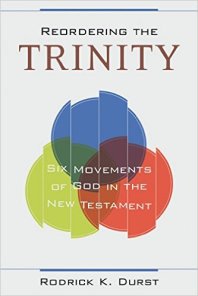
In order to do this, in the past, some theologians resorted to a41aka-4obzl-_sx331_bo1204203200_ proof text approach to this doctrine. Show that Jesus is divine, show the Holy Spirit is divine, throw it all together into a bowl and bam! Trinity. Yet these sort of hermeneutical moves no longer are very persuasive in the eyes of many. Thankfully people like Wesley Hill have taken a different approach for showing how the Trinity is indeed Biblical. But the proof text approach is not completely gone. Rodrick Durst’s new book, Reordering the Trinity, is one of those “proof text” type of Trinity books. But lets just call it a concordance approach. This isn’t necessarily a bad thing.
What is innovative about Durst’s book is not the fact that he lays out 75 (yes seventy-five) occurrences of the Trinity in the New Testament. What is innovative about this book is that Durst show that in these 75 occurrences there are 6 different patterns.

  1. Father, Son, Holy Spirit
  2. Father, Holy Spirit, Son
  3. Son, Father, Holy Spirit
  4. Son, Holy Spirit, Father
  5. Holy Spirit, Son, Father
  6. Holy Spirit, Father Son

He then goes on to give percentages for how many times each of these combinations occur. (Father, Son, Spirit takes the lead with 28 occurrences and Spirit, Son, Father comes in last with only 8 occurrences.) What is most interesting about this book is that he shows that each of the 6 patterns have different thematic significance!

  1. Father, Son, Holy Spirit – Missional
  2. Father, Holy Spirit, Son – Formational
  3. Son, Father, Holy Spirit – Christological
  4. Son, Holy Spirit, Father – Regenerative
  5. Holy Spirit, Son, Father – Ecclesial
  6. Holy Spirit, Father, Son – Sanctifying

What’s really groundbreaking about this is that it leaves us with various options for thinking through and praying through different ways when we are focusing on different things. For instance if we are focusing on praying about sanctification we may start with the Spirit, move on to the Father, and end with the Son. Or if we are praying about mission we may begin by asking the Father to be glorified as we go out and proclaim the Son by the power of the Holy Spirit, etc.

What’s great about this book is that Durst has this devotional aspect in mind when he is writing. He even includes an appendix for incorporating this Trinitarian Ordering into your own prayer life.

Overall I found this book to be very stimulating for my personal devotional life. It opened up to me the mind blowing idea, or to put it a better way it gave me a theological basis, for prayer that is focused on different persons of the Trinity. So, if you take this book as a series of proof texts that the Trinity is Biblical you will be disappointed. But if you read it as a sort of concordance showing how Trinitarian ordering makes a difference in your own walk with God then you have stumbled upon an amazing resource.

Note: I received this book from the publisher in exchange for an impartial review.


Apostolic Church Planting

Church planting is en vogue. You can find books upon books on the subject and even conferences on the topic that draw 1000’s of attendees. (I have to admit my favorite one of these conferences is Exponential.) But most church planting isn’t planting in the biblical sense. Yes it’s the start of new congregations, which is planting a “church” in some sense, but biblically church planting consists of starting new local gatherings with an emphasis on the creation of new disciples. At least that is what J.D. Payne, pastor of church multiplication at Brook Hills, has to say. Quite simply Payne defines church planting as,

Evangelism that results in new churches.

This (really) short book, which in some sense is a distillation of his longer book Discovering Church Planting: An Introduction to the Whats, Whys, and tumblr_inline_nh93znkgjr1qm2vhiHows of Global Church Planting, is an attempt to provide the reader with the essential aspects – practically and theologically – that are necessary for doing church planting in a Biblical fashion.

Payne begins with stressing the importance of nailing down your ecclesiology before you start planting. He then provides the reader with a sort of “pathway” to planting as well as the stages involved in growing a church plant. Most importantly, in my mind, Payne stresses the need for developing leaders which will one day oversee the church. This is clearly the Pauline model.

Overall, I found this book to be very helpful. It’s a clear and concise model for doing church planting. It draws its insights from Scripture, experience, and testimonies. I myself am not a church planter, but I have plenty of friends who are. After reading this book I came away with a better understanding both theologically and practically about what exactly it is that they are doing. I believe that this book could serve as a useful set of reminders for those who are planting churches. But I also believe, and I hope that this book will help spur on a new generation of church planters.

Note: I received this book from IVP in exchange for an impartial review.

The Task of Trinitarian Theology

Many books on the doctrine of the Trinity begin by decrying the state of Trinitarian theology. Many of these authors believe that the ever so important doctrine of the Trinity has been pushed off to the margins, with many Christians living as functional Unitarians, primarily because the doctrine seems so impractical. In an effort to make it “practical” many Social Trinitarians have begun to show how its practical for our social relationships. Some evangelicals have sought to show how its practical for our understanding of gender roles. These may or may not be good “practical” implications (my money is on the fact that they are not good), but I think that there is a better way to show how “practical” this doctrine is. Fred Sanders hints at this in his essay “What Trinitarian Theology is For: Placing the Doctrine of the Trinity in Christian Theology and Life.” (Advancing Trinitarian Theology)

In this short essay he lays our 5 things that this particular doctrine functions within systematic theology (i.e. shows how its practical for doing theology).

  1. The doctrine of the Trinity helps us summarize the biblical story.
  2. The doctrine of the Trinity helps us articulate the content of divine self-revelation by specifying what has been revealed.
  3. The doctrine of the Trinity orders doctrinal discourse.
  4. The doctrine of the trinity identifies God by the gospel.
  5. The doctrine of the Trinity informs and norms soteriology.

These are all very helpful points. But I especially like what Sanders has to say about points #2 and #4.

Under his discussion of point two he has a fantastic diagram with options for an answer to the question: What do the sending of the Son and the Holy Spirit signify about the eternal life of God? The diagram lays out 7 options along a maximal and minimal position.

Under point #4 he says something I though was absolutely fascinating:

The doctrine of the Trinity serves to identify God by the gospel, or to specify the identity of the God of Christian faith. It does so primarily by insisting that God is the author of two central interventions into the course of human history, the incarnation of the Son and the outpouring of the Spirit. These two actions, considered not in isolation but as culminating events, mark God as a particular God. The God who sent a Son and a Holy Spirit, because he always already had a Son and a Holy Spirit to send, must be essentially different form a God who could not and did not self-communicate in this way. (39)

Anyway… Fred Sanders is coming in to our Trinity Seminar tomorrow morning and I really look forward to hearing what he has to say.


Theology and the Mirror of Scripture

What is an “evangelical?” Is there even such a thing? If one were to look at the vast spectrum of people who call themselves evangelicals, one might be tempted to say that there isn’t. Yet somehow, this moniker can’t simply be shaken off. People keep on calling themselves (and other) evangelicals. It’s a sociological-theological-historical term that I believe should not be abandoned. Even though its definition as a sociological reality is being stretched beyond recognition, there is such a thing as being a “mere” evangelical. And whatever it means to be a “mere” evangelical is defined by God’s word and God’s act.9780830840762

In their most recent book, Theology and the Mirror of Scripture: A Mere Evangelical Account, Kevin Vanhoozer and Treier (V&T) have attempted to give an account of what such a “mere evangelical” theology might be. By the looks of their endorsers on the back of the book it would seem as though they have given a satisfactory account.

According to V&T mere evangelical theology begins with theological ontology, specifically with the Trinitarian God of the gospel. It begins with the economic Trinity which mirrors the immanent Trinity. However this Trinitarian God who reveals himself in history is not know to us apart from Scripture. So V&T also argue that the biblical testimony yields knowledge of this Triune God because it mirrors who this God is. As V&T say, there is truth and authority in this mirror. Mere Evangelical theology is focused on the God of the Gospel and the Gospel of God. God himself is the light. Scripture is a mirror of that light. Tradition is a mirror who’s light is not from itself but is derivative from the light of God reflected through scripture.

The second part of this book relates V&T’s theological ontology and mirror metaphors to various theological practices – specifically the interpretation of scripture, the role of tradition, and the role of scholarship in the church.

What unites V&T’s proposal for mere evangelical theology is the metaphor of “mirror” which is scattered throughout the book. I believe this is a helpful metaphor which (at least for me) helped me make sense of the ontological priority of God in doing theology and the primacy of scripture. But where it made things most clear for me is in the role of tradition in doing theology. Calling tradition a mirror was a helpful move, for it emphasizes that it still reflects the true light, yet in some derivative way which is not foolproof from distortions.

V&T’s proposal for thinking of theology as a mirror of the God of the Gospel and the Gospel of God is a very useful metaphor, it even has implications for ecclesiology, for one might even say that the Church and local churches are also mirrors of the God of the Gospel/The Gospel of God.

Overall, I highly recommend this book by two able theologians who have devoted much work to theological prolegomena. It fits right alongside Swain and Allen’s Reformed Catholicity as a book which addresses how to be reformed and evangelical while doing theology within the context of “mere” Christianity.

(Note: I received this book from IVP in exchange for an impartial review.)

Vanhoozer on the 6 Marks of Evangelical Theology

Vanhoozer says that there are six marks of Evangelical theology. Personally I think there should be seven or maybe forty. Those are better numbers because they are “Biblical” but whatever, six works I guess….

All kidding aside what marks evangelical theology off as “evangelical.” Is it simply that it is done by people who call themselves evangelicals? Is there something distinctive about it that makes it “evangelical” i.e. subject matter, emphasis, the way its written, goals, Etc.? Is it that it fits

latc-treier

If you will be in L.A. in January make sure to come to LATC. Daniel Treier will be presenting a plenary titled “Scripture’s Textual Voices: A Dogmatic Account.


well within Bebbington’s quadrilateral (word, cross, activism, conversion)?

The answer to that question, “What marks theology off as evangelical?” is a complex question with a complex answer but Vanhoozer and Treier seek to answer it – or at least give some direction in how we might go about answering it – in their new book Theology and the Mirror of Scripture: A Mere Evangelical Account.

In a helpful section on “The Gospel of God and the God of the Gospel” Vanhoozer and Treir give us 6 characteristics (3 substantive and 3 stylistic) that mark theology as “evangelical.”

Mere evangelical theology, as an anchored set, can initially be characterized in terms of two principles, one material (substantive), one formal (stylistic), each with three entailments. As to substance, mere evangelical theology is (1) orthodox, conforming to the early creeds; (2) catholic, spanning all the times and places where there has been a local church; and (3) Protestant, affirming of the Reformation solas. As to style, it is (1) radical, first because it is anchored in the root (radix) of the gospel – the triune God – and second because this rootedness leads it to confront the world with the claims of the gospel; (2) irenic, acknowledging that we need many perspectives and people groups fully to appreciate the gospel’s wealth of meaning; and (3) joyful, first because it take it bearing from the best of all words that can be heard and, second, because it takes its energy from the Spirit, the minister of God’s word and the giver of God’s life. (52)

Do you find these six marks helpful? Would you change any? Add any?

4 Ways to Become a Better Writer (Pt. 4)

So you want to be a better writer? Maybe its for a blog, maybe its for your creative fiction, or maybe its just for essays assigned to you at school. Either way, over the next few days I will be giving you 4 Tips that will help you become a better writer. and Tip #3.

A few days ago I gave you Tip #1, Tip #2, and Tip #3. Here is your final tip!

4. Reread and Rewrite.

Justice Brandeis: “There is no great writing, only great rewriting.”

James A Michener: “I have never thought of myself as a good writer. Anyone who wants reassurance of that should read one of my first drafts. But I’m one of the world’s great rewriters.”

Michael Crichton: Books aren’t written—they’re rewritten. Including your own. It is one of the hardest things to accept, especially after the seventh rewrite hasn’t quite done it.”

Roald Dahl: “Good writing is essentially rewriting. I am positive of this.”

Elmore Leonard: “If it sounds like writing, I rewrite it.”

Vladimir Nabokov: “I have rewritten — often several times — every word I have ever published. My pencils outlast their erasers.”

Helen Dunmore: “Reread, rewrite, reread, rewrite. If it still doesn’t work, throw it away. It’s a nice feeling, and you don’t want to be cluttered with the corpses of poems and stories which have everything in them except the life they need.”

Raymond Chandler: “Throw up into your typewriter every morning. Clean up every noon.”

Will Self: “Don’t look back until you’ve written an entire draft, just begin each day from the last sentence you wrote the preceding day. This prevents those cringing feelings, and means that you have a substantial body of work before you get down to the real work which is all in the edit.”

Via Justin Taylor