Internalism about Justification

Both Foundationalism and Coherentism are internalist accounts of justification. Both seem to be plagued by problems, in part because they are proposition based accounts of justification. Given this I’ve been tinkering around with some externalist accounts of justification. For those of you who are interested here are some problems with internalist accounts of justification:

  1. It doesn’t allow for “knowledge” among naïve people, novices, or the mentally handicapped (at least in accessibilist accounts of internal justification).

Example: One of the most powerful motivations for externalism is that we correctly attribute knowledge to unsophisticated persons, children, and some animals. These individuals, though, lack internalist justification. So either knowledge doesn’t require justification or justification should be understood externally. Grandma knows that she has hands even though she can not rehearse an argument for that conclusion and can not even think of anything else to defend the claim that she does have hands. Timmy knows that it’s a sunny day and Lassie knows that there’s water in the bowl. In each case it appears that the subject is justified but lacks any internally accessible reason for the belief. Reflection on these cases, and many others like them, supports the externalist central contention that internalism is too strong. Persons can know without possessing internalistic justification. (Ted Poston)

  1. It becomes incredibly easy to justify false beliefs.

Example: One powerful skeptical argument begins with the premise that we lack direct access to facts about the external world. For any experiential justification we have for believing some fact about the external world—for example, there’s a magnolia tree—it’s possible to have that same justification even though there’s no such fact. The experience one has is caused by a state of one’s brain and it is possible that science could develop a method to induce in one that brain state even though there are no magnolia trees for hundreds of miles. The skeptic continues to argue that since we lack direct access to facts about the external world we lack non-inferential knowledge (or justification) for believing those facts. The final step of the skeptic’s argument is that we do lack sufficient evidence for inferential knowledge (or inferential justification) for believing those facts. Here the skeptic argues that the evidence we possess for external world beliefs does not adequately favor commonsense over a skeptical thesis. Any appeal to experiential evidence will not decide the case against the skeptic and the skeptic is happy to enter the fray over whether commonsense beats skepticism with regard to the theoretical virtues, for example, coherence and simplicity. (Ted Poston)

Some Possible Responses:

  1. This only arises under an accesibilist account of justification. If we have another internalist account, maybe a weak accessibilist account (in which the only thing necessary is the possibility of access) or a mentalist account then this isn’t really a problem.
  2. Its fine that we can have the same justification for things that don’t correspond, mainly because we are talking about the justification of propositions, not the justification of beliefs which actually correspond to the external world. (This seems to me to be a version of coherentism.)



Jonathan Edwards, Sex, and the Trinity (New Paper)

Teens getting pregnant, bundling, and boys chasing around girls making fun of their periods – no its not your local jr. high – its Puritan Pastor Jonathan Edwards’s church. If you want to know what “youth” ministry was like in Jonathan Edwards day take a look at my latest journal article:  Bad Books and the Glorious Trinity: Jonathan Edwards on the Sexual Holiness of the Church


You can now read it for free over at the McMaster Divnity College’s Journal of Theology and Ministry website. Print copies of the article will be available through Wpif & Stock Publishers soon.


The Relation of Theology and Philosophy of Religion

What is the relationship between theology and philosophy of religion? Helen De Cruz (Assistant Professor of Philosophy, VU University of Amsterdam), Kevin Hector (Professor of Theology and Philosophy of Religion, University of Chicago Divinity School), Alan Torrance (Professor of Systematic Theology, University of St. Andrews) discuss this question.

Kevin Vanhoozer on the Task of Preaching

What do we “do” as preachers? Are we giving people more information (biblical, practical, spiritual)? Are we giving them encouragement? Are we shaping their affections? Kevin Vanhoozer has a suggestion….

From The Drama of Doctrine:

The ministry of the Word involves far more than ideas. Thanks to a host of postmodern prophets, we are more aware than ever of the power of language to shape human thinking and experience. Language creates a “world,” that is a cultural framework in which we live and move and process our experience. Preaching, teaching, and evangelism are the means by which the gospel becomes that all-encompassing framework that allows us to think and experience truth, goodness, and beauty in light of the history of Jesus Christ. The Ministry of the Word involves more than communicating a few truths; it involves transmitting a whole way of thinking and experiencing. Preaching and teaching should be “evangelistic,” then, in the sense of enabling people to indwell the gospel (=evangel) as the primary framework for all that they say and do. (74)

So what do preachers do? They create worlds….world that are shaped by the gospel.


Sanctified by Grace – Book Review

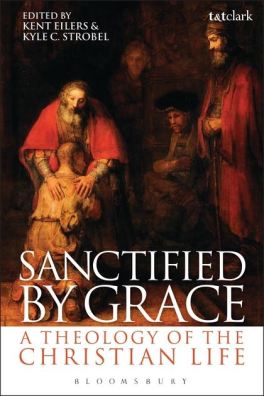
Last week, as a part of a blog tour, I began a series of blogs on Kent Eiler and Kyle Strobel’s 2014 book – Sanctified by Grace. Today I “officially” wrap things up with my review of the book! (Though I will still be writing about some of the essays in this book in 9780567383433the future) Let me just be upfront with my opinion – this book will serve as a great textbook for any upper-class undergraduate or seminary level systematic theology course.

The Purpose

According to Eiler and Strobel there needs to be a recovery in Christian dogmatics in which Christian rationality is grounded in the movement of the Spirit within the sphere of grace. (7) Also, dogmatics needs to take on the temptation to accept unformed natural reason as the only possible form of “reason” in the academy. (8) Given these two points, Strobel and Eiler have edited a collection of essays that provide a dogmatic account of the Christian life in which doctrine/life and confession/practice are held together. Here is what they have to say in their own words:

The approach is straightforwardly doctrinal – focusing the life of the Christian on the triune God who creates, elects, calls, and redeems. This is the God of grace who gives himself in Jesus Christ and who catches people up in the movement of his Spirit of love.

Overview

The book is broken up into four parts: 1)The Gracious One, 2)The Graces of the Christian Life, 3)The Means of Grace, and 4)The Practices of Grace. Part one is grounded in the idea that an account of the Christian life requires a careful elaboration upon the one who establishes, sustains, and perfects the Christian life. This section includes essays on the Trinity, election, creation/providence, salvation, and sanctification.

Part two treats the way God’s grace works out in the lives of his creatures. It covers the relationship between reconciliation and justification, victory and redemption, as well as mortification and vivification.

Part three takes a look at the channels or instruments by which God’s grace in Christ is offered and set forth. In other words it addresses the means of grace including, Scripture and Sacraments.

The final part covers the “practices of grace.” It takes a “practical turn” (though its all been practical throughout) by addressing the practices of prayer, preaching, forgiveness, and doing theology.

Thoughts…

This book really isn’t typical. Most books on dogmatics aren’t really geared towards helping make sense of our lives as Christians. This book really is dogmatic theology in a different key, its dogmatic theology written with people’s growth in mind. For this reason I think that this book is perfectly suited for upper-class undergraduates. The reason I don’t think it would be a suitable resource for freshmen or sophomores is that many of these essays are written at a high level and would probably be too complex for underclassmen. I think this book would also be very much suited for seminary students. In seminary people often find themselves asking – so what does this have to do with what I’m going to be preaching about in 2-3 years? This book could show seminary students that complex dogmatic discussions really are important for the everyday life of Christians.

All in all this is a great resource for classroom use. In the future I will find myself assigning particular essays or maybe even the whole book for my own classes.

Sanctified by Grace – Preaching

A few days ago I began a blog tour on Kent Eilers and Kyle Strobel’s 2014 book Sanctified by Grace. Over the next few days I will be posting some highlights from various chapters, concluding with a review of the book as a whole. Today I turn my attention to the chapter on preaching.9780567383433

As a college minister I preach quite regularly. At times it can be a challenge (because preaching is always challenging)! But its extra challenging because I straddle the two seemingly opposing worlds of academic theology and pastoral/spiritual theology. Now most people would say, that these sorts of theology should never be in conflict – and I agree! I agree in principle, but in reality it doesn’t often work out as neatly as we would want it to work. Thankfully Eilers and Strobel have put together a book that helps straddle that gap. Here is what they say about this project:

Coordinating the doctrine of the Christian life to God’s economy of salvation and the practices which are fitting to redeemed existence is not one option among many. Rather, we suggest, this coordination between doctrine and life, belief and practices is integral to life within the movement of God’s Spirit. Within the dynamism of the Spirit’s formation, doctrine and life are pulled together in the broader picture of grace. (7)

Doctrine and life! Belief and practice! Pulled together! This is exactly what the church needs – and this is exactly what should be happening in our weekly preaching….

Preaching – William Willimon

Theology, the editors tell us, is never an end in itself; knowledge of God always breaks fort in love to others. A central outlet for this love is in preaching. (17) In the chapter on preaching Willimon emphasizes several things. First is that preaching revolves around

181b8413c65acac2d17c0a6c70d99462_400x400
Will Willimon

hearing a God who speaks. The task of listening is often overlooked when talking about preaching, but it shouldn’t be! Not only does the congregation listen, but the preacher listens as well! The preacher must listen faithfully to the biblical text just as the congregation must listen faithfully to the word being proclaimed. Listening is not just a skill to be developed though. Listening is a spiritual exercise that hinges on the conditions of our hearts.

But perhaps even more central than listening is to preaching lays the notion that God speaks, and that somehow we speak because God has spoken, and that somehow in our own preaching God speaks! We have a loquacious God – who in our day primarily reveals himself in preaching.

One thing that I really appreciated about this chapter is the importance Willimon places upon the task of preaching. Nowadays many people tend to see preaching as superfluous or as belonging to a bygone era. But according to Willimon this should not be so. A primary way that the Christian life is formed and sustained is by preaching. Willimon rightly points out that in our culture, where preaching is charged with being authoritarian, archaic, or a one-way act of communication, Christians must learn how to be properly attentive to preaching. (227) Thankfully Willimon lists out some helpful practices which will aid in our faithful listening to sermons. Here are a few:

  • A willingness not to receive an immediate, practical, pay off from the sermon.
  • The expectation that a sermon could disrupt one’s received world by verbally rendering the coming Kingdom of God.
  • A patient willingness not to have every single sermon speak to you.
  • An understanding that preaching is a communal activity. A sermon is public speech.
  • A desire for a preacher, a pastor, who cares more for the right division of the Word of God than for the love or ire of the congregation.
  • A relinquishment of our prerogative to talk about what we are obsessed with discussing (sex, family, security, health and a docile willingness to engage in a conversation with a living God, talking about what God wants to talk about.
  • A vulnerability to the mysterious comings and goings of the Holy Spirit.

Life with a loquacious God demands disciplines of listening. These words from William Willimon are sure to help make us better listeners of this loquacious God.

Sanctified by Grace – The Triune God

Sanctified by Grace (Eilers and Strobel) is an attempt to do theology in a way that involves more than the comprehension of Christian truth, rather it is an attempt to do theology in a way that helps bring about Christian faithfulness.

In their preface to the book Eilers and Strobel write that the normal Christian life is 9780567383433intimately and inescapably theological and that the work of Christian Dogmatics can and should participate in the sanctification of the Holy Spirit who forms Christians in the likeness of Christ.
Having said that they notice that there is often a divide between doctrine and theology on the one side and spirituality and ministry on the other. In this book they hope to help tear down that false dichotomy. In my own opinion the doctrine that they start with fits this theme very well. If there is a doctrine that many Christians see as useless, though true, is the doctrine of the Trinity. Thus inviting Fred Sanders to write a chapter on this topic which gives itself over so easily to this false divide is a great move.

In this chapter Sanders sets our spiritual growth in the middle of a Trinitarian truth, specifically Trinitarian adoption. He argues that believers are adopted into the life between the Father, Son, and Holy Spirit. The eternal begetting of the son stands behind the temporal mission of the Son to save humanity. The Spiration of the Spirit stands behind the Spirit’s work in uniting us to the Father and Son. Thus, the Christian life itself can only be understood in light of the Trinity.

For me the highlight of this chapter included his discussion of how eternal processions give rise to temporal missions. The relationship between these two is often tricky and convoluted. Most theologians intuitively know there is a link, but that link is hard to pin down. Sanders does a good job of explaining the connection without being dogmatic about the “link” between the two.

Another highlight was his discussion of adoption. Sanders does a fine job navigating between the view that our sonship is merely metaphorical and the opposite view that we become totally immersed in the life of God (erasing the creator/creature distinction). Rather by advocating a soteriology of Trinitarian adoption, he is able to maintain our intimacy but distinction from God.

Overall Sanders does a great job of showing how the doctrine of the Christian life is shaped by Trinitarian though, specifically the eternal processions of the Triune God. He succeeds in showing that the Christian life is filial by essence.


Sanctified by Grace Week

This week I begin my focus on Kent Eiler and Kyle Strobel’s 2014 book – Sanctified by Grace.

In Sanctified by Grace the editors present a portrait of redeemed Christian existence within the multifaceted and beautiful whole of Christian belief about God, humanity and the world. The book articulates theologically how the Christian life is anchored in God’s grace, specifically his reconciling, justifying, redemptive, restorative and otherwise transformative action. Simply put, to understand the Christian life as a life of grace, you have to first glimpse the gracious One, the God of the gospel.

Over the next week on this blog you will be able to find my interaction with some of my favorite chapters (favorite not necessarily because I “like” them but because I find them to be intellectually and spiritually stimulation) as well as a review of the book.

9780567383433

As a preview of some of the topics I will be covering, here is the table of contents:

Introduction—The Christian Life in Dogmatic Key • Kent Eilers and Kyle Strobel

Part One—The Gracious One

  1. The Triune God  •  Fred Sanders
  2. The Electing God  •  Suzanne McDonald
  3. The Creating & Providential God  • Katherine Sonderegger
  4. The Saving God  •  Ian McFarland
  5. The Perfecting God  •  Christopher Holmes

Part Two—The Graces of the Christian Life

  1. Reconciliation & Justification  •  John Burgess
  2. Redemption & Victory  •  Christiaan Mostert
  3. Communion with Christ  •  John Webster

Part Three—The Means of Grace

  1. Scripture  •  Donald Wood
  2. Church & Sacraments  •  Tom Greggs

Part Four—The Practices of Grace

  1. Discipleship  •  Philip Ziegler
  2. Prayer  •  Ashley Cocksworth
  3. Theology  •  Ellen Charry
  4. Preaching  •  William Willimon
  5. Forgiveness & Reconciliation  •  D. Stephen Long

Christmas!

“My mind goes quite giddy and I get goosebumps as I write this: God has come to be with us! The Lord of glory has made himself a closer friend than any other. No, not just close: the Bridegroom has made himself one with his dear Bride. Because of what the Son of God has done, I can now say that I am flesh of his flesh and bone of his bone. All he is he has given to us, so that all he has he can share with us.” – Michael Reeves (Rejoicing in Christ)

This is the glorious truth that we celebrate on Christmas – that God has come to be with us!

Merry Christmas.