No its not the beginning of a joke. Its the beginning of a typical interaction. You and your buddies are hanging out having a beer, and your non-Christian friend asks you about this whole “God thing” that you are into. Why do you believe all this stuff? Who is Jesus, and why did this Jesus have to die?
“Why did Jesus have to die?”- How would you respond?
I would probably give an answer that is very relational, because I many non-Christians my age have post-modern sensibilities which lead them to have an averse reaction to any account of the gospel which revolves around breaking rules. I feel as though they would be suspicious of a rules based gospel since moral absolutes, especially from an “ancient” religion, can come across as a power grabbing move.
My Response…
I would say: “The Bible says that God created the world and humans, but don’t get hung up on how that exactly works out. The point is that God is creator, but he isn’t only a creator, he was a good creator. He gave humans the whole earth as a gift, he blessed them, loved them and asked them to cultivate the rest of creation and their relationships to each other. However, something happened and the relationship broke down. Humans decided to betray God, by loving themselves and their desires more that God and each other. By turning from God they took away from God the thing that he deserved, love and worship. But since God loved his creation so much he devised a plan to restore all of creation, especially humans to himself. That is essentially the story of Israel that you get in the OT. The OT story culminates with Jesus who dies on the cross for us. See Jesus was not like us, he never betrayed God, his relationship never broke. Jesus was perfect. Because Jesus honored, loved, and worshiped God even unto death, we can appropriate what he did, so when God sees humans who put their faith in Christ God sees Jesus. Thus we are reconciled to God back into that perfect relationship. Because of that we can now go back cultivating creation and our relationships with one another.”
In laying out Barth’s position on the Lord’s Supper we cannot properly speak of “Barth’s position” because Barth ended his Church Dogmatics (henceforth CD) before touching upon the Lord’s Supper (henceforth LS) extensively,[1] thus any reconstruction of Barth’s position is just that, a reconstruction and not an exposition. However what we can say with certainty that for Barth, Jesus Christ the Word, is the sacrament. For revelation means the giving of signs, thus “revelation means sacrament, i.e., the self-witness of God… in the form of creaturely objectivity and therefore in a form which is adapted to our creaturely knowledge.”[2] Keeping in mind that Jesus Christ is the true sacrament we shall look at several places in CD in which Barth talks about the LS.
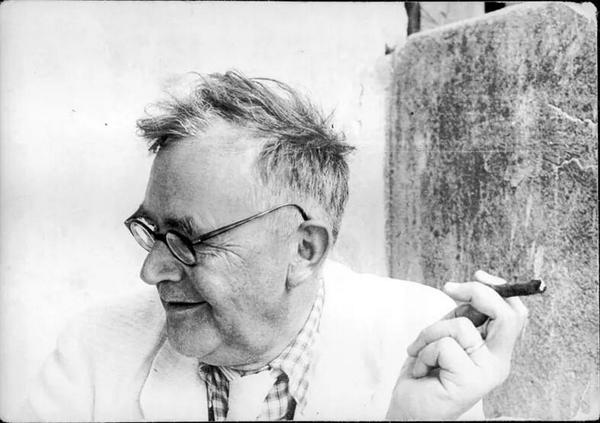
Karl Barth enjoying a cigar.
In CD IV.4 Barth explains that baptism is not a sacrament, but its meaning is found in its character “as a true and genuine human action which responds to the divine act and word.”[3] In understanding Barth’s stance towards the sacrament of baptism we might come to understand his views about the LS. By examining Zwingli’s exegetical work regarding baptism, Barth points out that Zwingli was basically right, that the meaning of the ceremony is found in human action, in the performance of the ceremony. Thus Barth says that he does not object if someone calls his own views “Neo-Zwinglian.”[4] Barth goes on to explain the LS is also a human decision and an act whose value consists human decision to respond to divine work.[5]
In CD IV.4 Barth also talks about the Holy Spirit feeding the believer with the body and blood of Christ. He says that Christ’s body and blood nourishes the believer.[6] Although he seems to be using LS language it is not clear that this is referring to the LS, for the context of this passage is the ongoing process of sanctification, not any one particular act.
In CD IV.3 also makes several references to the LS. In one section he mentions that Christ calls the elect to himself, conjoining himself to them. Barth says that the Lord’s Supper is “instituted to represent this perfect fellowship between Him and them which He has established.”[7] Thus in the Lord’s Supper the Christian celebrates, adores, and proclaims what Christ has done for them, namely redemption.
Finally, another important passage on the Lord’s Supper is found in CD IV.3. In this section he talks about the Word and the Lord’s Supper. Barth says that human words can acquire a function and capability that they did not have in themselves as elements of general human speech; once they are about the Word, they are received and claimed by the Word of God.[8] God uses human words, even though they are limited due to their creatureliness, for the service of His Word, God gives them power to bear witness to His Word. Barth says that the Lord’s Supper is similar to how God uses human words to bear witness to God’s Word. The elements of the LS do not cease to be what they are, bread and wine, but they now serve the “function and capability” of indicating and confirming the fellowship of the community with its Lord.[9]
According to these passages, especially the previous passage, it seems as though Barth’s position is conditioned by his theology of revelation and the Word. Barth believes that humans cannot know God unless God reveals himself to them. He believes that God reveals himself in his Word, Jesus Christ. Jesus, the Word of God, is God himself revealing himself. Thus scripture does not truly reveal God, scripture serves as a witness to the Word, the revelation of God himself. Similarly the LS is not where we encounter God. The LS simply serves as a witness to the Word. The Lord’s Supper serves as a witness to the Jesus by indicating and confirming the reconciliation that Jesus has brought to the elect. So when the elect practice the LS, they bear witness to the Word and confirm to themselves and each other what Jesus has done for them and is doing for them, he has reconciled them to himself and he is sanctifying them.
—————————————
[1] James Buckley, “Christian Community, Baptism, and Lord’s Supper,” In The Cambridge Companion to Karl Barth, ed. John Webster, (Cambridge: Cambridge University Press, 2000), 196.
[2] Buckley, “Christian Community, Baptism, and Lord’s Supper,” In The Cambridge Companion to Karl Barth, 201-2.
[3] Karl Barth, Church Dogmatics: IV.4 the Doctrine of Reconciliation, trans. G.W. Bromiley (London: T&T Clark, 2009), 30:126.
[4] Barth, Church Dogmatics: IV.4 the Doctrine of Reconciliation, 127.
[5] Barth, Church Dogmatics: IV.4 the Doctrine of Reconciliation, 128.
[6] Barth, Church Dogmatics: IV.4 the Doctrine of Reconciliation, 37.
[7] Karl Barth, Church Dogmatics: IV.3.2 the Doctrine of Reconciliation, trans. G.W. Bromiley (London: T&T Clark, 2009), 28: 169.
[8]Karl Barth, Church Dogmatics: IV.3.2 the Doctrine of Reconciliation, trans. G.W. Bromiley (London: T&T Clark, 2009), 29: 55.
[9] Karl Barth, Church Dogmatics: IV.3.2 the Doctrine of Reconciliation, 29: 55.
During the “German Church Struggle” Bonhoeffer and some of the dissenting pastors decided to set up a new seminary in Finkenwalde in order to train pastors for the Confessing Church. These Pastors met, not only to receive academic training, but to receive spiritual nourishment as well (this was quite absent in most German pastoral training at the time since training was primarily an academic exercise). These pastors gathered for prayer, study, meditation upon the word, and of course the study of theology. As Bonhoeffer led these pastors (and soon to be pastors) he developed a way of life centered around discipline, prayer, and scripture. At times it seemed as though this new way of life was overly monastic, students were bored with how rigid the routines were even to the point where some dropped out of the seminary, but at other times it was exactly what the students desired, it was a burst of fresh air for students who were used to the deadened spirituality of German universities.
Bonhoeffer sitting with some younger students.
In Charles Marsh’s gargantuan biography of Bonhoeffer titled Strange Glory he outlines what life at this modern day monastery at Finkenwalde looked like…
Each day would begin and end in quiet meditation. The bretheren would rise and proceed in silence to the dining room for prayers; there, in the early morning light, they would sit until God had spoken some word for the day into their hearts – or until a half hour had passed. Then morning praises were sung. After hymns, the men read antiphonally from the Psalter. There followed a reading from the New Testament, and prayers, sometimes from the prayer book, otherwise extemporized. Morning worship concluded with another hymn…the men would return to their bunk room in silence to make their beds and “put their things in order.”
After breakfast, devotional exercises began, with two or three men sharing a room… for the first half of this period they were to meditate on scripture. Bonhoeffer instructed them to center their thoughts for an entire week on a single passage, not for some purpose of exegesis – as would have been expected in the universities – or even for homiletic inspiration, but “to discover what the verses had to say” in the quiet of the morning.” (Strange Glory 232)
(Note: Look for my review of Strange Glory on this blog in about a week or so.)
I have really grown to like the Kregel Exegetical Library commentaries on the Old Testament. A while back ago I reviewed a commentary on Judges from the same series, I really enjoyed it and found it useful, so I had pretty high expectations for this commentary on the Psalms from the same series.
Let me share with you a few things I found to be very helpful…
Engagement With Current Scholarly Work – This commentary does a good job engaging other important works written on the Psalms. For instance in his commentary on Psalm 47 Ross interacts with Mowinckel’s enthronement theory and several more modern variations upon that theory.
It Doesn’t Get Bogged Down on Source Criticism – Though Ross does attempt to (carefully) address the sitz im leben he doesn’t fall into the trap of trying to discern the various sources of the Psalms. Instead he opts for taking the canonical version of the Psalms and makes comments on that version instead.
The Inclusion of Textual Variants and Comments on the Variants – This isn’t necessarily helpful to a preacher, nevertheless the quality and quantity of comments on these textual variants makes this commentary stand out among other Psalm commentaries.
It Provides Clear Outlines of Each Psalm – This will be very helpful to preachers. Its almost as he has broken down each Psalm into 3 (or 4 or 5) point messages!
Helpful & Concise “Message and Application” sections – I found it personally helpful that for each Psalm covered in this volume Ross provides an italicized “central expository idea.” This is a one or two sentence long phrase which captures the central theme of the Psalm. When preaching narrowing down one’s passage to one central idea is very helpful, not only for crafting the sermon but also for helping the congregation remember the central point. Now as they are, these “central expository ideas” probably won’t work as message points, but they are certainly a good start on making an accurate, deep, and memorable statement of your own.
One thing that would have been helpful, but wasn’t included would have been a brief recap of the introductory material. Ross often alluded to things he had written in the introduction, however the introduction is in volume one, not in volume two… all this to say, volume two certainly does not exist as a stand alone volume, you need volume one. However, the fact that volume two didn’t include any sort of introduction didn’t really change my opinion of this commentary. In fact this made me want to go and get the first volume!
As a preacher and bible college teacher I found this commentary to be useful, exegetically rigorous, as well as very practical. I highly recommend it to pastors and seminary students (some of the issues addressed in this commentary might be a bit too technical for a bible college/undergraduate student or a lay person). So if you are looking for a high quality commentary on Psalms 42-89 you should purchase this volume.
(Note: I received this book courtesy of Kregel in exchange for an impartial review.)
It is well known that Adolf von Harnack along with other German theologians of the early 20th century promoted a “return” to the essence of Christianity. They believed that through the centuries Christianity had been perverted by Hellenistic philosophy. True Christianity – the essence of Christianity – was found in the teachings of Jesus, not in church dogma. In other words the teachings of Jesus were the kernel of Christianity and dogma was the husk. If modern day people were to believe in Christianity they would need to get rid of the husk and embrace the kernel.
Among the “husk” was the doctrine of the divinity of Christ. Liberal German theologians tended to believe that Jesus was not “divine” in the same sense that the creeds spoke about, rather (in a Schleiermacher-ian sense) he was divine because he possessed “God consciousness.” This belief isn’t the essence of Christianity, rather it’s the essence of low Christology.
In comes Barth though – he points out the foolishness of this type of theology. He points out that this sort of Liberal theology only amounts to idolatrous speech, because this sort of theology did not actually talk about God as he is rather it amounted to talking about God in a really loud human voice. To talk about God is to speak the Word of God after God. It is to allow God to reveal himself – something only God can do – then speak God’s words after God. The theology of Liberal Germans was stuck in an anthropomorphic captivity, theology needed to be set free…
With this Barth – and a new school of theologians emerged talking not about a God in our own image, but talking about a God who traverses the path to human beings; a God who can only be known in his self-revelation. This God was radically different from the God of the Liberal Germans. That God did not require much from a person, he simply required one to live a moral and upstanding life amidst one’s social strata. After all if the essence of Christianity was “Jesus Moral Teachings” what more should one do? However Barth, and in today’s blog Bonhoeffer preached of a Christ who demands way more than simply an “upright life.” This God – the God who reveals himself – demands everything one has…
The following is a section from a lecture titled “Jesus Christ and the Essence of Christianity” that Dietrich Bonhoeffer gave in Barcelona during a brief stint as a parish minister:
To the nineteenth- and twentieth-century mind, religion plays the part of the parlor, as it were, into which one doesn’t mind withdrawing for a couple of hours, but from which one then immediately returns to one’s business. One thing, however, is clear: namely, that we understand Christ only if we omit to Him in a abrupt either-or. He was not nailed to the cross as an ornament or decoration for our lives. If we would have Him, we must recognize that He makes fundamental claims on our entire being. We scarcely understand Him if we make room for Him in merely one region of our spiritual life, but rather only if our life takes its orientation from him alone or, otherwise, if we speak a straightforward no. Of course, there are those not concerned with seriously considering the claims Christ makes on us with His questions: Do you wish to make a complete commitment or not? They should rather not get mixed up with Christianity at all; that would be better for Christianity since such people no longer have anything in common with Christ. The religion of Christ is not the tidbit after the bread it is the bread itself, or it is nothing.
This powerful word continues to speak today – Christ – the true Christ makes claims on our entire being. As God himself he has the right to make those demands of us.
I am prone to action. I am prone to “do – do – do.” I am prone to taking matters into my own hands and hoping that God will bless what I am doing. This is especially true of me when it comes to being on mission and doing evangelism. I want to create a system, develop a fool proof strategy, or figure out the latest and greatest methods for evangelism. In one sense that’s a good thing, we want to be faithful in accomplishing the task that God has entrusted us with – and part of being faithful is working hard at it. However I often find myself placing too much confidence in these sorts of things and not relying enough upon prayer.
In The Best Kept Secret of Christian Mission: Promoting the Gospel With More Than Our Lips, John Dickson calls us back to rely upon the power of prayer for evangelism…
Evangelism is grounded in heartfelt prayer. I realize this is a mother’s-milk statement, but sometimes I am in danger of treating prayer as if it were mother’s milk – something I have grown out of. How many churches have spent more time crafting mission statements, devising strategic plans, and organizing evangelistic programs than pleading with God for success in these activities? I am charging myself here. In my own church we tried to remain conscious of the priority of prayer. Instead of developing a manifold strategy for evangelism, we decided to produce and distribute a seven-paragraph congregational prayer, something that captured our hopes as a congregation and gave focus to our pleas to the Lord and planning evangelism. We figured that even if our strategies failed, the Lord might still answer our prayers. (66)
Evangelism is grounded in heartfelt prayer. That truth permeates scripture. Paul tells the Romans that it was his practice to plead with God on behalf of people who did not yet follow Jesus…
Brothers and sisters, my heart’s desire and prayer to God for the Israelites is that they may be saved.” (Romans 10:1)
Paul urges Timothy (and us) to pray for non-believers in the world…
I urge, then, first of all, that petitions prayers, intercession and thanksgiving be made for all people – for kings and all those in authority, that we may live peaceful and quiet lives in godliness and holiness. This is good, and pleases God our savior, who wants all people to be saved and to come to a knowledge of the truth. (1 Timothy 2:1-4)
Paul urges Timothy to pray for all people in order that all people may be saved and come to a knowledge of truth. Praying for those who don’t believe is one of the most important things we can do when it comes to mission and evangelism.
But its not just Paul who urges prayer for evangelism and mission – Jesus urges us to pray too! Before Jesus sends out his disciples he tells them
“The harvest is plentiful but the workers are few. Ask the Lord of the harvest, therefore to send out workers into his harvest field.” (Matthew 9:37-38)
As you reflect on the importance of prayer to evangelism and mission I would ask you to ponder these three questions:
What are the names of non-believers that you are praying for?
What unreached people groups are you praying for?
How can you begin to incorporate prayer for the lost into your everyday prayer time?
In honor of the 4th of July I give you a song about American militarism and the havoc it has wreaked in Central America…
Happy 4th of July!!!
This guy comes up to me His face red like a rose in a thorn bush Like all the colors of a royal flush And he’s peeling off those dollar bills Slapping them down One hundred, two hundred And I can see those fighter planes And I can see those fighter planes
Across the mud huts where the children sleep Through the alleys of a quiet city street You take the staircase to the first floor Turn the key and slowly unlock the door As a man breathes into a saxophone And through the walls you hear the city groan Outside is America Outside is America, America
Across the field you see the sky ripped open See the rain through a gaping wound Pounding on the women and children Who run Into the arms Of America
Many years ago Avery Dulles wrote a classic book on ecclesiology titled – Models of the Church – in this book he outlines several key models that Protestants and Roman Catholics have used to explain the nature of the church. Dulles explains that the church has been understood as an Institution, a Mystical Communion, a Sacrament, a Herald, a Servant, as well as a Community of Disciples. However the problem with some of these “models” is that they aren’t models or images that Scripture uses to describe the church. Yes there is some truth to these images, however they ignore the fact that God through Scripture intended us to use scriptural images as the primary images for our understanding of the Church. Among these images are “family,” “body,” and “Temple.”
In Scripture God reveals to us the nature of the church through images and models – these should also be our primary images and models for understanding the church…
Scripture clearly lays out some images and metaphors that shape our self-understanding of what it means to be church. We even have some helpful historical models (which by no means are on par with Scriptural models); for instance the church as a sacrament or as a suffering servant. However, a problem arises when we uncritically begin to appropriate modern day images and apply those to the church. Once we begin to indiscriminately apply from culture around us we begin to walk on thin ice – the problem is that these images carry a lot of baggage and they can (unconcsiously) twist and deform our scriptural understanding of what it means to be the church.
So what are these (unhelpful) models? Here are five models suggested by Michael Goheen
The Church as a Corporation: Corporations have a bottom line (money) and they are ready to make use of any means which can help them efficiently achieve that bottom line. The danger with this model is when the church begins to value efficency and pragmatism over faithfulness.
The Church as a Theater: Theaters are where people go to sit back and passively enjoy some sort of entertainment. The danger with this model is that people begin to come to “church” in order to be entertained once they stop being entertained they bail. This is so wrong on many levels – its consumeristic and it imagines church as simply a place one goes to.
The Church as a Classroom: The Church exists to teach. What is wrong with this model? Well lets begin with the fact that western education tends to be reductionistic – western education doesn’t form the whole person, rather it simply focuses on helping people to have “correct beliefs” regardless of whether or not they actually live “correctly.” However, we shouldn’t bag on the teaching function of the church – the church certainly is a place for teaching, but it can’t be reduced to western models of teaching.
The Church as a Motivational Seminar: Two Words – self help. Enough said…
The Church as a Social Service Office: The government has social service offices – they provide welfare, take care of the weak, needy, and poor. These are all things that the church ought to be doing as well – Its part of loving the world! However the church is not simply an institution for providing social services, the church cannot simply preach a “social gospel” it must preach a holistic gospel. This means that the church will address these issues and help these people but within the context of Gospel announcement.
All of these models have certain elements of truth (some definitely more than others). However we must be careful about leaning too heavily on any of these models. God has given us models in Scripture to use – so those must be the primary models that shape our understanding of the nature of the church.
Last week I read through a book called Dispatches from the Front – Stories of Gospel Advance in the World’s Difficult Places. The book follows Tim Keesee as he travels the world, telling stories of the bold faith and sacrificial bravery that many of our brothers and sisters portray as they face challenges for being Christians.
The truth is that our brothers and sisters on the other side of the world – Asia, Africa, the Middle East, and Latin America often face persecution and challenges at the hands of their governments and/or neighbors. Thinking about the challenges they face can surely be discouraging yet we know that the gospel is moving rapidly in these “impossible” and “hard” places. Samuel Zwemer, an early 20th century missionary to Islamic countries and professor of missions at Princeton Seminary reminds of this fact, that no situation is impossible for the Lord:
The Kingdoms and the governments of this world have frontiers which must not be crossed, but the Gospel of Jesus Christ knows no frontier. It has never been kept within bounds. It is a message for the whole race, and the very fact that there are millions of souls who have never heard the message becomes the strongest of reasons why we must carry it to them. Every year we hear of further advance into these regions of the world by commerce, by travelers, by men of science. If they can open a way for themselves in spite of all these difficulties, shall the ambassadors of the cross shrink back? God can open doors. He is the “Great Opener.” He opens the lips of the dumb to song, the eyes of the blind to sight, and the prison house to the captive. He opens the doors of utterance and entrance of the gospel. He opens graves and gates, the windows of heaven and the bars of death. He holds all they keys of every situation. – Samuel Zwemer (The Unoccupied Mission Fields of Africa and Asia)
Do not be discouraged when you hear stories of other Christians facing opposition in these “closed” places – for opposition and suffering is the appointed means for the Gospel to reach these places. Don’t be discouraged for we know that the Gospel will flourish in these places one day because the Gospel of Jesus Christ knows no frontier….
The “10-40 Window” is one of the most difficult areas to reach for the gospel. But it can be done!


 CWoznicki Think Out Loud