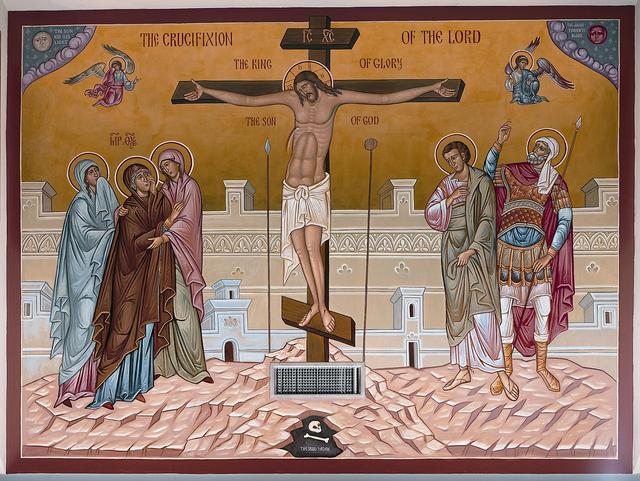
Review: The Victory of the Cross – Salvation in Eastern Orthodoxy by James R. Payton Jr.

For many evangelicals Eastern Orthodoxy is compelling, if not for its seemingly evangelical convictions (contrasted with “Rome”), but for the fact that for many it remains a rather mysterious entity. Thus, introductions to Orthodoxy written for Protestant or evangelical audiences abound. [Sidenote: Why aren’t more of these kinds of introductions being written about Roman Catholicism?]

The first step for Western Christians, if they are going to learn about Orthodoxy, is to “get inside the instincts intuitions, and perspectives of the Orthodox approach.” James Payton Jr. is a helpful guide in doing just that. Even though he is a protestant, he has imbibed enough of Orthodoxy to be able to present it fairly – his writings have even garnered support from Orthodox theologians.

The Victory of the Cross is Payton’s attempt to introduce Orthodox views on salvation to western Christians. The first thing that we are made aware of is that the Orthodox understanding of salvation is more holistic than typical western understnadings. To quote Kallistos Ware, “Out human salvation leads… to the redemption fo the whole created order.” Vladimir Lossky concurs, saying, “Redemption is a wondrous reality, which extends across the entire cosmos, visible or not.” Some key features of the Orthodox narrative is that dath isn’t a curse it is a consequence. Also, guilt is not inherited. Original sin refers to original corruption and the primal sin but does not carry the Augustinian notion of original guild. Another key feature of Orthodoxy’s understanding of salvation is that salvation is not merely proclaimed in the New Testament. As Payton says, “The focus on the Savior binds together scripture, the apostolic message, and the tradition passed on and defended in the Church.”

How is salvation accomplished? The Orthodox place a lot of weight on the incarnation as a saving work. Payton explains, “The incarnation was not merely getting the Savior on the ground, as it were, so that he could eventually save. The incarnation was itself already a step in the accomplishment of salvation.” The Orthodox also emphasize the Chris is the last Adam who recapitulated in himself the whole human story. Christ lives the various stages of human life, being faithful where Adam was not, sanctifying every 5256stage of life for those who are in Christ. Third, there is an emphasis on how Christ defeats death and frees humanity from the hold that Satan had upon it.

What is the goal of salvation? The goal is theosis. In the West theosis remains controversial (at least at the popular level) but a doctrine of theosis finds many parallels in Western doctrines of union with Christ. The Orthodox understanding of deification finds its impetus in what happens to Christ’s human nature. If we want to know what it means for our natures to be deified we must look at what happens to Christ’s human nature.

Overall I found Payton’s introduction to the Orthodox understanding of salvation to be an excellent overview. I would highly recommend this book to those seeking to familiarize themselves with Eastern Orthodoxy. His final two chapters describe in detail what difference an Orthodox theology of salvation makes to the life of the church and to the life of individual believers, so the book also ahs a practical component. I think this would make an excellent textbook in an introductory class on Orthodoxy or in a class that surveys issues in soteriology.

Note: I was provided a free copy of this book by the publisher.

The Unity of the Human Person According to the Greek Fathers

Kallistos Ware begins his discussion of human personhood by referring to David Jenkins, who was the Bishop of Durham at the time, who insisted that personhood cannot be defined. According to Jenkins, “There is a sense in which we do not know what is involved in being a person. Thus, we do not know how far being a person goes. That is to say we do not know what, if anything could properly be described as the fulfillment of being a person.” (197) Jenkins’s words highlights what Ware believes is an important feature of personhood, namely, “to be open always to point beyond…To be human is to be unpredictable, creative, self-transcending.” (198) This transcendent and open feature of personhood is affirmed by the Church Fathers. Since God is incomprehensible, so are human persons. (198)

The claim that humans are incomprehensible, transcendent, and open, however does not prevent us from identifying the features of human personhood that embody these factors. Ware identifies three factors. First, humans are a “microcosm.” They exist on both the spiritual and material level. When you look at a human person, in some sense you “see the whole creation.” (200) Second, humans are mediators. In their act of mediation they transcend the division between male and female, they transcend the material order, they even transcend creation. Third, humans are a “microtheos.” Humans have the task of transcending and unifying the created with the uncreated. Humans are not only the universe in miniature, “but also microtheos, God in miniature.” In being deified humans unite all created things to God, “revealing the divine presence in our own persons, in one another, in every tree, rock, and stream, in the whole creation.” (204)

Towards the end of this essay Ware adds a further point, one that underlies the other three points he had already made. This point is that “like the personhood of God, [human personhood] is exchange, self-giving, and reciprocity.” A person, is what he or she is “only in relation to others.” In order to fulfill these tasks—being a microcosm, a mediator, a microtheos—humans must be in relation to others. He then cites John Macmurray who says, “Since mutuality is constitutive for the personal, ‘I’ need ‘you’ in order to be myself.” Ware summarizes his point well I cannot be a mediator, a bridge-builder, unless I relate to my fellow humans. My vocation to divinize the world is essentially a vocation realized in common with others.” (206)

What I find interesting about Ware’s contribution to the project of understanding personhood is that he approaches the matter from the angle of vocation. Human persons are beings with a particular kind of vocation. This vocation requires relationality. However, after reading this essay I’m still left wondering whether there is a definition of a person in general or whether we must define personhood according to different types (e.g. human person vs. divine person vs. angelic person). If there is one definition of personhood what would Ware include in that definition? It seems as though openness and relationality would be included in that definition. This latter feature—relationality—is part of a trend that I noticed when reading the anthropological texts in this report. Usually, the grounds for including relationality appeals to Buber or Macmurray. It thus seems fitting that the last blog on this series on personhood will be Macmurray’s lectures on personhood.


Christian Theism and the Concept of a Person

In our modern world, says Adrian Thatcher, “the credibility of theism suffers from a close association with Cartesian Dualism.” (180) Thus, Thatcher’s goal is to show that the Christian concept of God and the Christian concept of human persons does not require dualism.

Thatcher begins his argument by outlining six different uses of the concept of a “person.” First there is the theological use, which is illustrated by Augustine’s use of persons for the three of the Trinity. Second, there is the “ontological” uses, where a person is defined by their essential difference from non-persons. Third, there is the psychological use, which refers to the particular character that a person acquires. Fourth, there is a moral use, which understands humans as ends and not means. Fifth, there is the existential use which sees a person as what they make of themselves. Finally, there is the social uses in which “persons are constituted by their mutual relationship to one another.” (181) God cannot be conceived of as a person according to any of these six uses, yet Thatcher says, God has been called a person by philosophers, theists, and atheists. This, he calls the “personalist consensus.” (181) The personalist consensus primarily ties God to the “ontological” use of person, moreover this ontological use rarely makes reference to embodiment.  Thatcher finds this non-embodied use of “person” problematic because of the way that the Bible talks about persons and the emphasis that the Bible places on resurrection and ascension.

Thatcher argues that we can reject the dualism that underlies much of the personalist consensus and still maintain that God is a person. The way to do this he says is to appeal to ever changing understandings of matter. Matter is open, emergent, and fathomless, it is inclusive of form and mind, so we can say that God is in a real sense corporeal or material (as long as we don’t have Cartesian res extensa in mind). The conclusion is that God can fulfill the requirement of being embodied, thus, God can be personal.

God, however, is personal in more ways as well. Christ is God incarnate, the incarnate Christ who is homoousios with the Father can fulfill all six notions of personhood. This allows us to call God a person in an even fuller sense. It also has the implication that God becomes a person. Without entering into social relations by means of embodiment with other persons God lacks the relation to others that defines personhood. So, “God can become a person, in this [social] sense only as he creates some community of rational agents in relation to which his own perfection can be expressed.” (190)

Thatcher’s essay is interesting because it attempts to apply changing understandings of matter to theology. However, I must admit that I don’t feel the force of the necessity of saying that God must be embodied. This is certainly true of human beings, the Bible doesn’t suppose that humans are meant to be disembodied beings. Moreover, I don’t feel the force of the “personalist consensus.” Among those whom he cites as supporting this consensus is Richard Swinburne who says that “God is a person, yet one without a body, seems the most elementary claim of theism.” (182) This might be true of theism in general but not of Trinitarian theism. God is one nature, three persons. The proposals that Thatcher makes does not line up with creedal Trinitarian theology. Moreover, the suggestion that God becomes a person in the fullest sense only when God creates other rational creatures undermines the classical doctrine of aseity.

A Theology of Personal Being

In a short essay titled “A Theology of Personal Being,” John Macquarrie makes three assertions about what it means to be a human being. First, “a human person is a being on the way.” (172) Humans are “unfinished” – this is in contrast with traditional views that regard human nature as some sort of fixed object. Macquarrie believes that the dynamic nature of human nature is the biblical teaching. He cites 1 John 3:2 for example, which says that we are God’s children but it does not yet appear what we will be. He also cites eastern theologians who thought that God’s image was a kind of potentiality that would eventually be realized. The view that human persons are “beings on the way” is confirmed by Marxist and existentialist philosophers. For example he says “Sartre’s view of the human being as surging up from nothing and then making himself recalls the story of Abraham going out into the wilderness.” (174) The notion that human nature changes is further confirmed by our use technology. He says, “The big differences between ourselves and the animals is this: that animals have bodies that are pretty much determined… but we add extensions to our bodies…They have become natural in some sense, part of what it is to be a human being.” (175)

Second, a human person is a “being in the world.” (176) By this he means that humans are embodied. Humans are not simply spirits; to be a human person you need a body. This is affirmed in the doctrine of the resurrection.

Finally, human persons are “beings with others.” (177) Macquarrie explicitly draws on Martin Buber’s “I-Thou” concept. No person exists without relationships to other persons.

A few questions came up in my mind as I read this essay, primarily concerning the use of the term “nature.” He claims that part of what it means to be a human is to have a nature that can change. The traditional view, however, affirms a static nature. Yet, the traditional view in fact affirms that people do change, just not at the level of nature. I’m not sure why the definition of nature needs to be changed in order to accommodate the fact that humans change in significant ways. The only reason why I imagine why Macquarrie might say that significant changes to a person change a nature is that his understanding of “nature” or “essence” tracks more with an existentialist understanding of nature. This wouldn’t be surprising since Maquarrie is known as an existentialist theologian.

Paul and the Person: Reframing Paul’s Anthropology

Susan Eastman’s book, Paul and the Person: Reframing Paul’s Anthropology is an attempt to generate a three-way conversation between stoic understandings of personhood, contemporary cognitive science/philosophy, and Pauline scholarship. She argues that Paul’s writings—at least in modern scholarship—have been read through the lens of Enlightenment assumptions about persons as autonomous, discrete, self-determining individuals. As Eastman puts these three conversation partners into discussion with one another she identifies some overlapping insights. First, the self is irreducibly embodied and socially formed. Second, the self is formed in encounters with one another – thus the practice of change or spiritual formation always occurs in the context of relationship with others. Finally, we become individuals in and from relationships.

Her thesis that for Paul the self is always a self in relation to others raises a number of questions, like: “What kind of agency is implied by a self that is not solely self-determining?” “What happens to both freedom and responsibility?” “What is the role of the body in an account of the self.?” “How are Paul’s accounts of the person as self-in-relation to ‘sin,’ on the one hand and to Christ, on the other mutually related?” “How do people change-or do they?” (9) She answers some of these questions over the course of this book. However, what interests me the most is her discussion about how a person is a self-in-relation to Christ. The main takeaway for me is that she ends up defining personhood in terms of our relation to Christ and Christ’s relation to us. She suggests that “Paul’s anthropology counters any criterialism about qualifications of being a person, precisely because it is grounded in the story of Christ’s mimetic assimilation to the human condition.” (178) This story is expressed in Philippians 2. Christ is sent into the world in human form, he identifies with sinful humanity to the point of death, and is victorious over death. As Eastman explains, “for Christ to become en homoiomati anthropon is for him to share fully in the desperate contingency, suffering, judgement, and death of Adam’s heirs.” (139) Thus, Christ relates to every person who expresses the form of human existence. Christ “establishes a new relational matrix of humanity.” In a real sense he takes up all of humanity’s story when he becomes incarnate. She suggests that human personhood is thus “not attained by any achievement including participation in Christ; it is granted globally by Christ’s participation in the depths of human life.” (179)

Eastman’s proposal that for Paul humans are persons-in-relation can’t help but raise some important questions. For example, we might wonder if there is any significant difference between those who are personalized simply in virtue of being the kind of creature that Christ entered into their story and those who are united to Christ in virtue of faith. At one point she says that her working definition of a person is “’one for whom Christ died,’ thereby including the entire human race.” (14) Naturally such a view would rule out any form of limited atonement because that doctrine would claim that the reprobate aren’t persons! Perhaps those who are inclined to accept limited atonement could distinguish between different degrees of personhood in a way similar to Zizioulas. For those who aren’t inclined to accept limited atonement there is still a question as to whether the relational account admits to degrees of personhood. Christ certainly relates to those who are united to him by faith differently than those whom Christ died for. How does this different relation fit into Eastman’s account of personhood deriving from one’s relation to Christ? She doesn’t say. Perhaps a distinction between objective personhood derived from being the kind of creature that Christ died for and the subjective experience of personhood derived from experiencing union with Christ might help solve this puzzle. By this I mean that on this model perhaps it is the case all persons are personalized in virtue of being related to Christ’s salvific work but that only those who are aware of their relation to Christ experience all the benefits of personalization.

Trinitarian Personhood

William Ury is Professor of Systematic and Historical Theology at Wesley Biblical Seminary, Trinitarian Personhood is the published version of his dissertation undertaken at Drew University. Part of the reason Ury undertook this project was because he noticed a “bankruptcy of modern thought with regard to personhood.” (4) He attributes this bankruptcy to a lack of “proper theological anchoring.” (4) Most reflection on what it means to be a person devolves into views which focus too much on “rational individuality,” or “psychological experience,” and “consciousness.” Ury recognizes that these elements are important, and practially adequate, but that a view of personhood that emerges from a lopsided focus on these features results in a notion of self-determination which ends up with isolationism. He identifies this as one of the major problems of the modern world.

In light of these problems Ury suggests that we ought to rethink our definitions of personhood in light of the doctrine of the Trinity. He claims that “preserving analogically heuristic categories of a relational trinity promises a substantiation for both the worship of a self-giving God and the wholeness of human persons offered by the church.” (4) Thus, Ury’s burden is to establish that relationality is central to a proper understanding of divine persons. Throughout the book he claims that cognition and volition—two typical properties—are constituent of but not necessarily equivalent to a complete concept of personhood. The way that he establishes this thesis is through a historical study of Trinitarian theology of divine persons. He surveys the etymology of prosopon, persona, hypostasis, ousia, prote ousia, deutera ousia, and substantia. His survey of Eastern theologians leads him to believe that the mutual indwelling of divine persons is the groundwork for the notion of a Trinitarian hypostasis. He also reinterprets Augustine’s trinitarian theology and argues that his theology possesses relational categories, thus the difference between the east and the west—while real—is overexaggerated.

While the Greek Fathers and Augustine are lifted up as being relational, Ury places the blame for a static understanding of personhood at the hands of Boethius. In his attempt to confront Nestorianism and Eutycheanism—two heresies that stemmed from the identification of person with a nature—Boethius developed his famous definition of a person. Boethius says,

Wherefore if person belongs to substances alone, and these rational, and if every substance is a nature, and exists not in universals but in individuals, we have found the definition of person: The naturae reationabilis individua substantia. [an individual substance of a rational nature] (203)

Ury rightly points out that the Trinitarian persons cannot carry this kind of personhood or else you end up with something like Tri-theism, therefore, those who follow this tradition will need to claim that “the divine Persons really are nothing other than the divine essence itself.” This is, in fact the move that most theologians in this tradition make. They argue that the plurality which defines the “three” of the Trinity is plurality of relations and that persons and attributes are identical with the divine essence. This line of thought gets picked up by Aquinas who says that a “divine Person ‘signifies what is distinct’ in the nature of God.” (221) Therefore, a person is actually a substistent relation. Aquinas himself says that “Person means that which is most perfect in whole of nature, namely what subsists in rational nature.” (221) Ury finds this line of thought very problematic, he goes as far as to say that those who hold to such a view “ought not to claim to be Trinitarian.” (272) According to Ury, the person who rescues the notion of personhood was Richard of St. Victor who defined a person as a rationalis naturae incommunicabilis existential. Ury summarizes Richard’s view by saying that for Richard a Person is an “incommunicable existent both producing and receiving the love which is the substance of the Godhead.”

Although the burden of Ury’s book is to establish that Triniatarian persons are relational, he does make some comments for our understanding of human persons. He explicitly claims that “in a relational definition of person there resides the premise that for both divine and human spheres to be personal – they must be interpersonal. By its very nature the relational definition critiques the modern viewpoint of sociality; that of a collection of individuals who do not really have anything to do with one another but a mere truce of co-existence, hopefully peacefully. (280)

By the end of the book I wish that Ury had spent more time “investigating the implications of [the] relational definition.” Although he argues that relationality is essential to Trinitarian theology, he never investigates the implications of his findings! The implications of his study are relegated to several paragraphs in the conclusion of the book.

Podcast Alert: Prayer, Free Will, and Determinism with Chris Woznicki

I recently recored a Podcast with Ryan Mullins on human nature, prayer, and free will. You can listen to it here or on Spotify!


In today’s episode, I sit down with Chris Woznicki. He recently won the IVP Early Career Philosopher of Religion prize for an essay that he wrote on human free will, determinism, and prayer. In today’s episode, Chris and I chat about theological anthropology before turning to discuss the nature of prayer, and the relationship between free will and theological determinism.

Credits:

Host: R.T. Mullins (PhD, University of St Andrews) is a research and teaching fellow in analytic theology at the University of St Andrews.


CFP: 2020 Convivium Conference ‘Inhabiting Memories & Landscapes’: a cross-disciplinary engagement with Wendell Berry

This should be of interest for those who are interested in the “theology of place” and especially those who are interested in the theology of Wendell Berry.


In his novels, poetry, and essays, the American Agrarian writer, philosopher, and farmer Wendell Berry frequently speaks of the need to be ‘placed’, to inhabit a particular landscape and its social memory over an extended period of time. This, he believes, is a necessary precondition for fostering communities that care for the earth and the people who live off it—what he refers to as conviviality.


This conference will offer an interdisciplinary exploration of notions of conviviality, social well-being, and the good life that are rooted in the interplay of local landscapes, memory/heritage, and social identities. How have societies in the past inhabited memory and their landscapes? In a time of increasing globalization and networked societies? What models are there from around the world for sustainable communities that also value heritage? How might contextual approaches to research better account for landscapes and heritage? How are social memories and local landscapes impacted by current concerns about misinformation and the climate crisis? What economic, social, environmental, and political policies today might wendell-berry-c-guy-mendes_crop-e1563466456950encourage a ‘convivial’ engagement with local heritage and conservation?

The conference will feature keynote lectures, interdisciplinary paper panels, and a concluding panel discussion, as well as a Cathedral tour and a possible walk taking in local landscape and heritage. We invite papers and panels from across disciplines that engage either with the writings of Wendell Berry or with the interplay of memory/heritage, landscape, and social identity.

Possible topics could include but are not limited to:

  • Any aspect of the fiction, poetry, or essays of Wendell Berry
  • Writings about nature and place in an age of globalization
  • Memory, local landscapes, and place in regional literature, historical studies, and theology
  • Concepts of and attitudes towards memory, local landscapes, and place in a globalised society
  • Concepts of ‘placed’ sociology, economics, and political theory
  • Past and present notions of ‘conviviality’ or the good life that account for harmonious relationships with local environments and heritage
  • Intersections of the local and global and their impact on social memory, landscapes, and identity
  • Impact of tourism on local connections with inhabited landscapes and historic sites
  • Connections between nature and heritage conservation
  • Environmental ethics and approaches to localism that account for local heritage, religion and culture

We invite abstracts of approximately 250 words for

  • 20-minute papers
  • pre-formed 90-minute panels (please send an abstract for each paper)
  • poster presentations which will be displayed for the duration of the conference

Please send abstracts, accompanied by a short biographical note to rescanon@breconcathedral.org.uk. by 16th March 2020. Please note that the organisers will not accept proposals for all male panels.

Persons in Communion

Karl Barth famously made the decision to speak of “modes of being” (Seinsweise) rather than persons when speaking of the Trinity. There are several reasons why Barth decided not to adopt “person” language. For example, Barth was concerned that the term “prosopon” too closely implied a form of Sabellianism, where persons were like masks of some quartum quid. He is also concerned that modern connotations of the word would too easily creep into the meaning of the term. This seems to be Barth’s major concern; if we take seriously Barth’s concept of revelation, then we cannot move from concepts of personhood that are derived from human experience and impose them upon God. The term Seinsweise – although not perfect – carries significantly less baggage and thus is preferable.

Although Alan Torrance identifies with the Barthian project, he rejects this move away from the use of “person.” He explains that “Barth underestimates the extent to which the language of Seinsweise risks sterilizing rather than communicating an appreciation of the dynamic, perichoretic, and participative presence of the Triunity.” (232) Moreover, the rejection of “person” language builds on a false understanding of how human language works. Torrance explains, “It is inappropriate, not the least in theology, to dissociate the meaning of a word from its ‘performative’ effect, its conditioning of the apperception of the theological community. A false condition is a false communication and thus sematic distortion.” (232)

According to Torrance, one of Barth’s failures is that he doesn’t take seriously the fact that God commandeers our language and that the meaning of that language is socially conditioned (i.e. the meaning of language is it’s use). Barth should have recognized that revelation captures and transforms, or to use a term that Torrance uses throughout the book, “commandeers” human language so that human language, for example language of personhood, isn’t defined by common practice, but through its use in the church.

Torrance’s description of how language is commandeered for revelation is cyclical. God reveals himself as he is, yet he does that to us in history. The fact that it occurs in history means that words and concept in use are “drawn up into the communion constitutive of God in and through our being.” This language is then reconfigured in light of revelation. An example of how this cycle works is the language of God the Father and God the Son. Torrance explains that these concepts already exist, and that God commandeers these concepts in revealing himself, this commandeering redefines these concepts in light of revelation. Something similar happens with the term “person” when spoken of about the Trinity. God, in revelation, commandeers the language of persons. Thus, rather than having to use “modes of being” we can continue to use “person” so long as we remind ourselves that God himself redefines what we mean by the term person.

What then is a divine person? Here Torrance turns to Zizioulas for inspiration. Like Zizoulas, he wants to think of personhood in dynamic terms, personhood should be conceived in terms of perichoretic participation. However, Torrance is very critical of Zizioulas’s ontology. He points out that Zizioulas’ conception of the monarchia of God being identified with the Father creates a form of subordinationism and instead opts for T.F. Torrance’s notion that the monarchia is the Trinity itself. Another problem that Torrance identifies is that Zizoulas account of personhood makes it difficult (if not impossible) to describe human beings who have not experienced salvation (by communion in the church and by baptism and the Eucharist) as being fully personalized. Recall that in Zizioulas’ system it is through baptism that humans are incorporated into the filial relationship that constitutes Christ’s personhood, and thus humans participate in a person constituting relation. This Zizioulas identifies as Ecclesial personhood. Torrance summarizes this well when he says that “Personhood is ultimately a transcendence beyond biological constraints which is conceived eschatologically and which takes place in such a way that there is a perichoretic communion of persons participating in the triune, personal life of God.” (301) Now Torrance himself doesn’t fully develop an account of human personhood, yet it is clear that Torrance would also apply a relational account of personhood. Rather than making the ecclesial community the basis for personhood, I’m inclined to think that he would appeal to the vicarious humanity of Christ as having some import for saying why all humans, not just those in the church, can be persons. How we are personalized in light of the vicarious humanity of Christ (a very Torrancean theme) is a topic that I will need to further explore in my chapter on personhood.


CFP: “Vengeance is Mine”: Christianity, Violence, and Peace

CFP from Megan Gooley, Conference Chair, Fordham TGSA


Greetings,

I am writing on behalf of the Fordham Theology Graduate Student Association with a call for papers for our annual graduate conference.  The conference theme is “Vengeance is Mine”: Christianity, Violence, and Peace and will feature Dr. George Demacopoulos as the keynote speaker. We would very much appreciate it if you would share the attached call for papers with any graduate students in theology, religious studies, ethics, and any other related social science and humanities fields.ge Demacopoulos as the keynote speaker. We would very much appreciate it if you would share the attached call for papers with any graduate students in theology, religious studies, ethics, and any other related social science and humanities fields.

Proposals should be sent to fordhamtgsa@gmail.com by January 17, 2020. Students should feel free to reach out to that email with any questions as well.