Book Review – The Sticky Faith Guide for Your Family by Kara Powell

Last year our church transitioned from having a “children’s ministry” department and a “student ministry” department to having a “family ministry” model. Instead of seeing these two stages of life as two-clear-distinct-separated stages we came to the realization that we can minister more holistically to parents and their children with the understanding that the development of a child’s faith is a process that really begins at birth and continues on even into the college years. In the process of transitioning into a “family ministry” model we have sought to discover ways that we can help parents cultivate environments and experiences that can help their children’s faith flourish – because the truth is parents can often feel overwhelmed by the idea of being their child’s primary source of spiritual care, its easier to outsource that to the kids ministry pastor, small group leader, or youth pastor.

Parents can often feel overwhelmed by the idea of being their child’s primary source of spiritual care.

As we have been trying to figure out how to practically help these parents we have been scouring all sorts of resources that we can use to create resources for parents – that is when I came across The Sticky Faith Guide for Your Family by Kara Powell….

The Sticky Faith Guide for Your Family is an easily readable, easily accessible, and entertaining collection of “Sticky Faith” research findings partnered alongside of “Sticky Ideas.” Youth pastors know that the Sticky Faith team is at the forefront of youth culture research, so you know that the findings you are reading in this book are very well researched and are the latest-greatest thing. Youth pastors also know that the Sticky Faith team isn’t simply a group of theoreticians, the Sticky Faith team is a team run by practitioners, so you know that the practical advice offered in this book is tested and tried.

Pro’s

  • The Sticky Ideas Seep Into Every Area of Life – Its easy to think of a child’s spiritual formation as simply something that happens on Sunday’s or Wednesday nights at church or possibly around the dinner table at home, but Powell does a good job pointing out that faith develops at home, on vacation, in community, in our mistakes, in our transitions, and even in our times of service. Basically if you are looking for “sticky faith ideas” to start applying to many areas of life, you will find them here.
  • It is Super Practical – The cover of the book states that there are “over 100 practical and tested ideas to build lasting faith in kids.” 100 ideas! Trying to implement 100 new practices in your family can seem overwhelming if not impossible. However Powell is pretty clear on the fact that parents can’t implement all 100 ideas, they probably can’t even implement 10 ideas really well! She recommends that you aim for 5, 3 or just even 1 idea before you start to implement new ideas.
  • The Chapter on Transitions – Transitions between elementary to jr. high to high school to college can be some of the most difficult seasons in a child’s life and even in a parent’s life. But one thing that is often underestimated is how difficult those transitions can be for youth pastors. As somebody who had the difficult task of helping high school students transition into our college ministry I certainly appreciate any help I can get. Powell provides plenty of practical advice for making that transition. She also provides (in the appendix) an overview of the College Transition Project – within this appendix she provides research criteria for “vibrant faith.” College ministers will definitely appreciate this criteria, not as a fool proof list of things to judge one’s student’s faith but as a helpful guide to evaluating where your students might be at.

I highly recommend this book – and that isn’t just me saying that – I actually liked this book so much that I gave it to our family ministry’s pastor as a possible resource for equipping parents to instill vibrant faith into their student’s lives.

(Note: I received this book courtesy of Zondervan in exchange for an impartial review.)

Couple Uses The #ShareaCoke Campaign To Make A Classic Pregnancy Announcement

Its made its way all over the internet as the next viral sensation, its been called a “classic” pregnancy announcement, it has been hailed as the epitome of viral marketing, its made its way around the office of our kids ministry department…

Watch as my co-worker and former classmate announce the newest member of their family:

What do Kids Really Want?

This last week I made my way through Kara Powell’s new book The Sticky Faith Guide for Your Family – a book that contains a lot of research on creating sticky faith and even more practical tips on building lasting faith into kids. One chapter that really caught my attention was her chapter on “Service that Sticks.”

Dr. Powell interviewed five hundred youth group graduates and asked them the question: “what do you wish you would have had more of in youth group?” This was these student’s opportunity to openly and honestly share what they would have really wanted to do at Church. Its sort of scary question, because it can make a youth pastor/leader feel like the students didn’t actually like what the ministry was doing.

What do you think students really want from their youth groups?

Well Dr. Powell and her team at Fuller seminary compiled all of their research and discovered that youth group graduates wanted the following four things from their youth group:

  1. Time for deep conversation
  2. Mission Trips
  3. Service Projects
  4. Games

Who would have imagined that students didn’t place games and fun activities at the top of their list!??! Your pastors and leaders would do well to listen to what these students really want. If our students want to go on mission trips – give them mission trips! If they want to serve others, let them serve others! We need to be intentional about creating missional opportunities for our youth groups – hopefully those experiences carry over into adulthood!

High School Students on a Mission Trip

Unfaithful

It is widely recognized that we Christians in the US (at least in the coastal regions & big cities) live in a post-Christian world. We live in a world where Christianity is no longer the central institution of society, we live in a world where rival ideologies abound. In such a world Christians are going to be drawn into two opposite but equally dangerous postures: withdrawal and assimilation.

We Christians will be tempted to withdraw into our own religious “ghettos” and completely privatize our faith , or our faith will begin to look a lot like the way of the world – living, acting, and thinking in ways that mirror culture around us.

Where we are at in the history of the church – this post-Christian era – we would do well to learn from our brothers and sisters who have lived in exile, namely our brothers and sisters in the prophetic books.

In A Light to the Nations: The Missional Church and the Biblical Story Michael Goheen explains how Daniel and his friends provide an excellent example of how to navigate the fine line between retreat and assimilation while living in exile:

The book of Daniel offers an example of what this might look like in practice. Daniel and his friends are pressed into civil service of the Babylonian empire. They are able to carry out their tasks in public life precisely because they remain rooted in a different story. Consequently they remember their identity, remember which community they belong to, and remember which God they serve. Daniel and his companions are “bilingual”, knowing the speech of the empire and being willing to use it, but never forgetting the cadences of their mother tongue. As they struggle to be faithful at the crossroads between biblical story and the immensely powerful story of the empire, committed to the Lord yet serving the Shalom of an arrogant world kingdom, their lives consisted of “endless engotionatoin” of when to acquiese and when to resist. How does one remain faithful in the midst of a pagan world? (65)

How do we remain faithful in an increasingly non-Christian world? That is the question that we are faced with living in post-Christian America. That is the question that many college students will have to ask themselves as they return to their schools in just a few weeks. That is the question that the Church will have to ask itself in the coming years as people become more and more hostile towards orthodox Christianity. Michael Goheen gives a great answer (actually Daniel does…):

  1. Remember your identity
  2. Remember which community you belong to
  3. Remember which God you serve

And I would add my own point:

Remember the story you live in…


How Can Philosophy be Used in the Church?

Timothy Pawl (University of St. Thomas) is a brilliant brilliant man. I first heard him at the Los Angeles Theology Conference two years ago, some of his replies to the other speakers blew my mind and forced me to ask myself – who is this guy??!!?!

Well I recently stumbled across a video in which he explains why some Christians ought to do philosophy and how those Christians can put philosophy to use for the service of the Church.

Do We Worship the Holy Spirit?

I have run into several people across the years who have been very adamant about the notion that as Christians we should not pray to the Holy Spirit, sing to the Holy Spirit, or worship the Holy Spirit. They say that all of our worship/prayer ought to be focused on Father, through Jesus. Are they right?

Do We Worship the Holy Spirit?

Karl Barth seems to think that they are wrong, we indeed ought to direct prayer and worship to the Holy Spirit. In Church Dogmatics 1.1.12 Barth quotes the Nicene Creed which adamantly affirms that we ought to worship the Spirit as well:

And I believe in the Holy Spirit, the Lord and Giver of life; Who proceeds from the Father and the Son, Who with the Father and the Son together is worshiped and glorified…

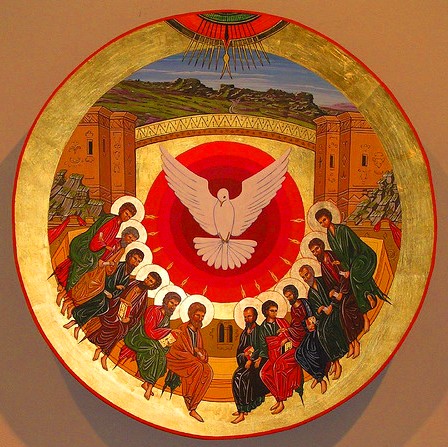
The Holy Spirit descends upon the apostles during Pentecost.

The Father is worshiped and glorified, the son is worshiped and glorified, the Spirit is worshiped and glorified. What the creed refers to, according to Barth, is that the One Lord is to be worshiped and glorified as Father and as son and also as Spirit. Thus tritheistic worship is ruled out. All this to say that “the Holy Spirit is denoted as an object of worship and glorification.”  As the third person of the Trinity, the Holy Spirit is fully God. As part (such a tricky word) of the Godhead he is one with the divine essence.  This means that when we worship the Holy Spirit, we are fully engaged in worship with the Triune God. This is just as true as when we worship Jesus or when we worship the Father. All Christian worship is directed at the entire Triune Godhead, its not as though one person of the Trinity gets left out when we worship the other persons of the Trinity.

So to answer your question – “Do we worship the Holy Spirit? The answer is an emphatic yes.”

Book Giveaway – Strange Glory by Charles Marsh

Last week I wrote a review of Charles Marsh’s “Strange Glory.”

This is an excellent and highly entertaining biography. It is very well written; at times it felt as though I were reading a novel, not a historical biography. But more importantly than that it is comprehensive, it goes beyond merely reporting the standard story, but instead strives to get into Bonhoeffer’s mind.  Marsh understands Bonhoeffer’s theology, and he seems to understand some of the things that really acted as driving forces in Bonhoeffer’s life. I recommended that you read this biography alongside of Eric Metaxas’ biography so that you will be able to form your own picture of who Bonhoeffer really was.

Today I would like to announce that I am doing my first ever free book giveaway! The publisher has graciously provided me with an extra copy to giveaway, so I want you to have it!

So you might be wondering… How do I get a free copy?

That is a great question! There are two things I need you to do:

  1. Follow me on Twitter – my handle is @CWoznicki
  2. Tweet at me why you want to read this book

It’s as simple as that! At the end of the week I will take all the names of people who have followed me and tweeted at me about the book this week, and I will randomly select a winner to send a free copy of this book to. And don’t worry, the shipping is covered as well!

Good luck!

Book Review – Strange Glory by Charles Marsh

Pastor. Martyr. Prophet. Spy. Those are the four words that Eric Metaxas used to describe Dietrich Bonhoeffer in his magisterial biography of the famous German-Lutheran pastor/theologian. The Bonhoeffer that Charles Marsh offers in this new biography of Bonhoeffer could be aptly described by those four words as well, however he adds two new words to the description of Bonhoeffer – “Strange Glory.”

Marsh’s biography follows the same general contours of most Bonhoeffer biographies. Bonhoeffer is born into an academic-socially elite family. He lives a life of privilege even during a time of economic hardship through Germany. He goes to school where he studies theology among some of the most important theological minds of his century – Harnack, Holl, and Seeberg. He was exposed to the theology of Barth. He took up pastoral posts in Spain and London. He took a trip to America to study at Union, this trip would forever change his life. He came back to Germany as Hitler’s power began to rise. He helped lead the dissident churches and founded an underground seminary at Finkenwilde. He took part in the Abwehr’s plot to overthrow Hitler from power. Eventually he was arrested and killed for taking part in resisting the Nazi government. So what makes Marsh’s biography stand out above the other biographies that have already been written? It’s his notion of “strange glory.”

According to Marsh, Bonhoeffer’s life is fraught with contradictions. At once he is driven by earthly and worldly passions yet so much of him is dedicated to the transcendent Christ. This strangeness is especially evident in some of his letters – in many of his letters you catch a glimpse of two sides of Bonhoeffer, he writes about Christology, the resistance, and solidarity with the poor and oppressed. Moments latter, within the same letter, he might go off into a rant about a relative sending him the wrong pair of clothes. He will describe in detail his fashion “needs,” days spent lounging at cafés drinking coffee or wine, visiting the opera and fantasizing about vacations taken to exotic parts of Europe. Another part of this “strange glory” is his relationship with Bethge – which many other reviews have already commented on.

Pros

There are several key things that make this biography stand out above many others.

Marsh’s ability to engage in complex theological discussions – Whether it’s a discussion of Church dogmatics, Hegel’s Philosophy, or the intricacies of Liberal Protestant Theology Marsh “gets it.” He is able to concretely summarize and engage with Bonhoeffer’s contemporaries. Also, Marsh takes the time to engage with Bonhoeffer’s theology, presenting discussions of Ethics, Life Together, Christ the Center, Sanctorum Communio, and Act and Being in depth.

It gives a different take on Bonhoeffer’s first Trip to America – It has been well noted that Bonhoeffer was extremely disappointed by the state of Christianity in America (except for African-American churches). Most biographies allow Bonhoeffer’s feelings during his time in America to color their interpretation of how important this trip was. While in America, Bonhoeffer was highly critical of American theology, which was essentially politics and humanitarianism. However, latter on in Bonhoeffer’s life we see how deeply this trip affected Bonhoeffer. Much of how he resisted the Nazi government and his defense of Jews in Germany was shaped by his time in America.

It paints a vivid picture of Bonhoeffer’s emotional needs – More than any other book on Bonhoeffer that I have read, it paints a picture of Bonhoeffer as a man who not only craves, but needs Bonhoeffer seems to be an emotionally needy person. Whether its his relationship with his sister Sabine, his close community at Finkenwilde, or his friendship with Bethge, Bonhoeffer seems to be a person who cannot do life alone. He consistently seems to move from person to person, seeking to find some sort of fulfillment. He seems absolutely depended upon reciprocal love and attention from others.

Bonhoeffer and his sister Sabine

He does a good job explaining the apparent contradiction between Bonhoeffer’s pacifism and his willingness to kill Hitler – this apparent contradiction is resolved by making use of Lutheran theology, essentially Bonhoeffer knew that whether he took the route of action or inaction he would be guilty of sin, so following the (apparently) Lutheran principle of “sin and sin boldly” Bonhoeffer was able to justify taking part in the plot to kill Hitler.

This is an excellent and highly entertaining biography. It is very well written; at times it felt as though I were reading a novel, not a historical biography. But more importantly than that it is comprehensive, it goes beyond merely reporting the standard story, but instead strives to get into Bonhoeffer’s mind. It does that very well. Marsh understands Bonhoeffer’s theology, and he seems to understand some of the things that really acted as driving forces in Bonhoeffer’s life. I recommended that you read this biography alongside of Eric Metaxas’ biography so that you will be able to form your own picture of who Bonhoeffer really was.

(Note: I received this book free from the publisher in exchange for an impartial review.)
Missions – It’s All About Jesus

Why do we do missions? Why do we invest so much money into sending people to the other side of the world to plant churches, to share the gospel, and to tangibly exemplify the kingdom? Why do people sacrifice their lives, their families, their hopes and dreams and desires for this thing we call “missions?” The answer is actually not that complicated. In fact the answer is so simple that we can describe the entire purpose of missions in just one word, actually, in just one name: Jesus.

David Mathis, in an essay titled Remember, Jesus Never Lies reminds us of this simple but profound reason for missions…

At the end of the day, global missions is about the worship of this spectacular Jesus. The goal of missions is the worldwide worship of the God-man by his redeemed people from every tribe, tongue, and nation. The outcome of missions is al about delighting to praise Jesus. And the motivation for missions is the enjoyment that his people have in him.

Missions aims at, brings about, and is fueled by the worship of Jesus.

Another way to say it is that missions is about Jesus’s global glory. From beginning to end – in target, effect, and impetus – missions centers on the worldwide fame of the Messiah in the praises of his diverse peoples from every tribe, tongue, and nation. What’s at stake in missions is the universal honor of the Father in the global glory of his Son in the joy of all the peoples.

May our entire lives always aim at, bring about, and be fueled by the worship of Jesus!