To see the practical implications Paul’s apocalyptic gospel in Galatians it is helpful to begin by looking at chapter 1 verse 6 which says that the Galatians are abandoning the grace of Christ and are turning to a different gospel. We should note that verse 1:3 begins with the “grace” that the Father and Christ offer the Galatians and that in 1:6 Paul says that they are leaving the “grace” of Christ and turning to a different gospel. This inclusio of “grace” might indicate that what is contained between these two graces is what should be contrasted with the “different gospel.” If this is the case then Paul’s gospel is essentially an apocalyptic gospel, one which essentially claims that Christ has freed us from this age by addressing the problem of sin. This notion of being freed from this age is in line with Jesus’ message in the gospels that Israel’s exile has ended. It seems as though Paul is saying that Jesus who somehow addresses our sins is the one who frees us from exile which we were under and that this exile was this present evil age. Thus Paul’s gospel is in line with Jesus’ proclamation of the Kingdom which is about the end of exile and the reign of YHWH.
Understanding Paul’s thoughts in this passage has various implications for Christian practice. One such implication is that it calls us to question our understanding of our hope as Christians. Many Christians would say that their hope is essentially in heaven, that one day when they die they will go to heaven, not to hell. However Paul’s gospel message is that we have been freed from the present evil age. This message implies that somehow we are no longer living in the evil age but that we have entered a new age. The fact that Christians can now live in the new age should affect the way they see their lives as Christians. If we are to understand that we have hope now, and not merely after we die, then this will radically change how we interact with the world around us. If our hope is now, then our lives as Christians cannot have an escapist mentality. As Christians we must begin to figure out what it looks like to live in light of the truth that because of Christ we are now living in the age to come.
When Paul first came to the churches in Galatia the gospel he preached was received with much enthusiasm. However, after Paul left Galatia other itinerant missionaries arrived and began to advocate a different message. Although it is obvious that this message was not in line with Paul’s message, the nature of this message as well as the identity of these messengers is not very clear.
The Options:
Longenecker believes that the messengers were Christian Jews who came from Jerusalem stressing the fact that Gentiles needed to be circumcised and to keep the cultic calendar, for full acceptance by God and as a proper Christian lifestyle.[2] “These Christian Jews might have been associated with the ‘circumcision party’ of the Jerusalem Church whose activities are illustrated in Acts 15:1, 24.”[3] Other options as to who these messengers were include: Jewish Christians of Gnostic persuasion, Jewish Christians with no specific support from Jewish authorities in Jerusalem, and Gentile Christians.[4]
The Method:
Commentators have attempted to work backwards by trying to piece together their message by reading Paul’s reactions and defenses. By coming to understand Paul’s defense commentators have pieced together Paul’s gospel and this other party’s gospel. However there are several flaws with this approach.
The Flaws in the Method:
Cousar helpfully points out that “the Bible is always interpreted in one set of historical circumstances or another.”[5] Thus in our current interpretation of Galatians we are conditioned to hear Paul’s words in Galatians by our post-reformation understanding of Christianity. Along with this post-reformation understanding of Christianity of Paul’s message is a particular understanding of the gospel. Since we are shaped with a post-reformation understanding of the gospel, it is easy to understand Paul’s opponents as being opposed to this gospel. So we begin with our understanding of the gospel and read these opponents as being opposed to our gospel. Because we do this I believe that it is more helpful to begin with the question “what is Paul’s gospel?” and then try to figure out “who are Paul’s opponents?” rather than the other way around.
The answer to the question of “what is Paul’s gospel?” must have some continuity with Jesus’ proclamation of the gospel. Although some will claim that there is not much, if any, continuity between Paul and Jesus and their messages I believe that there is. The continuity between their message is found at the very beginning of Galatians. In verses 3-4 Paul explains the work of Christ. Paul says that Christ gave himself for our sins to set us free from the present evil age, according to the will of our God and Father. The phrase “evil age” is a distinctly apocalyptic expression.[1] In speaking of an evil age, Paul implies that there is another age to come. Paul says that it is Jesus Christ who’s death for our sins sets us free from this evil age. Martyn notes that verse four which indicates that Jesus has “snatched us out of the grasp” of this age, is related to the notion of “buying out of enslavement to.” [2] So the question is, “is the fact that we are snatched out of the grasp of this evil age the gospel or is it simply something else that is also accomplished by Christ?”
————————————————————————————-
[1] J. Louis Martyn, The Anchor Bible: Galatians, (New York: Doubleday, 1997), 97.
All the time I’m asked, “just what is analytic theology?” And “what makes it different from philosophy of religion?” Or even better, “What makes it different from philosophical theology?” Well in a sense it is a form of philosophical theology but only more theological in nature…. My quick answer to the question “what is analytic theology?” Is that analytic theology is theology performed in an analytic key – that is it takes the form and virtues of analytic philosophy to do theology. Sometimes its hard to tell what is analytic theology and what isn’t but the reality is that analytic theology just “feels” analytic. You just know it when you see it. I realize that is not a very helpful definition and that really doesn’t get to the root of the problem. So to help bring a little more clarity, I want to refer you to a paper titled “Analytic Theology as a Way of Life” by William Wood.
In this paper he helps us distinguish between philosophy of religion, philosophical theology, and analytic theology. I find his remarks to be super helpful.
It is helpful to distinguish analytic theology from other related forms of philosophical and theological inquiry. Consider first analytic philosophy of religion. On my understanding, the specific task of analytic philosophy of religion is to use the tools of philosophy to investigate arguments for and against the existence of God, as well as to investigate the properties or attributes that the major monotheistic traditions would ascribe to God: omnipotence, omniscience, omnibenevolence, and so forth. Philosophy of religion, in short, concerns what might be called (non-pejoratively, at least here) “bare theism.” In distinction from philosophy of religion, we next have philosophical theology. Philosophical theology, as I understand it, uses the tools of philosophy to investigate the theological claims made by a specific religious tradition. Thus, Christian philosophical theology investigates the meaning, coherence, and truth of specifically Christian doctrines like the trinity or the incarnation.
Where does this leave analytic theology? One might worry that analytic theology is just another name for analytic philosophical theology and not anything new or distinctive. In my view, however, this worry is spurious. It is true that there is no sharp distinction between analytic theology and analytic philosophical theology. Nevertheless, the label “analytic theology” functions as a quick and easy way of letting one know the nature of this particular kind of inquiry: it features certain presuppositions and assumptions but not others; it features a certain kind of writing; it appeals to some intellectual influences and interlocutors but not others; it features a certain kind of writing; it appeals to some intellectual influences and interlocutors but not others; it similarly presupposes a certain set of intellectual villains, and so on. The label “analytic theology” is better than the more venerable label of “philosophical theology” as a shorthand description for this kind of inquiry. It is better because it is more specific. There are many different kinds of intellectual work that can justifiably be called philosophical theology—Kant uses the term, Schleiermacher uses the term, and there are many forms of philosophical theology that have nothing to do with analytic philosophy. The label “analytic theology” describes those forms that do.
A few weeks ago Kyle Strobel (Talbot Seminary) came in to Oliver Crisp’s Jonathan Edwards Seminar to present a paper on Jonathan Edwards’ doctrine of theosis. For those of you who are interested in this topic – here are my rough notes:
Kyle Strobel – assistant professor of spiritual theology and formation at Talbot School of Theology
Is there such a thing as a Reformed Doctrine of theosis?
• Isn’t necessarily an “eastern doctrine.”
Theosis – several options
• Either communication of attributes
• Or participation in divine nature
• Edwards – does both
Theosis, Deification, Divinization are synonymous terms.
Though there is accepted terminology there is no accepted definition across the traditions.
Assumed: The Divine essence is incommunicable. But the divine nature is communicable.
For a doctrine of theosis to be the doctrine of theosis it must order the rest of soteriology.
The protestant tradition appropriated theosis with Protestant particularities:
• Communication of divine attributes
• Participation in relation to the divine persons (through adoption)
Edwards is able to draw together both traditional expositions of theosis.
What Edwards does is provide a thorough going Reformed doctrine of theosis.
1-Doctrine of Trinity → gives us the mechanics for theosis.
• The doctrine of God simply is affection in pure act.
• The Son and the Spirit both have natures intrinsic to their identity. But they are persons only as they exist in perichoretic relation to one another.
• See the psychological analogy
• Edwards distinction b/w divine essence & divine nature protects from radical divinization
o The nature is communicable but the essence is not
o i.e. Holy Spirit is God’s very holiness – which we can receive
• The natures of the persons are communicable. God gives himself to the believers so they can participate in his own life: his self-knowledge and self-love.
• In Edwards account its impossible to pull apart the persons and natures of God. (The son just is his love and the Spirit just is his love.)
• If God is going to give himself to you he just has to give you his Son & Spirit.
Concluding Thoughts
• Theosis – grounded in Trinitarian participation, modeled in incarnation, effected by Spirit.
• What kind of doctrine of theosis is this? One that covers both options.
• God’s own personal attributes of knowledge and love are now known as through a mirror darkly, but in new creation they will be made clear.
• Glory and happiness are words that describe God’s communicable life. This just is what we participate in.
• He offers a qualification though – never lose their personal identity.
N.T. Wright has written a plethora of books that span the spectrum between devotional and intense academic tomes. The Challenge of Jesus seeks to place itself somewhere in the middle of this spectrum.
In the preface to this book Wright last out three goals that he has in writing this book. The first goal is to maintain historical integrity when talking about Jesus. The second goal is to help Christian disciples to follow the Jesus of Scriptures. The third goal is to help the next generation of Christ followers to love on mission in this postmodern world we find ourselves in. The majority of this book focuses on the first goal, and ends with two chapters that address the last two goals. This makes a lot of sense because if we are going to be able to live as disciples of Christ we need to now who Christ really was.
Wright accomplishes these goals by asking five important questions (p. 33):
1-Where does Jesus belong within the Jewish world of his day?
2-What, in particular, was his preaching of the Kingdom all about? i.e. what was he aiming to do?
3-Why did Jesus die? In particular what was his own intention in going to Jerusalem that last fateful time?
4-Why did the early church begin, and why did it take the shape it did?
5-How does all this relate to the Christian task and vocation today?
He answers each one of those questions in a separate chapter. Regarding question 1 Wright argues that Jesus was leading a messianic movement, not completely unlike other messianic movements of his time (yet also with a radically different twist.) In other words Jesus was announcing the Kingdom of God. Regarding the 2nd question, Jesus was creating new symbols of the Kingdom, the cross and the temple. By doing this he was reconstituting the people of God around himself. All of this pointed to an end of exile which was being accomplished by God in Christ. Why did Jesus die (question 3)? He died because it he believed it was his vocation to for Israel what Israel could not do and he believed that he would undergo the sufferings that Israel deserved for its unfaithfulness in other words, Jesus himself would go into exile and suffer at the hands of the enemy. This answer is related to the 4th question. The early church began because Christ was bodily resurrected, this meant that God was vindicating all that Christ has done. The exile is over and a new creation has begun. Finally the 5th question, how does all this relate to the Christian task and vocation today? Quite simply, Christians are to live as a part of new creation, as a part of this story that has climaxed in Jesus, and they are to live out the truth that Jesus really is the King and Messiah not only of Israel but of the whole world.
Like most books written by N.T. Wright this book excels in its historical portrayal of the facts. Wright certainly has done his research (this book is essentially a condensed version of Jesus and the Victory of God) and his research almost always leads him to surprising, yet orthodox, conclusions. There is no doubt in my mind that Wright gets the historical picture of Jesus right in this book. However what Wright gets wrong, in this book and may other books where he addresses the church in out postmodern setting is in the application of those historical realities. That isn’t to say he doesn’t get the overall contours right – he says “our task is to implement his unique achievement.” (182). That is absolutely right, however the ways he calls the church to implement Christ’s achievement is a little bit off. This has been said of Wright before so I won’t belabor it. Even though he warns against those who emphasize the discontinuity between the present world and the next and throw up their hands in resignation and those who emphasize the continuity between the present world and the next and imagine we can build the kingdom of God by our own hard work he definitely tends to fall a little too much on the continuity side of things. At times he sounds like he has an overemphasized eschatology. Of course he denies this, but its clearly in his writings. However if it comes down to it, I would rather someone work hard for the Kingdom of God than throw up their hands and wait for heaven to come one day. Despite this one small downside in this book I highly recommend it.
In my opinion this short book is the best introduction to Wright’s thought on who Jesus is.
Note: I received this book from IVP in exchange for an impartial review.
I have spent the last few weeks studying the book of Jonah for our series at Soma, Chasing Rebels…
The first week we kicked things off with the notion that God pursues rebels like you and me. Today I want to jump forward to the end of the book – after Jonah has complained about God’s compassion and mercy towards the Ninevites God gives him an object lesson. Basically God causes a vine to supernaturally sprout up and give Jonah shade, the next day God causes a worm to eat up the vine and a hot eastern wind to scorch it. And boy is Jonah pissed! His anger burns and he exclaims that he is angry enough to die because of this vine (its sort of an expletive in Hebrew). The lesson worked – it got the reaction from Jonah that God wanted all along. Here is how commentator Leslie Allen paraphrases that conversation in NICOT. (God is the one talking here:)
Let us analyze this anger of yours – it represents your concern over your beloved vine… but what did it really mean to you? Your attachment could not be very deep, for it was here one day and gone the next. Your concern was dictated by self interest, not by genuine love. You never had for it the devotion of a gardener. If you feel as badly as you do, what would you expect a gardener to feel like, who tended the plant and watched it grow only to see it wither and die, poor thing? And this is how I feel about Nineveh, only much more so. All those people, those animals, I made the, I have cherished them all these years. Nineveh has cost me no end of effort. They mean the world to mean. Your pain is nothing to mine when in contemplate their destruction.
God’s compassion extends to rebels like the Ninevites and surely it extends to us. Its our responsibility to extend it to others who don’t know God.
There was once a day when most theology books were written in order to elicit a worshipful response from the reader. This was especially true of books on Christology – these books were intended to make the reader see how awesome, powerful, gracious, kind and all out joy inducing Christ was. However, our theology books have slowly began to be written by specialists out of touch with the heart of the church – and thus these types of theology books have become the exception rather than the norm. Michael Reeves’ book Rejoicing in Christ seeks to take us back to the days when worshipful theology books were the norm. He seeks to present a through and rigorous Christology all the while presenting it in such a way that causes people to (this is not be being clever) rejoice in Christ.
This book is based on the notion that at the center of Christianity is not an idea, rather its not even the “gospel” – the center of Christianity is Christ himself. Everything begins and ends with Christ. At one point he even says that “to be truly Trinitarian we must constantly be Christ centered.” (23) He is absolutely correct!
This little book has 5 short chapters. Chapter 1 covers Christ’s role in creation and his preexistence. Chapter 2 covers his humanity an life prior to the crucifixion. Chapter 3 covers his death and resurrection. Chapter 4 covers how our lives as Christians are grounded in our present union with him. Chapter 5 is concerned with eschatology.
You might summarize the book like this (119):
Past: Having died with him, we can look no further back into our past than him. Christ, not our failure, is our history.
Present: United to him, we now share his glad life and standing before the Father. Filled with his Spirit, we are made ever more like him.
Future: the judge of all the earth is our faithful Savior; when he appears we will be with him, we will be like him and we will be co-heirs with him.
What great news!
There are a couple of themes that weave themselves throughout this work – all themes that many evangelicals have sadly forgotten or just plain ignored. The first is a sort of Adam Christology – here Reeves does not simply cover the typical Romans 5 passage or simply discuss federal headship – rather Reeves consistently comes back to the notion that Christ fulfills Adam’s humanity in a sort recapitulation of Adam’s vocation. The second is an emphasis on union with Christ. This theme was certainly central to the reformers like Calvin and Luther, but has been ignored by many evangelicals up until recently. Both of these themes – which constantly pop up in every chapter of the book are grounded in Patristic themes. This sure makes sense – because a lot of Reeves theology has affinities with T.F. Torrance’s theology. It’s a sort of Reformed take on Patristic theology.
I thoroughly enjoyed the book and I think that you will enjoy it took. Rejoicing in Christ represents the perfect blend of head and heart. Rejoicing in Christ exemplifies what Christian theology ought to look like – its academically rigorous yet always reverent and worshipful. But that is not only the goal of Christian theology – it’s the goal of human beings as well… or as the WST puts it:
1. What is the chief end of man? A. Man’s chief end is to glorify God, and to enjoy him forever.
As you read this wonderful book I have no doubt that you will be led to glorify God because of it and find yourself rejoicing and enjoying Christ more than you did before you even cracked this book open.
Erin Dufault-Hunter, professor at Fuller Theological Seminary, recently wrote:
Many Mennonites shirk the label “evangelical,” especially as it often associates us with US Christians who narrate their relationship to the nation-state quite differently than we do. But most recently my tiny adopted tradition has become cool; nonviolence has become fashionable (and God help us if we so depreciate the cost of waging peace).
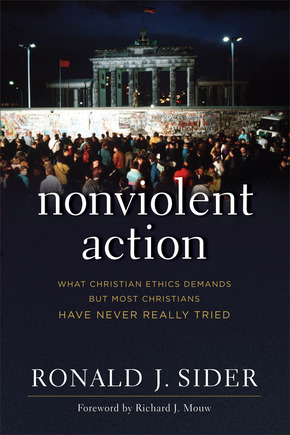
Though I am not drawn to the Mennonite tradition (and I certainly love my evangelical tradition/label), I can definitely agree with her that among evangelicalism – nonviolence and Anabaptism has become quite cool. Its probably for good reasons though – the Anabaptists are on to something when it comes to their ethics. But its not just the Anabaptists – you can find some reformed (lower case “r”) writers writing about non-violence (see Preston Sprinkle’s Fight – I wrote a review here). So being reformed myself and committed to non-violent action, I’m glad to see more resources come out that are accessible to evangelicals. Ron Sider has a history of writing books that have pushed evangelicals to be more socially aware and engaged. He has pushed them (us) to think through issues that we might have ignored i.e. the legitimate use of violence as Christians. His latest book: Nonviolent Action: What Christian Ethics Demands But Most Christians Have Never Really Tried is one such book.
On the back of the book – Richard Mouw writes that Sider has written a “wise, balanced, and inspiring book” that is “a richly instructive guide for all who have pledged their allegiance to the Savior who is also the prince of peace.” Whether you agree with non-violence or believe in just war – the fact is that as Christians we are called to follow the Prince of Peace and we are called to be peacemakers. So at the very least non-violence is an issue that all Christians have to deal with. We have to ask ourselves – is this the best way to live as disciples of Jesus Christ or is there some other way?
Alright – lets actually get to the book…
Non-Violent Action
The structure of the book is pretty straightforward; there are four parts. Each of the first three parts is intended to inspire people to nonviolence and to show people that unlike what many opponents say, nonviolence actually works. Part 1 covers the early days of nonviolence by looing at non-violence in the early church and nonviolence through leaders like MLK and Gandhi. Part 2 show us how non-violence helped topple the soviet empire. Part three takes a look at non-violent movement in the last decade or so. Let it be known that all of the cases he examines are not necessarily Christian movements (i.e. Ghandi & the Arab Spring) however a majority of the cases he follows are Christian an Sider’s call to non-violence is ultimately grounded in Christianity.
For me, the fourth part was the most interesting. It consisted of Sider’s constructive argument for non-violence. His first argument is that non-violent movements contrary to popular opinion, actually work. They accomplish their goals with far less loss and they tend to lead to stronger democratic societies. The reason for this latter accomplishment is that “those who win by the gun tend to rule by the gun.” His other argument for non-violence is that non-violence as a strategic systematized method has not really been tried yet. Regarding this, Sider makes a great point,
Pacifists have long claimed that they have an alternative to war. But that claim remains empty unless they are willing to risk death, as soldiers do to stop injustice and bring peace. (158)
If pacifists think that they have an alternative to war, then they must have the guts and integrity to prove it in the brutal world in which dictators such as Hitler, Somoza, Stalin, and Marcos kill and destroy. If pacifists are not ready to run the same risk as soldiers in nonviolent struggle against evil, then they have no moral right to pretend they know a better way. (167)
Those are powerful words! Sider’s other point is that According to the just war tradition (which most Christians find themselves in) lethal violence must always be the last resort. He calls into question the notion that just war theorists have been consistent with this position. He points to the fact that just war theorists have not spent the amount of time and money to explore the possibilities of nonviolent action.
“Women of Liberia Mass Action for Peace” – one of the stories of a successful nonviolent movement that worked.
Sider’s book however ignores the most important argument for nonviolence (although the title does imply it) – namely that it is what Christianity demands. When I hear most people argue against nonviolence (usually for loving reasons and to protect the weak) the argument almost always goes something like this…
Non-violence would be great. But we live in a sinful broken world. Non-violence just doesn’t work because we don’t live in an ideal world.
Arguments around non-violence almost always center around the idea that “it doesn’t work.” Sider here set out to argue that it does in fact work, and history has proved that it can and it does! However that misses the point of Christian non-violence. The call to Christian non-violence isn’t a call to pragmatism. Even if nonviolence didn’t work and Jesus called us to it then we would have to do it! (Whether God calls for it is up to debate; I certainly believe he did call us to peace.)
What I’m trying to point out – and what Sider so unhelpfully forgot to address – is that: The call to nonviolence isn’t grounded on what does or does not work. The call to nonviolence is grounded on whether or not this is what Jesus calls his followers to do.
Note: I received this book from the publisher in exchange for an impartial review.
Faith is such a hard concept to grasp… John Webster sheds some light on it in a sermon on Hebrews 11:
Often when we think and talk about faith, we fall into a trap. The trap is that of thinking of faith as some sort of special power or faculty that we have, or at least that we ought to have. We think of faith as a sort of natural talent, a bit like being good at arithmetic or having a flair for gardening—again, some power or capacity we have or would like to possess. Very often thinking in this way about faith is bound up with a sense of frustration about ourselves, a sense that to some extent we are deficient Christians because we don’t seem to have much of a talent for faith. “If only we had more faith,” we chastise ourselves; if only we had a great measure of this mysterious power which would somehow make the Christian life more real and lift us out of our doubts and confusions.
The problem with thinking along these lines is that it begins in the wrong place. It begins with us: our attitudes, our emotions, our inner lives. And in this it tends to reinforce the false idea that sorting out how to live a life of faith is basically a matter of figuring ourselves out. It can encourage us in the idea that getting faith right means cultivating some attitude, putting our inner lives on some sort of disciplined regime. And the result of that is that we’re disoriented from the start. The basic rule for thinking about faith is this: What matters about faith is not us, but the object of faith. Faith isn’t primarily a power or capacity in me; it isn’t first and foremost an attitude which I adopt; indeed, it’s not first of all something which I do. Faith is objective—that is, faith is wholly turned outward to the object of faith. In a real sense, it’s not faith itself but that toward which faith is turned that is critically important in getting our thinking straight. What matters about faith is therefore not us but God, the object of faith.
Webster, J. (2014). Confronted by Grace: Meditations of a Theologian. (D. Bush & B. Ellis, Eds.). Bellingham, WA: Lexham Press.
May we remember that its not about the size of our faith but the “size” of the object of our faith – i.e. God himself.



 in Christ seeks to take us back to the days when worshipful theology books were the norm. He seeks to present a through and rigorous Christology all the while presenting it in such a way that causes people to (this is not be being clever) rejoice in Christ.

 CWoznicki Think Out Loud